
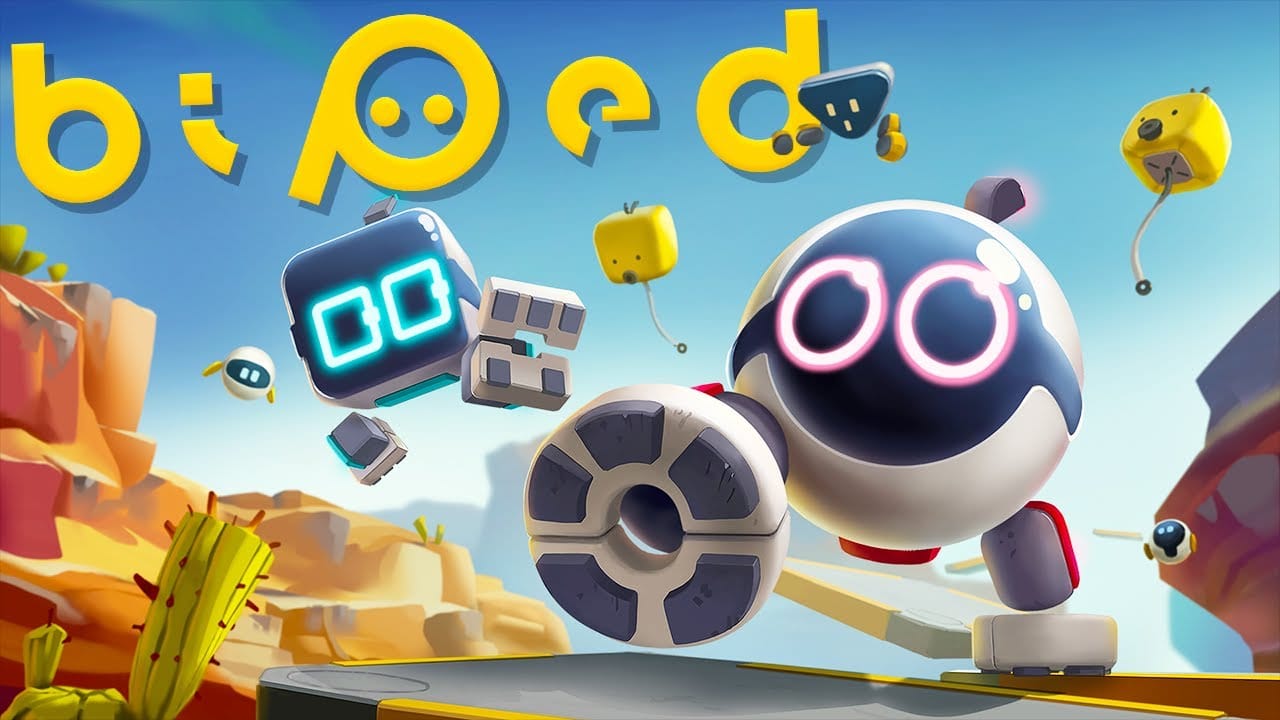
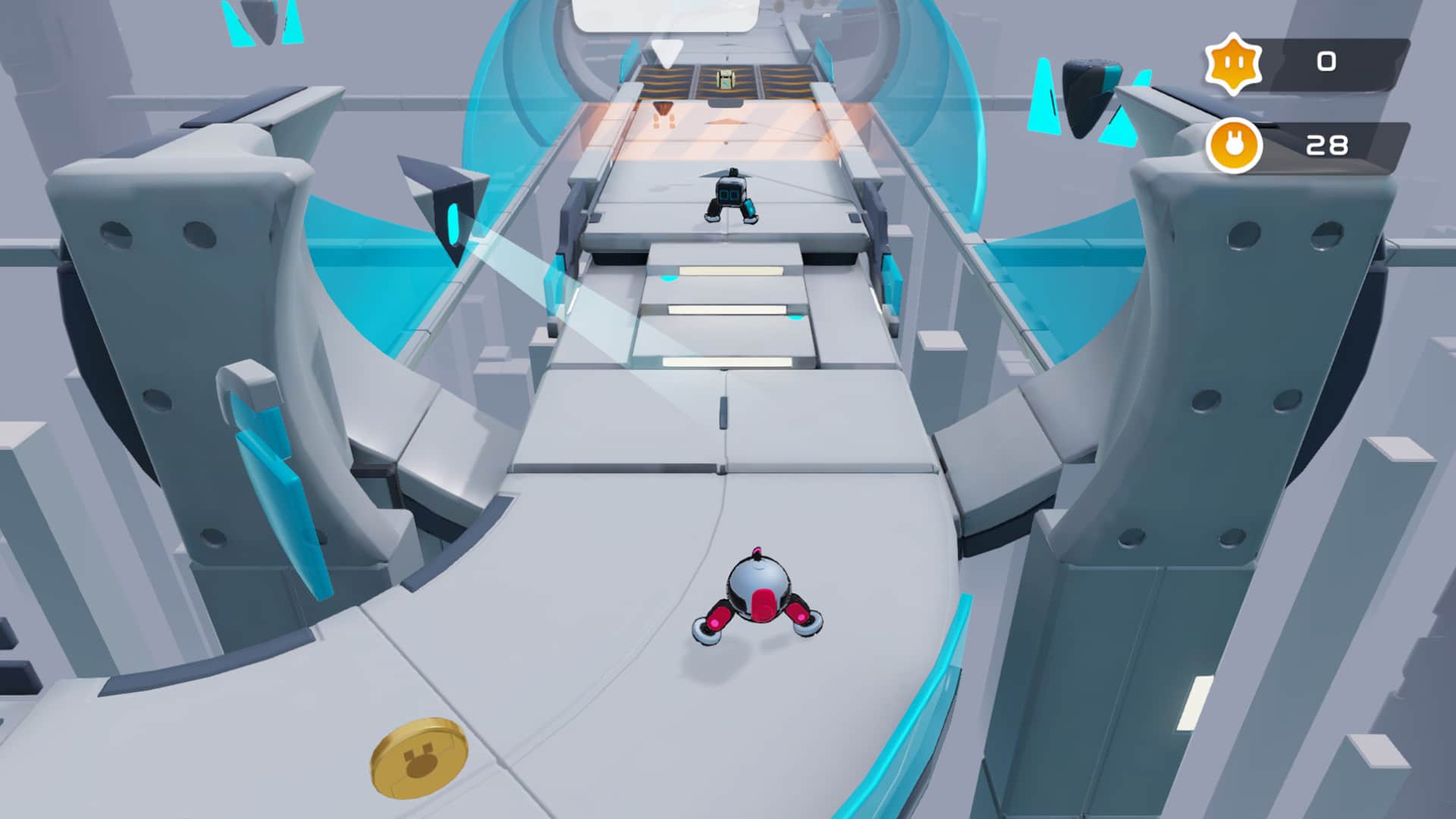
Imagine Earth in another dimension and time, where human beings don’t inhabit the planet and bipeds have built planetary facilities in the wild. This is the setting of NExT Studios’ new co-op adventure game, Biped, which launched on PS4 earlier this month and on Steam March 26, 2020. The game focuses on moment-to-moment collaboration between two bipedal robots, Aku and Sila, as they walk side by side in a fun and bonding journey through forests, valleys, waterfalls and icy mountains, all while trying to keep planet Earth from going dark. Accentuating all the game’s twist and turns is the score by composer Thomas Parisch, which incorporates everything from jazz to electronic music. To get a better idea about the creative process behind the sound of Biped, Parisch answers the below ten questions in this exclusive interview.
–Biped is set on Earth in an alternate dimension where there are no humans, and little robots have built planetary facilities. This theme feels very sci-fi like. How did you pick to incorporate jazz into a story like this?
Jazz was incorporated not as much because of the setting but because of the gameplay, the style of the robots and the genre of the game. Jazz is conducive to conveying an easygoing, laid back and playful attitude. The underlying mood of Biped has all these characteristics. With Jazz I can easily be cool and funny, tongue-in-cheek…. Especially with improvisational sections it can be very playful, the sort of trial and error players go through in the game. Besides, I used jazz in more of an electro fusion style, so synth sounds are a big part of it. And those come in handy for sci fi scenarios of course.

-In previous interviews you have said that there is a lot that goes into deciding the initial approach, sound wise, of a game. What were some of the initial ideas for Biped that didn’t end up making it into the game?
We tried something more along the lines of naïve musique concrete, for lack of a better word. It was based on instruments such as guitar played in unorthodox ways, basically played by someone who doesn’t know how to play it well or avoids using the conventional technique (I was the perfect musician for it myself). Very close mic-ed, I used a lot of very quiet sounds which were amplified after the fact. We liked the results, but I guess we were missing the playfulness, it ended up being a bit too serious. We needed a similar naiveté, but with a lighter mood and with the ability to play freely and a bit wildly also. The unconventional playing techniques can be limiting sometimes. Also, it was mostly acoustic. I felt however that we did need to have electronic elements be a bigger part. Another approach I tried was a more experimental electronic one. Actually, “Inside the Roboverse”, a track on the album, was adapted for the final music from a first idea in this direction. It was the menu music for a while but eventually it got replaced by another track.
-Zac Zinger performed some ethnic woodwind solos in the game, at what point in the game would players be able to hear these?
Zac’s playing is featured on a track called “Ocarina Blues” (yes, it is a kind of blues on an ocarina) in the Sunset Ridge level, for example. Also, he plays tin whistle on the Celtic stuff like River Run and Gigue-a-byte, both used in the level Blue Rapids, the river level. The (literally) free flowing feel of that level felt right to be accompanied by Celtic music.
-Koozer Zhang was the musical director for Biped. What do you think he helped you the most with?
To begin with, he is the person to make sure I fulfill all the technical requirements, of course. … but more importantly, he helped finding the right mix of elements for the overall approach: electronica, world music and jazz all wrapped up. And he is crucial to questions like what and how to emphasize for which level. Also, he indicates the pacing for different levels and sections as I often don’t have the whole context and connection when working on a set piece. He is there with the developers and has the higher level view so his input is crucial to me.
-Did you only work with Koozer at the beginning of the game when deciding the sound or did he give input during the whole process?
Of course, he is there for the whole project. At later stages, we might not discuss style much anymore, that is mostly in the beginning. But I still need him to give me feedback as he is the one testing the music in real time with the game and checking connections, implementation, mix, interplay with sfx etc. These checks need to happen always. Besides, in the very beginning of the project, when I did the very first trials, still in 2018, there was another audio director, Yang Jie. Koozer took over from him a bit later.
-In a previous interview Koozer discussed giving each map a special world musical element. An example being, the forest map has some Indian music elements. The relic map has some Aztec elements. Which of these maps was the most challenging for you to score?
I don’t think one stands out to me as especially challenging. They all had their challenges. But I think a big challenge with these world music elements as a whole was when we recorded them. Since these instruments are a little finicky, they often turned out different from what we had imagined. Also, there were improvisational sections as mentioned, which, as in the nature of the matter, are unpredictable. But I still needed everything to balance in the end, however. Often tracks are not all world music, or all jazz etc. We cannot go overboard with solos or too ethnic sounding parts for example. At times it took such adjustments of live recorded parts. Still, it was totally worth it. One can’t overstate how much live recordings add to the music.
-You have worked on games such as Resident Evil 6 and Honor of Kings with other composers. You solely scored Biped. Did you break the game up into sections when scoring not to get too overwhelmed? What was your work process like?
I actually scored in a few big chunks. Koozer had prepared spreadsheets listing all required pieces with his notes. Some parts were also still under development or revision so scoring everything in one go wouldn’t have been possible. This is actually quite common with games in my experience. I did have all tracks for each level together for the most part, though. A few tracks were also revised a bit as the game evolved and previously scored parts got changed. Games, just like cuts in movies, are bit of a moving target often so these changes happen. It is exciting however to be working on something that’s still evolving, one can be part of the growth and create something in an organic way alongside it which allows for greater integrity.
-Besides scoring Biped all on your own, how has working on this title been different from your other ones such as Resident Evil 6 and Honor of Kings?
Obviously, Biped is a very different genre. It is light, bright, playful, fun. RE6 and HOK are quite heavy, dramatic and serious. The music for these titles, accordingly, was epic, bold and largen than life drama. The score for Biped is cute and quirky, it was the perfectly contrasting creative challenge. Pretty much everything I couldn’t do with RE6 and HOK was what was specifically asked for in Biped. It’s almost like it the exact antithesis. Actually, I was dying to shift gears like that for while having worked on a series of mostly epic, dramatic adventure games so I fully embraced it for this very reason. Thinking about it now, there is really very little overlap between those projects. Only I can think of the world music elements in HOK. But there the world music aspect was integrated into an epic orchestra in a more classical scoring way. Biped, as already mentioned, lives more in a jazz style so the world music elements in it are again quite different, more free and improvised, all with a smirk. Also, HOK uses mostly Chinese traditional instruments, which we haven’t used in Biped.
-What are you doing at home to keep busy during this shelter in place time?
After taking some time adjusting to the situation, I now try to see it as an opportunity to work on a lot of projects postponed and/or procrastinated over time. I’m finishing a series of sketches of various musical ideas I collected over time, for example. More generally speaking, I actually think that such disruptions can be very healthy on many levels. If only this one wouldn’t come with such a cruel prize to pay, of course… But as we can’t do too much to prevent this situation from unfolding, we should try to find the opportunities in our changed lifestyles.
-Just a hypothetical, if there was to be a second installment of Biped, would you keep the same musical themes or would you go for something completely different?
I think I would keep the approach and the main theme, yes. I am quite happy with how the musical universe is set up. I think there is still a lot of room to reuse, vary and arrange the themes more. Also, electronica, world music and jazz are endlessly rich genres to draw from. Quite a few ethnic styles come to mind I could use for new levels as I would for the most part not use the same world music styles again; they should keep switching with the environments. Also, I guess I would reuse some synth sounds for consistency as some of them have become signature sounds for the game by now. So, even the music would of course be new and different, I am quite happy with the overall approach and would follow it again.
(Unisonar released Biped’s original score digitally on March 27, 2020.)
