
I appreciate games that claim their own little corner of the world by being different. Maybe it’s bias, fine, I’ll own that, but as a Dutchie, I can’t help but keep a close eye on what’s coming out of the Benelux. We’re not exactly shouting the loudest on the global stage, but now and then, a game drops that makes you sit up and go: yeah, this is why we matter, we are more than cheese, waffles, and free public transportation (go look up our countries separately, otherwise it will make no sense). Enter Modulus: Factory Automation, a title that doesn’t just flirt with the factory sim genre, but confidently rebuilds it from the ground up. And yes, that pun is absolutely intentional.
Made in Belgium
Let’s start with the people behind the machines. Modulus is developed by Happy Volcano, a Belgian studio that’s been steadily carving out a name for itself with smart, creative projects. Publishing duties are handled by Kwalee, a name you’ll likely recognize if you’ve spent any time in the indie or mobile space. What stands out immediately, especially when I was reading up on the game, is just how clear the vision for Modulus is. This isn’t a game trying to chase trends, nor is it attempting to out-scale the genre giants. Instead, the pitch is almost disarmingly simple: a meditative factory automation game where you don’t just optimize systems, you design the building blocks themselves. That’s not marketing fluff either, since it’s the foundation of the entire experience. (Insert Lego puns here; I am just laying out the stepping stones.)
A factory game with an identity crisis
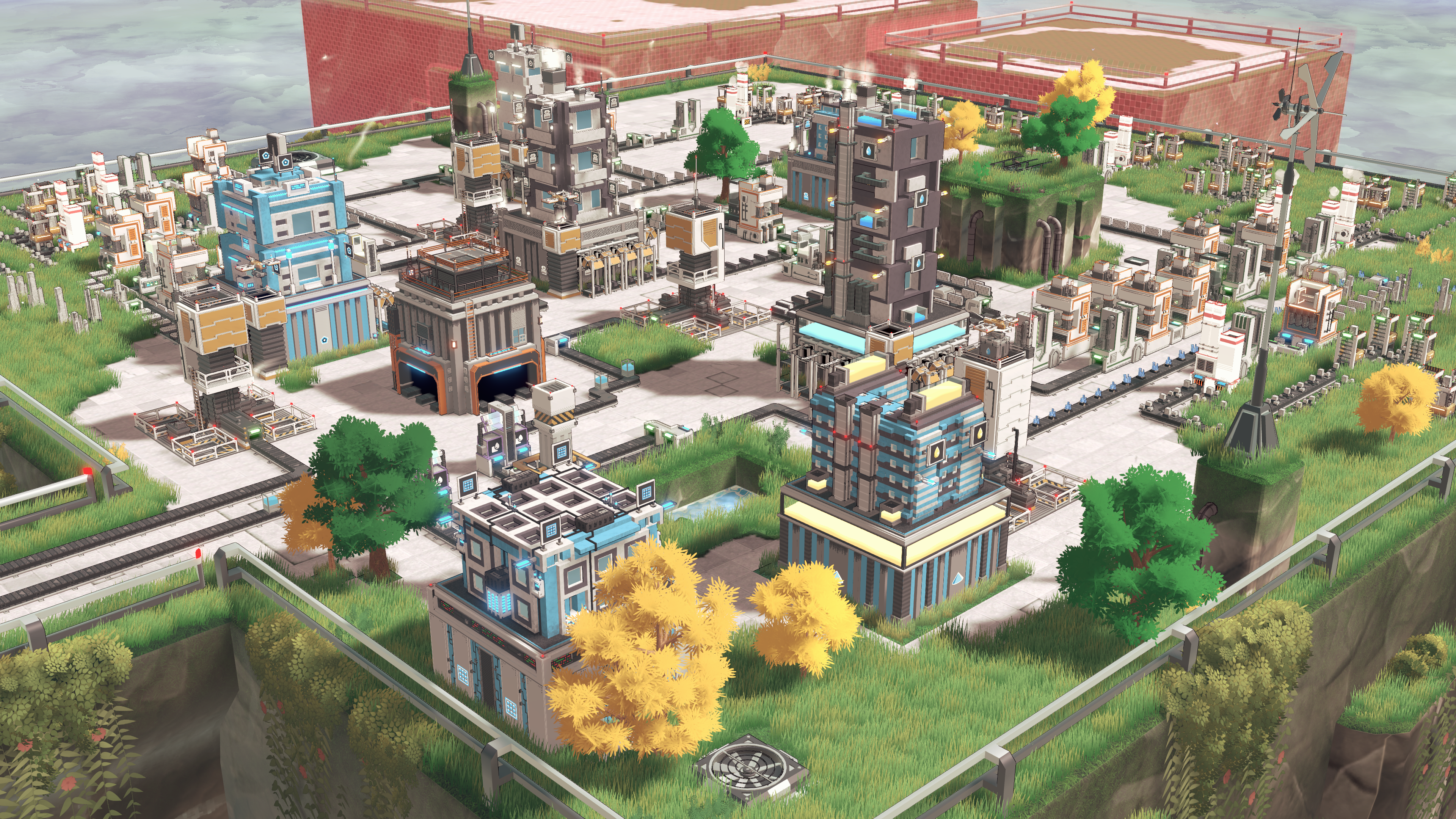
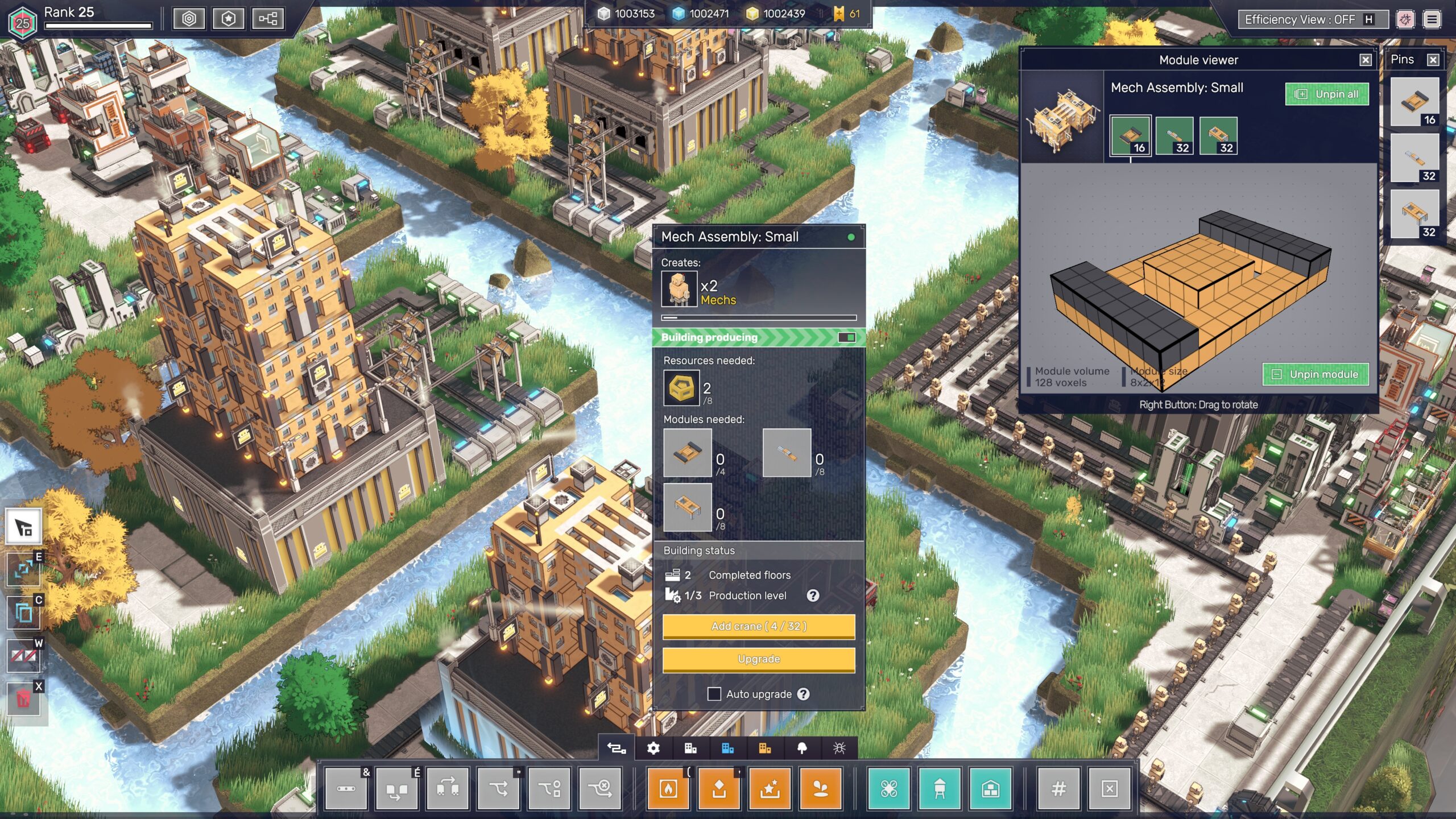
On paper, Modulus: Factory Automation sounds familiar. You build production lines and automate processes, which leads to optimized outputs. But the moment you actually start playing, it becomes clear this isn’t just another Factorio clone. The key twist? You’re doing more than just simple problem solving; instead, you’re designing the components that become the solution. Instead of working with predefined parts, you’re cutting, painting, stamping, and assembling 3D modules. These modules aren’t abstract resources; they’re physical, visible building blocks that stack, connect, and ultimately form massive structures. And narratively, there’s a subtle but intriguing hook here too. You’re part of a system, literally programmed by a Colony to supply bots with relentless efficiency, until something changes. A signal from deep space. The so-called Grand Neural Network is calling out (Borg vibes all over). Suddenly, your factories aren’t just about efficiency, they’re about building something bigger. Something existential, almost. It’s not a story-heavy game, but there’s just enough there to give your endless optimization a sense of purpose, if you ever needed one to start with.
No stress, just systems
One of the biggest differentiators is what Modulus doesn’t have. Sounds weird? Let’s see, before judging a bot by its chip. It has no enemies, no combat, and no timers. That changes everything, since leaving out the parts where many factory games thrive on, things like being pressured and escalation, Modulus leans into something almost zen-like. It’s a low-pressure sandbox where experimentation is encouraged and not punished. You’re free to build, break, rebuild, and refine at your own pace. There’s no looming threat, no ticking clock, just the quiet satisfaction of watching a system you designed actually work. And when it works? Oh, it clicks. Is this the most millennial-coded game ever?
Without making more puns and obscure references, I want to address something. At its core, Modulus is about spatial logic, which means that every production line is essentially a puzzle, one you design yourself. Which operators do you use? How do you route your belts? How do you fit everything into the environment, especially when you’re dealing with sky islands and real spatial constraints? Because yes, that’s another twist: you’re not building on infinite flat terrain. You’re working within confined spaces, connecting across gaps, and making everything fit in ways that feel more like solving a 3D puzzle than laying out a factory. And this is where the game truly shines. There’s a constant push-and-pull between efficiency and aesthetics. Do you build the most optimized system possible? Or do you create something that looks beautiful? The game actively rewards both, which is a rare balance to strike. But, and I cannot stress this enough, this game demands spatial awareness, especially when building the blocks you need to progress.

My ongoing feud with spatial insight
Let me be brutally honest for a second: my spatial insight is… not great. Like, at all. Think of a math test about spatial insight, and the teacher handing you a new test, during the test, since you messed up that badly. Like, give me a narrative RPG, and I’ll dissect character arcs like it’s my job. Ask me to visualize a multi-layered production chain with intersecting conveyors and modular outputs, and my brain just quietly exits the chat. And Modulus? It lives and breathes that kind of thinking, which is both a challenge for me and a chance to look at it from a different perspective.
You’re constantly rotating modules, aligning inputs and outputs, and mentally mapping systems before you even place them. For players with strong spatial reasoning, this is probably where the magic happens, those satisfying “aha!” moments where everything clicks into place. For me, it was more like: “Why is this not producing my piece?” “Wait, where did that go wrong?” “Who designed this mess… oh right, me.” And yet… I couldn’t stop playing. Because even when I struggled, the game never felt unfair. Every mistake was mine, and every solution motivated me even more. Every small optimization felt like another victory, even when it took me way longer than the average player. Watch me, math teacher whose name I won’t disclose since he’s retired by now.
Freedom of expression
If the structured progression isn’t enough, Modulus also offers a full-blown Creative Mode, with unlimited resources and no objectives. Plus, it offers you full access to tools and expanded module sizes. This is where the game leans hardest into its identity as a creative tool. You’re not just building factories, you’re essentially creating functional voxel art. Want to design the most efficient system imaginable? Go for it! And if you want to build something wildly inefficient but visually stunning? Also valid. The game doesn’t judge, it just gives you the tools, and that makes a perfect bridge to my next point!
A game that deserves a proper setup
Let’s talk practicalities for a second. Modulus is absolutely a mouse-and-keyboard game. No question. The level of precision required, with placing modules, rotating components, and managing layouts, demands it. Trying to play this with anything else feels like self-sabotage. And screen size? Bigger is better. I played most of the review on my ASUS ROG Ally Z1 Extreme in handheld mode (with a Bluetooth keyboard and mouse), but playing it on my TV with the same setup was a much better pick. This is a game where you’re constantly zooming in and out, managing complex systems, and trying to maintain an overview of your entire setup. A large monitor (or better yet, an ultrawide) genuinely enhances the experience.
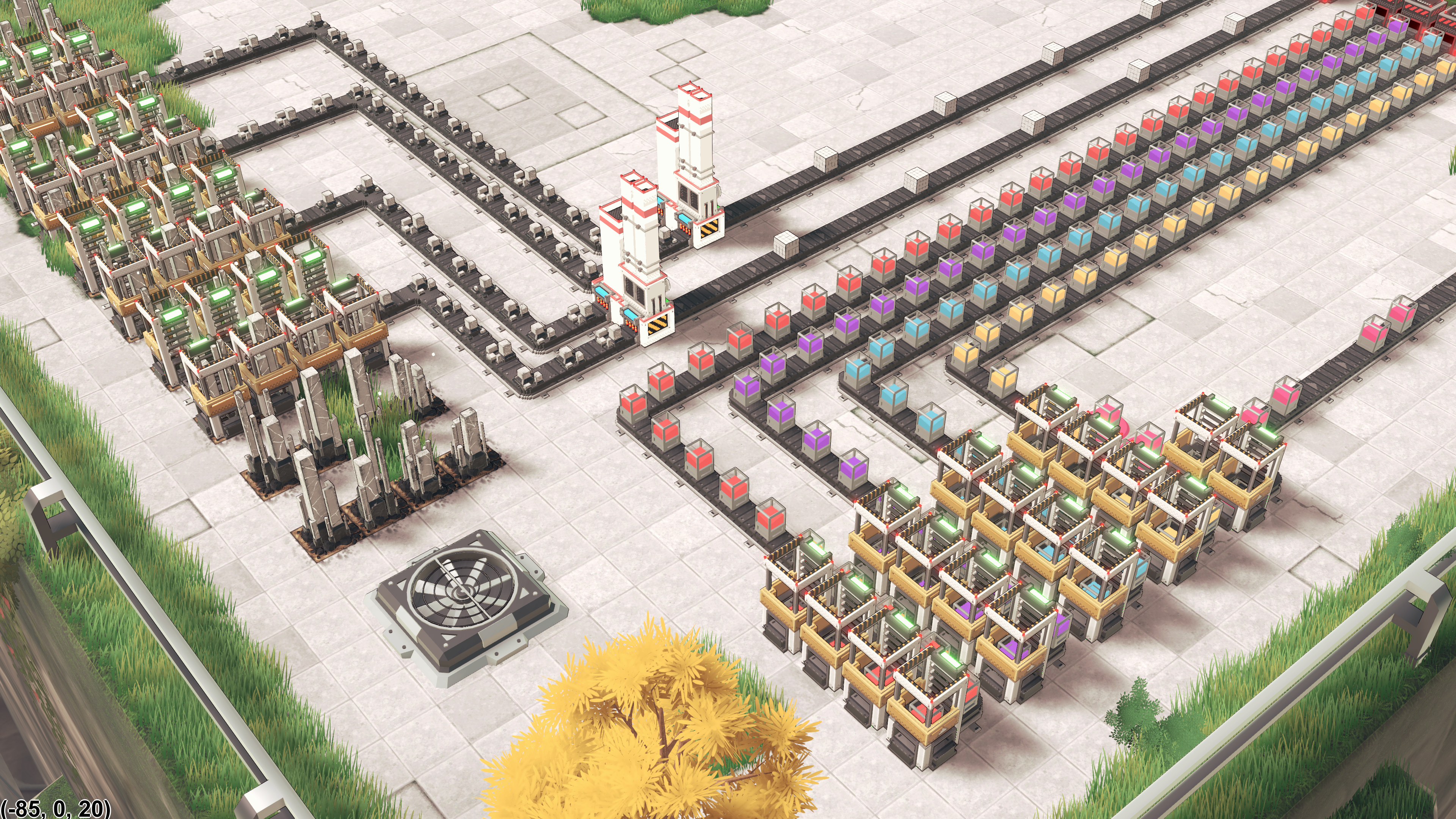
Visually, Modulus takes a different approach than many of its peers. It’s not about hyper-realism or flashy effects. Instead, it focuses on clarity and readability, and that’s exactly what a game like this needs: clean interfaces and distinct yet recognizable modules. And when your factory starts running at full capacity, with its conveyors moving, modules assembling, and structures rising in real time, it becomes its own kind of spectacle.
The flow of progression
Another thing the game nails is its pacing. You start simple, with some basic resources to build and upgrade systems. And then, gradually, new mechanics are introduced. Each layer builds on the last, deepening your understanding without overwhelming you. It’s a careful balancing act, adding layer on layer, which is quite hard to pull off. But Modulus pulls it off impressively well. Even when the complexity ramps up, and it absolutely does, you never feel like the game has left you behind. It gave you the tools and taught you how to use them; now it’s up to you and your spatial insight to make complex modules.

Conclusion
Modulus: Factory Automation is one of those rare games that feels completely confident in what it wants to be. It doesn’t chase scale, nor does it rely on pressure. It’s not here to overwhelm you with unnecessary systems. Instead, it focuses on intentional design, creative freedom, spatial problem-solving, and, in doing so, executes on all three with remarkable precision. For players who love factory games, puzzle design, or just the satisfaction of building something that works, this is an easy recommendation.
For players like me, whose spatial insight occasionally goes on holiday without notice, it might be a bit more of a challenge. But even then, it’s a challenge worth taking. Because underneath the occasional confusion and conveyor chaos lies something genuinely special. What’s that, you might ask? A smart, meditative reinvention of the factory automation genre that proves you don’t need scale to achieve depth, just a clear vision, and the tools to build it. So if you don’t mind, I’ll boot up my own digital zen-factory again.
