
Over the past few decades, many platformers have allowed gamers to explore 3D environments, but very few have allowed us to walk on walls and ceilings. So what better protagonist to showcase this mechanic than the cutest and most silly-looking lizard on Earth: the gecko?
Ocean and wind
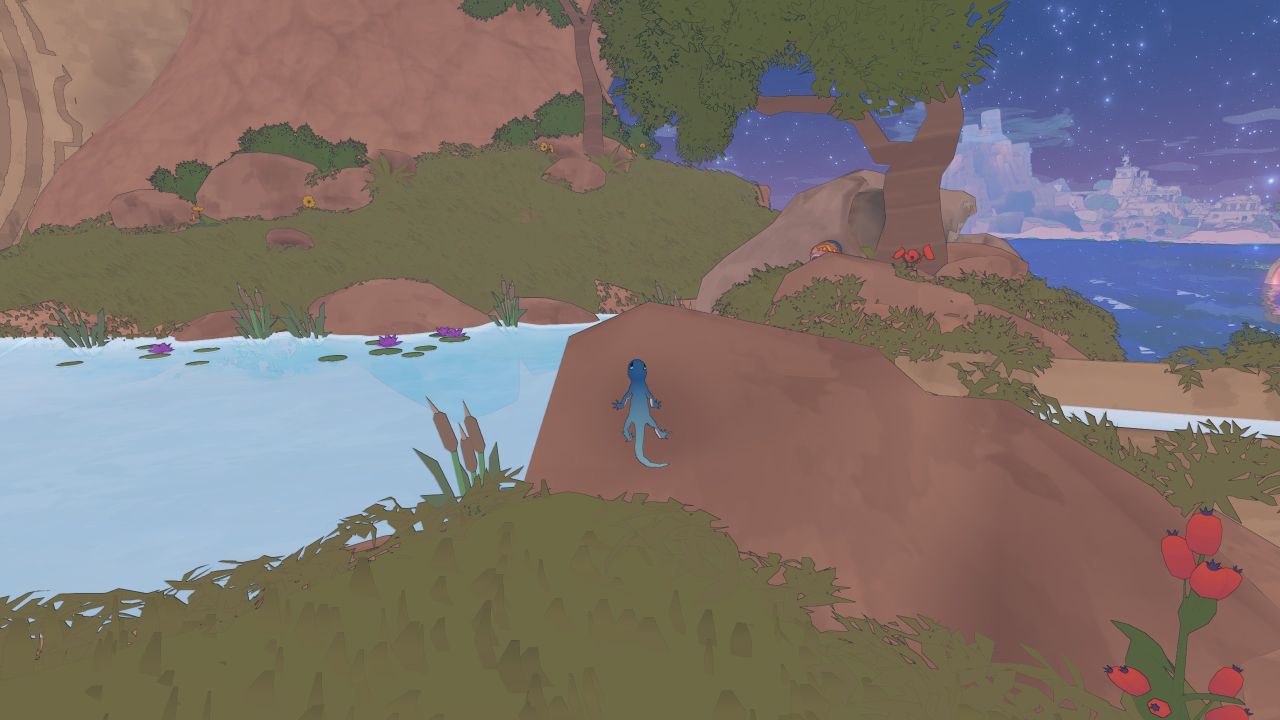
Gecko Gods is an indie game developed by Inresin and published by Super Rare Originals. It’s an open-world adventure game in which you play as the cutest and coolest type of lizard: a gecko. As a leopard gecko owner, this is just my unbiased opinion, but if you don’t agree with me, just look at the sheer amount of lizard memes and video compilations on the internet. Almost all of them feature one or more geckos. In the game, you play an unnamed gecko who becomes separated from his family during a storm and ends up stranded on an island. While trying to find a way off the island, a higher presence calls upon it, demanding that he awaken the Gecko Gods and restore balance to the world. This is not an easy task when you consider that you are a small lizard without any special powers. But then you realise the innate ability of most geckos: they are unrivalled climbers. Leave no surface unexplored or no stone unturned, and you may be able to awaken the deities that slumber in this archipelago.

Ancient puzzles
Because of the small stature of the protagonist. It is only natural that the focus of this game isn’t on combat. You have a dash that can damage the small number of enemies you encounter on your journey, but most of the time in the four to six-hour-long journey of Gecko Gods is spent solving puzzles. The archipelago is filled with islands with environmental puzzles. It starts simple in the tutorial island, where you mostly need to find levers to open gates or to lower water levels, but after this section, which takes an hour at most to complete, you get a boat to roam the world at your own pace. The variety of puzzles just keeps growing from there. I couldn’t help but draw the comparison with The Legend of Zelda: Breath of the Wild, where you start at the Great Plateau to learn the mechanics. But the game transitions to Wind Waker instead when it decides to open up. Also using a cell-shaded visual style that is bold and colorful. It’s an inspiration that is easy to spot when you notice it, but let me be clear: this game is very much its own thing and not a blatant copy.
What makes Gecko Gods quite unique is the use of verticality in a 3D space. Every surface is climbable, and puzzles integrate this design to the fullest. Switches can be on walls and ceilings, and you need to trace lines in the environment to find them. A gecko wasn’t just chosen to be the protagonist purely as an aesthetic choice; it couldn’t be a better fit for this kind of platforming. After an hour or two, you will be crawling through the environments and using your lizard brain to the fullest to progress. But offering this kind of freedom comes at a price…

Skill ceiling
Although the platforming in Gecko Gods feels smooth, I couldn’t ignore the cracks that started to appear as I kept playing. The ability to climb every surface in the environment meant that I had to adjust the camera angle frequently. Although the auto tracking worked well, I often found myself looking at a big brown wall with no clear indication of where to go. This was particularly apparent in some platforming puzzles. The game wanted me to go through a series of rings, but I couldn’t see where the next one was. It would be great if, in future patches, the camera could pan to the next target when I pass one of my goals. Being able to climb every surface in a dungeon or cave also meant that my perspective shifted depending on which wall I was facing. The 2D map screen doesn’t help with this. It only shows the route taken across the entire overworld. It mostly shows which islands you have already visited. A 3D map of the islands themselves might have been helpful in that regard, but discovering the right path might be part of the design philosophy. Personally, I didn’t enjoy spending fifteen minutes searching a particular island for the last of five bells needed to open a door. But that might just be personal preference. I know it’s hard to cater to everyone in this respect. Some people like to be guided towards objectives from time to time; others don’t.
One thing that felt awkward a lot was transitioning from a ceiling to another vertical surface above, such as a pipe or a hole in a wall. There were a number of times when my gecko let go of the surface when I wanted to move further up, forcing me to climb the entire wall again. Perhaps this could be addressed in a future patch, because if you want to collect every bug and relic in this game, you need to be able to explore every nook and cranny of these ancient ruins.

Lizard Brain
After reading the last paragraph, you might think that I’m not that fond of Gecko Gods, but that isn’t the case. It’s easy for me to sit at home on my couch and critique what I’ve just played, but at the other end of the spectrum are people who have put countless hours into perfecting their project. The build I played wasn’t final, and the developers are still working hard to fix bugs that I experienced during gameplay, but didn’t mention in this review. Game development is hard, and even games that have spent years in development may require fixes after release. So, before concluding this review, I want to emphasise something. When it comes to the joy I felt during exploration, Gecko Gods nailed the player experience extremely well. Discovering a new island and familiarising myself with the terrain was so thrilling that I couldn’t put the game down halfway through exploring an island. I had to finish it before turning off my Nintendo Switch. My primal instincts always pushed me to continue: to look around the next corner, to find the next puzzle, until there was nothing left to see. I started to exhibit the same behaviour as my gecko, Salt, when she is put in a new environment. She goes and touches everything she can reach before deciding where her favourite spot is to settle down in or under. Gecko Gods might not be perfect, but with a first major release like this, Inresin has certainly grabbed my attention. I can’t wait to see what they develop next.
Conclusion
Gecko Gods by Inresin might not be perfect because of some camera and control issues, but it is a great showcase of great world and level design, taking some well-thought-out lessons from other games in the genre. Choosing a Gecko as the main character might be ambitious because of the wall and ceiling climbing that comes with it, but when it clicks, Gecko Gods lets the neurons in your lizard brain fire at full speed. With some great puzzles sprinkled in to keep the inner ape awake.
