
You find yourself standing on a mist‑shrouded slope beneath Mt. Kafuku. Morning dew beads on ancient torii gates, and beyond them lie villages tainted by Seethe haze, grotesque corruption derived from yokai and bakemono of Japanese folklore. These defilements twist bamboo groves, splinter shrines, and poison springs. Welcome to Kunitsu-Gami: Path of the Goddess.
Guiding and guarding the humble maiden Yoshiro, your job is twofold: clean the land by day, defend souls by night. But before the first footstep lands, notice the beauty: stylized brush‑stroke textures, flare‑like particle effects during your sword’s ritual dance, and villagers’ rice‑straw garb set in a palette of autumn red/brown and deep midnight blue. Even the rocking cello hum beneath the cymbals hints at Shintō rituals. The opening cinematic immediately sets the tone. And everything screams ‘we also made Okami!’ which is the biggest compliment I can give to the team behind Kunitsu-Gami Path of the Goddess.
As the day begins, Soh steps forward, his headdress catching some stray light. You follow him through a village choked in corruption. His katana hums. A ghostly voice echoes:
“Purify what is tainted. Restore what is broken.”
Immediately, gameplay and story intertwine. Whether you feel more like a monk or a tactician, the path ahead demands both.

The daylit trial: rescue, assign, prepare
Each morning, villages await your salvation. You sprint to broken shrines, yank corruption roots with Soh’s spirit-cleaving slashes, and rescue villagers caught in spectral cocoons. Each now-freed soul begs words left blank for your interpretation and offers a unique palette to guide their strengths (and weaknesses).
You guide woodcutters to fell foes, archers to vantage points, priests to chant to slow down the corrupted demons, and sometimes even operate cannons, a curious addition for a folklore‑inflected story, standing ready, firing spirit‐charged shots. Placing villagers becomes a ritual of its own: a living jigsaw, each role a prayer against the coming night’s darkness.

As you work through clearing the village, Soh kneels at altar stones, offering crystals to repair shrines. Musubi, a divine currency, accumulates in his small satchel, representing each prayer you’ve answered. And in the quiet hours before dusk, villagers gather for a quiet ritual: forging bonds, exchanging yokai‐scarred tales (in kana), wiping dirt from ancient statues. The storytelling emerges through small ceremonial gestures and the inspection of tiny ema boards with drawings and scrawled hopes. You sense the narrative humming between these actions, not in written text, but in lived practice. Every choice resonates: change three villagers into woodcutters and forgo some extra artillery power, or risk a wave of archers to repel flying Seethe but with more legwork for yourself? Every choice amplifies your pilgrimage and its success.
When night falls
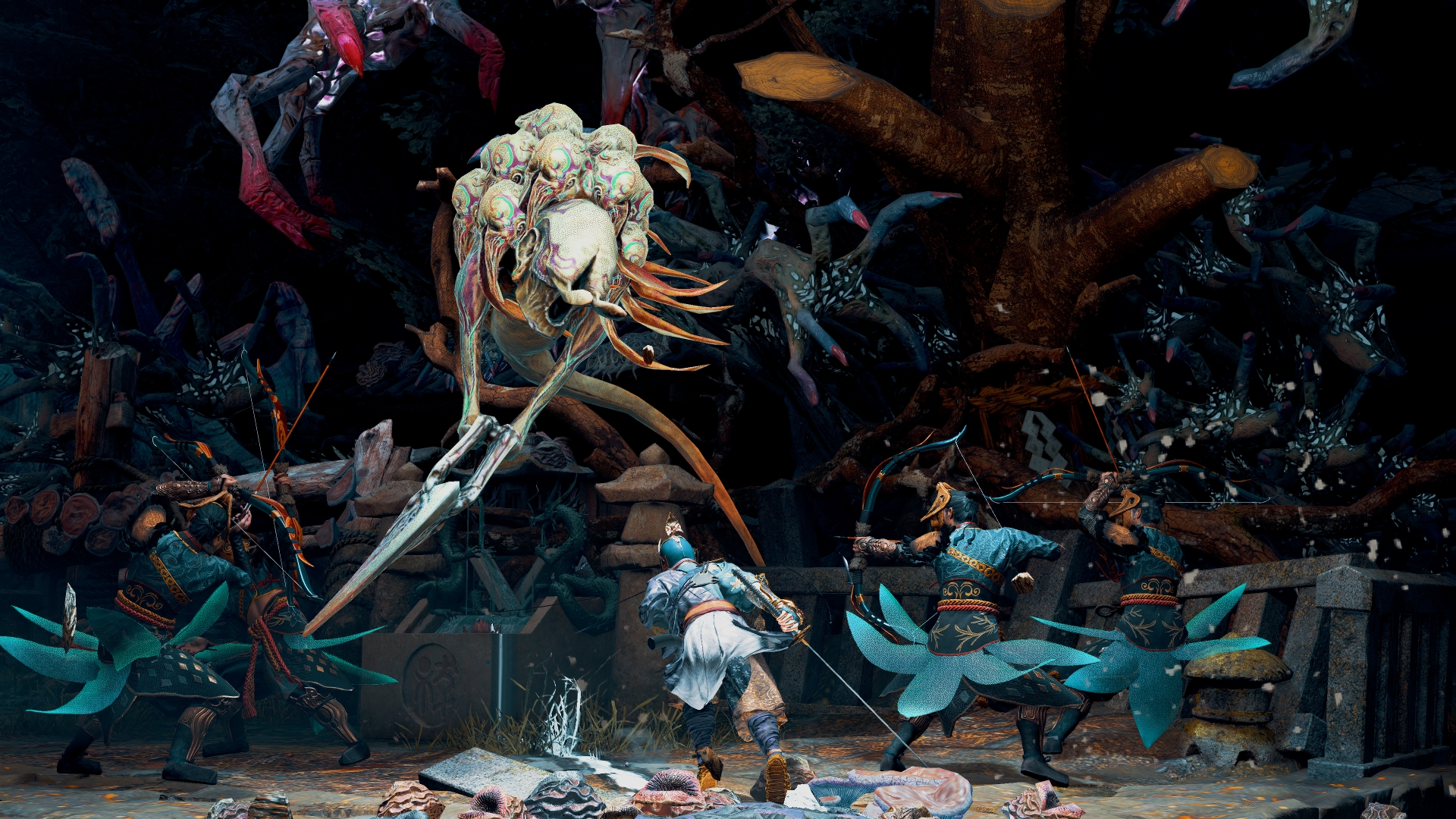
Night falls with a throbbing heartbeat. A purple mist rolls in with horrors like twisted bear-like bakemono with lanterns hanging like soul traps, rotting crane yokai and a lit more. The battlefield explodes. Your villagers, now stationed, automatically engage bows hissing, superior priests casting warding glows, cannon‑handlers bellowing flame. Meanwhile, you become Soh, the ritual dancer. Katana in hand, you parry, slash, and aerial‑flip through chaotic insects of spirit.
Combat feels like performance art. Every parry rings like a bell; every dodge leaves a trailing koi‑scale shimmer. You gust through wave after wave, dodging a lantern‑tipped oni lunging at Yoshiro. You use one of the power-ups to shatter an infernal lantern. You leap, drop, and slash all the while shepherding villagers. Already your mind ticks: bring back archers here tomorrow; place priests near the shrine, and maybe use a sumo to defend that one gate as a tank unit. What you get is quite something special, and not for everyone. This is cross-genre gameplay at its highest: action‑game momentum, defence‑game choreography, and RTS‑game planning. Capcom has synthesized all these genre elements into a singular ceremony of play. It feels risky. It feels alive, and I love it.

Rebuild, reflect, and renew
When the dust settles, dawn looms again. You awaken in a clearing beneath the mountain. Next to you, Yoshiro kneels by a half‑restored shrine. You hand her sweets, yuzu‑flavored mochi, kagami‑mochi, symbols of gratitude and sweetness for spirits and villagers alike. As you eat, her eyes brighten; nearby villagers smile.
Action shifts into rebuild. You use musubi to erect prayer halls, restore lanterns, and clean tributary springs. Each new shrine grants Soh buffs: deeper spirit‑core pools, wider warding circles, faster restoration. You also unlock masks, granting power-ups for your villagers and for Soh himself, which range from new villager roles to faster spirit regeneration or new dance attacks for Soh.
You stroll through the village, inspecting ema boards, crude villagers’ pleas like *“May my daughter remember her mother”, and noting painted depictions of Seethe monsters. Little narratives emerge: the blasted scorpion beast that once swallowed a shrine out of spite; the man who sacrificed his arm to stop it. These small boards stitch together a rural tapestry, a living folklore that absorbs your curiosity. And not the first (if you are interested, Google the Tapestry of Bayeux).
Your pilgrimage presses onward. More villages, more corruption, stranger Seethe emerge: a lantern‑wielding deer-woman yokai whose cries fracture reality; a giant crimson worm swirling beneath rice paddies. And the village pattern repeats, but it doesn’t wear thin, because the narrative stakes escalate. You’re descending Mt. Kafuku, yes, but also climbing toward a spiritual awakening—for you, for Yoshiro, and for the villagers.

Cross‑genre
It feels odd, at first, to swerve from katana combos to villager placement. But as you press ahead, the rhythm reveals itself:
- Day: Ritual excavation and rescue. You restore what was lost.
- Night: Combat ritual in chaos. You defend what you rescued.
- Dawn: Rebuilding. You reap what you sowed.
These are not separate modes, they’re parts of a single living spell. Without rescue, night falters. Without rebuilding, tomorrow weakens. Missing one thread unravels the weave. And every thread is tied to folklore. Masks are spirit talismans. Sweets are shrine offerings. Ema boards are the villagers’ prayers. Seethe are nightmares cast from ruptured spiritual bonds. You begin to understand the pilgrimage on a symbolic level: it mimics the cycles of decay, ritual, and renewal in Shintō belief.

Characters and lore as echoes
Yoshiro remains silent, yet she isn’t empty. Her occasional shrugs, her posture during daylight blessings, and her hand clutching Soh’s during storms, they speak volumes. She’s a guardian in training, slowly learning that cleansing isn’t erasing but transforming.
Boss encounters, like the lantern‑bearer scorpion, are almost mythic. You don’t simply hack at it: you provoke it into lantern‑dragging frenzies and dodge acidic blasts, then strike when it’s lit ablaze. When the final blow lands, the lantern shatters, light replaces corruption. You’ve purified more than flesh: you’ve reforged an ancient myth. And with it, dozens of villagers emerge to rebuild in gratitude. You wonder: did they survive because of you, or because you trusted in their roles too much? The story seldom spells it out. You’re trusted to feel it.
Switch 2 enhancements
On Switch 2, Capcom has layered two key systems:
- Mouse & gyro support: you can now drag villagers intuitively across battlefield locations, offering a sense of ritual placement by hand.
- Otherworldly Venture mode: an endless roguelike stretch of Mt. Kafuku. Yoshiro now moves herself; you return to Soh as a chosen spirit. Each wave introduces novel Seethe variations and mask upgrades, testing your strategy in an endless loop.
These additions expand the pilgrimage beyond its core linear arc, your ritual becomes customizable, and your story cyclic.
Imperfections in the Path
Yet the road isn’t without hiccups. Some villages feel repetitive: you’ve planted priests here before; still, you plant them again. Rebuild stages can drag on and the musubi cost doesn’t always align with strategic value. And once or twice, during boss fights, failure washes over you like cold water, your misplaced shield or missing archer squad reveals defeat. These aren’t mechanics’ faults, really, they almost feel built into the ritual. Capcom seems to expect failure as a form of spiritual test. However, not everyone wants a scroll that tests one’s faith.
The narrative’s silence is deliberate, resonant, but if you crave crisp, linear exposition, you may feel left twisting. Soh’s nearly mute spirituality is inflection, not interpretation.
Conclusion
After dozens of hours climbing Mt. Kafuku, dancing in moonlit fights, rebuilding break after break, you arrive at the final shrine. Yoshiro stands before it, sunlight glinting from her headdress as Soh lays the final crystal. The shrine pulses, the Seethe aura dissipates, villagers bow and light overtakes shadow. Your pilgrimage ends, but it leaves you changed: you know the shape of ritual, and you trust the cycle of decay and renewal. Kunitsu‑Gami hasn’t just entertained, it’s sanctified a moment and shows that experimental gameplay works, if executed right.
Kunitsu-Gami: Path of the Goddess is not simply a game; it really pulls you deep into Japanese folklore. It demands patience, strategy, and presence. Capcom’s gamble pays off beautifully, even if at times the narrative feels slow or the trial is too long; there’s still grace in its rhythm, power in its silence, and power in its ritual. If you long to wander a digital shrine, swing your spirit sword at the dark, and rebuild a tired world stone by stone; this pilgrimage awaits. Step forward. Let the spirit guide you.
