
When it comes to games there aren’t that many games that really get meta. Games that explore the concept of being a game. Playing with gameplay ideas, tropes or development of video games is something that’s just ripe for funny and insightful observations and criticism about the medium and industry. The Magic Circle is here to show the potential of such games. Its setting, Story, gameplay and presentation are all about how video games are made. And it delivers quite a nice look into how the creation of games and everything around it is done.
It will never finish. It will never end.
The Magic Circle begins by one of the main characters narrating over story boards, sketches, and concept art. He talks about the inspiration for the opening of his game and is pretty quickly interrupted by another dev on the team asking if the player can skip the intro. This immediately does a good job of telling the player almost everything they need to know. You assume the role of a playtester that has to play a demo build of an incomplete game under development by people who have very drastically different philosophies on what a game is, how it needs to be developed and what makes a game “fun”. There are a handful of characters in the game which you will interact with. There is the Ish, the creator of the text-based adventure game that came before and is interested in telling an engaging and emotional story. On the other side of the spectrum is the Lead Designer Maze who thinks games are all about gameplay and thinks story has no place in the medium. Lastly, the is Pro. The main character who is trapped in a very old and scrapped version of the game and reaches out to the player to escape.
The story of looking into a game that’s in development hell for over twenty years is interesting and seeing the people who are responsible for that sheds a lot of light on why these kind of things tend to happen. The dialogue is written very well for the most part with a few awkward lines. You get to see an intense battle as two developers try and push what they think is the definition of a game. The game does an excellent job of showing how game development goes, with developers arguing about their vision of the game but even text files scattered around the game from other developers having conversations or very passive aggressive arguments on certain aspects.
For how interesting the game’s narrative and most of its characters are it does not hold up in the end. The ending of the game feels too out there. The main story of the game was about game development and for the most part, it kept things real with a slight blend of fiction to compensate for making an actual game. The end however throws in some dumb cringeworthy and over the top moments that don’t really seem to fit with what came before it. If you are interested in developer commentaries, documentaries and game development then The Magic Circle has something to say you will find interesting.
 The Old Pro will guide the player all while having to listen to the devs argue over every little thing.
That’s so meta.
The Magic Circle get especially creative with its gameplay. The game plays in the first person but not soon after you begin does one of the developers decide to cut combat leaving the player defenseless. Pro does offer another way to defend yourself, trap creatures and edit their values, take enemies that are programmed to attack you and break into that code to change their weapons or allies. Once you trap a creature you can go inside its code wich is represented by simple lines of text. You can choose to remove their attack and abilities which you can then stitch into another creature or you can make the monster be your ally. It’s nothing that’s too deep or exhilarating but it fits the theme well and is a unique way to implement combat. It also helps that combat isn’t too frequent and doesn’t punish the player too much. You will also need the creatures to solve puzzles. The first part of the game will be a linear section but later the player will have to traverse a bigger level where they can do some slight exploring and go any direction they wish before coming across a progression blocker. Luckily being able to teleport to any life-source the player has come across will save them time.
What makes The Magic Circle so interesting is the way its level is designed. When starting the game players will come across a rock with a text file clearly visible. Reaching the file with conventional methods is impossible so the player might try to climb the roots around it to reach the file. Once opened the file states that the roots along the line of the rock make for an enticing natural staircase for the player to get to spots they shouldn’t be. At that moment it’s clear the developers want you to play the game as actual playtesters. Sequence breaking is encouraged and forcing yourself on pieces of the environment that look like you shouldn’t be on is usually rewarded with upgrades for you or your creatures. There are going to be points in the game where the player might think to themselves “huh, I don’t think I was supposed to do that to get here”. And that’s why The Magic Circle is so interesting. You play a playtester so you have to play as a playtester. The gameplay isn’t anything groundbreaking or even engaging. It’s the way its level is designed that promotes and invites the player to mess around or break the levels that make it so interesting.
 The game has an interesting take on combat.
Colors need to be approved before implementing.
When it comes to presentation The Magic Circle does some interesting things. The game is divided into two art styles. The first is a Cell-shaded look where everything was turned black and white because the lead director of the game wants to approve every color palette. This cell shaded style is entirely fantasy themed and it really does a good job. The designs are creative and sharp. Things like a giant hand keeping the sky aloft and trees intertwined by the branches look amazing. The second art style is reminiscent of the graphical capabilities of the original PlayStation. This style is used with a sci-fi setting and is an earlier version of the game that got completely scrapped. The two styles could not be any more different and the longer further the player progresses the more the two styles start to merge. It does an excellent job of showing a world that’s a messy unfinished product. It’s neat to walk around in a cell-shaded world only to see a low poly pixellated space station in the distance. When in the old world and walking around in low textured hallways only to come across an exit where the cell-shading starts are great. There is little music but the sound design and voice acting is top-notch. The Magic Circle looks and sounds the part.
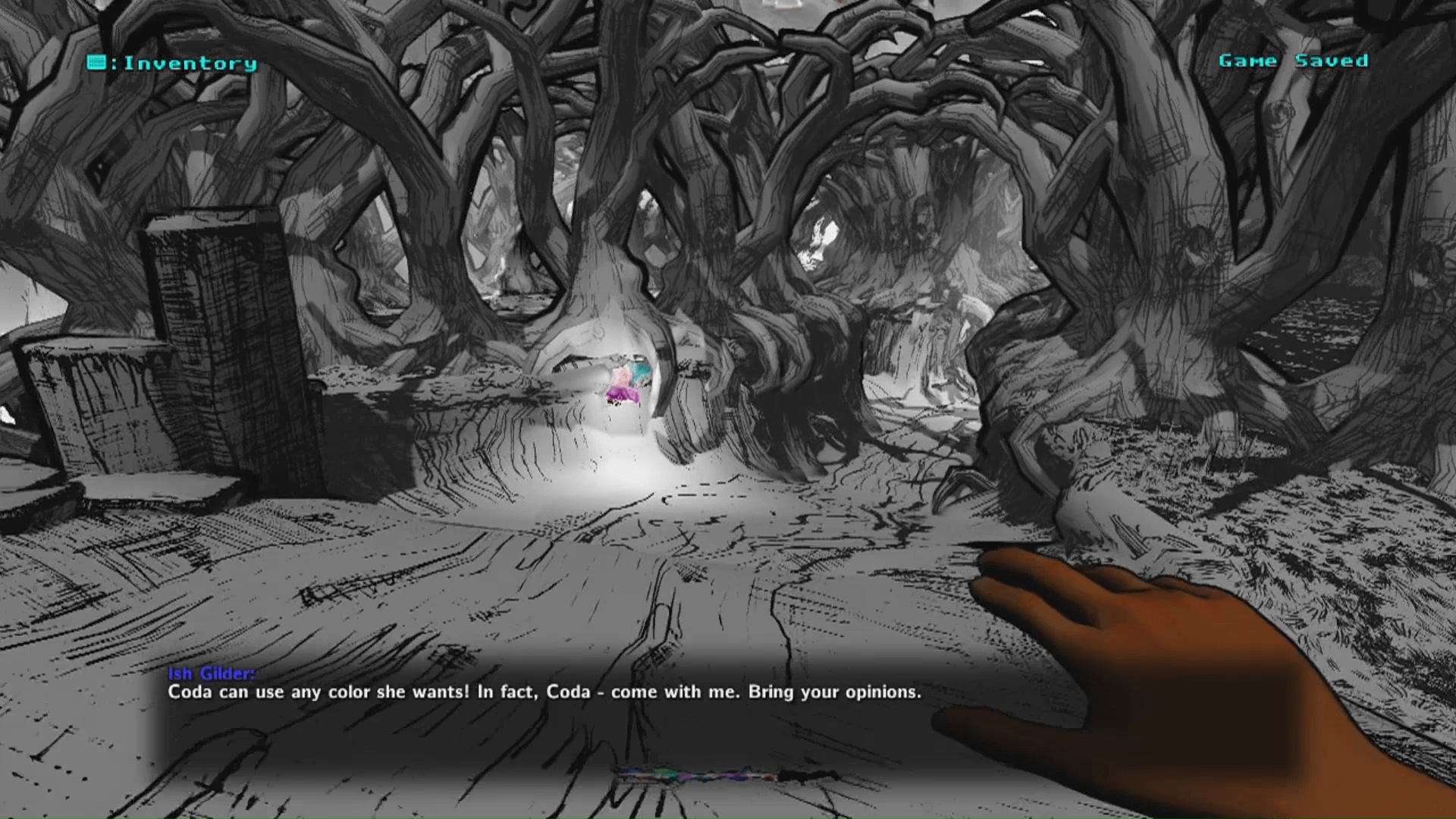 There are some cool aesthetics in this game.

The Magic Circle’s developers set out to do one thing. Show games and their development using games themselves as the medium. And they pretty much nailed it. It’s not a perfect game, or even that engaging from a gameplay standpoint. But how it handles every little thing and keeps it consistent with its theme is impressive. The game plays on every aspect of the fact that it’s an unfinished video game. It manages to give us a closer look into game development that tends to be ignored. It shows us how a game can go so wrong and get stuck in development hell. Its narrative is not without its flaws, though. The ending segment of the game where the gameplay demo is presented get a bit too ridiculous and character’s arcs feel as if they are left open and even though the game clearly shows that the main developers of the game are all in the wrong and partially right only one of them seems to get punished while the other is treated as if that person was right. The Magic Circle is a game for people who have an interest in these kinds of things should definitely play.
| The good: | The bad: |
| + inventive | – the ending. |
| + smart | |
| + cool insight in the industry |
4 out of 5:

If you are interested in other games similar to this one you might want check out these reviews:
