
There’s something about history that pulls me in every single time. Not the dry textbook kind, but the one I taught when I was a teacher. The stories, voices, and cultures that still echo in the present help put things in perspective. Games have become one of my favorite ways to step into those worlds, to experience perspectives you don’t often see on the big stage. And now and then, a title comes along that doesn’t just use history as a backdrop, but treats it with care, and a clear sense of responsibility. Reclaim! Azhe-giiwewining is one of those rare experiences. Let’s do an educational deep dive.
What is Azhe-giiwewining?
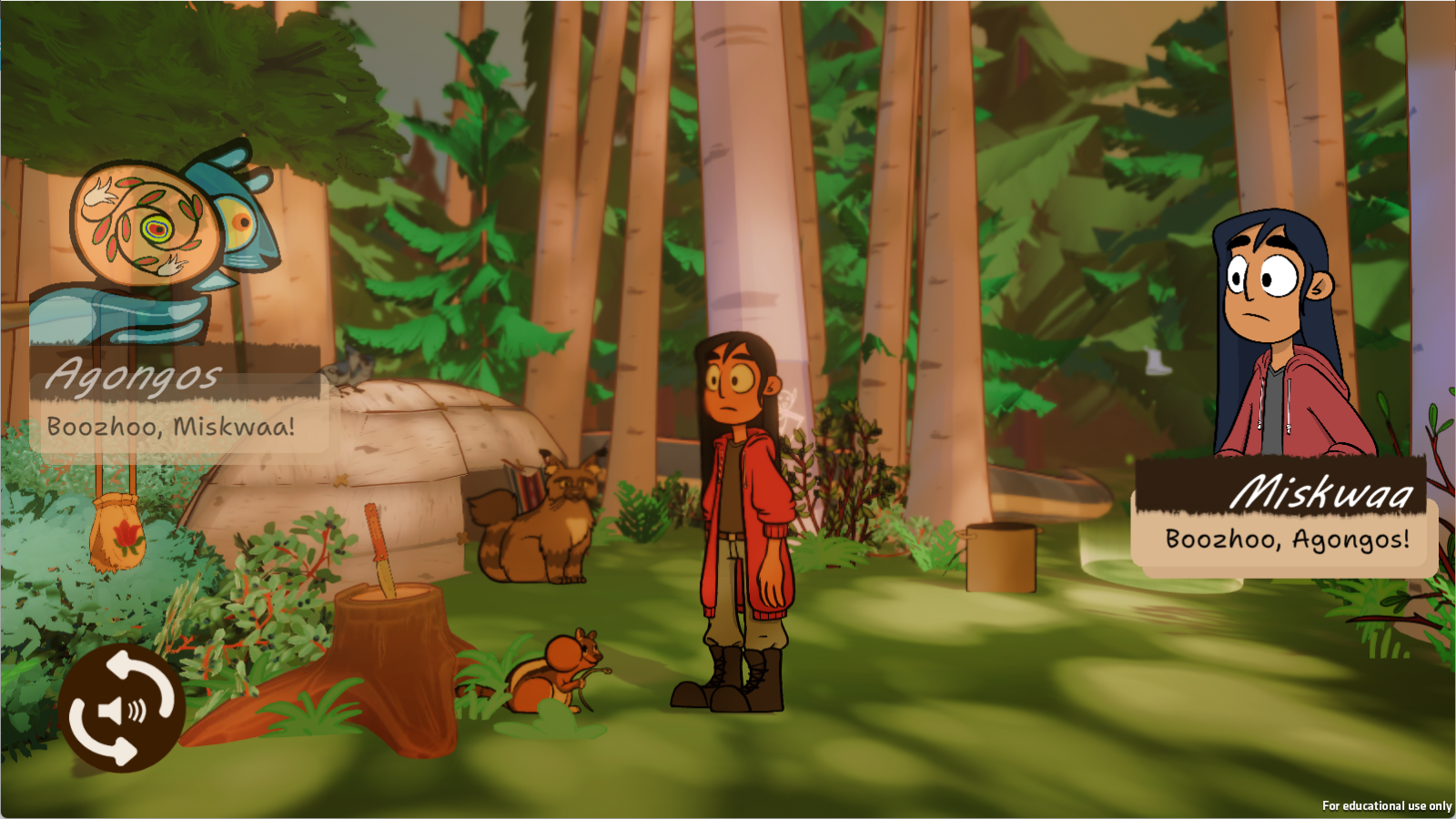
Before even touching the gameplay, it’s important to understand what Azhe-giiwewining represents. I hope I’ve chosen the right words for my explanation, so if that’s not the case, please let me know! The word itself, rooted in Anishinaabemowin (the language of the Anishinaabe people), roughly translates to “returning home” or “bringing something back.” And that’s not just poetic framing, it’s the core of the entire experience. This isn’t a game that borrows Native American aesthetics as window dressing. Instead, it’s deeply embedded in Indigenous perspectives, storytelling traditions, and lived histories. Developed with cultural input and clearly shaped by voices that understand the weight of representation, Reclaim! positions itself less as entertainment alone and more as a cultural bridge. What stands out immediately is how the game invites players to engage with Indigenous knowledge systems. Rather than presenting culture as something static or historical, it feels alive, dynamic, evolving, and deeply personal. You’re participating in a process of reconnection and understanding. And that’s where Azhe-giiwewining becomes more than a title; it becomes a mission statement. A mission statement with 1500+ voicelines in their own native tongue.
A story rooted in memory and identity
At its heart, Reclaim! Azhe-giiwewining is a narrative-driven experience about rediscovery. You step into the role of a young protagonist navigating both physical and spiritual landscapes, piecing together fragments of identity lost, suppressed, or forgotten over generations. The story unfolds in layers, blending personal narrative with broader historical context. Themes of displacement, cultural erasure, and resilience are ever-present but never handled with a blunt instrument. Instead, the game opts for nuance, quiet moments, symbolic interactions, and environmental storytelling that trusts the player to connect the dots (and if you don’t, read up on what happened to indigenous people in America).
What makes the way Reclaim! Azhe-giiwewining more than just another ‘point-and-click’, is that there’s a strong sense of duality throughout. On one hand, you’re exploring tangible spaces, such as forests, underwater settings, and other remnants of a past interrupted. On the other hand, you’re moving through memory, myth, and ancestral echoes, which gives you insights into ‘what has been and could have been’. The line between the two is intentionally blurred, reinforcing the idea that history isn’t something behind us; instead, it’s something we carry with us, through our ancestors and our traditions.
What impressed me most was how the narrative avoided the trap of overexplaining. It doesn’t lecture; instead, it invites the player to explore. This leads to a setting in which conversations feel natural, sometimes even incomplete, much like real-life exchanges where meaning isn’t always spelled out. This design choice adds authenticity but also requires a bit more player engagement, which, in this case, feels entirely appropriate. Read through the lines and see how the world is shaped by what we take with us. And that means that the emotional weight builds gradually. There’s no single “big moment” designed to hit you over the head. Instead, it’s the accumulation of small realizations that lands hardest. By the time the credits roll, you’re not just finishing a story; you’re reflecting on it and, hopefully, gaining an interest in the Anishinaabe people.
Classic foundations with modern relevance
Mechanically, Reclaim! Azhe-giiwewining leans heavily into the point-and-click adventure genre. And yes, in 2026, that might raise an eyebrow or two. But here’s the thing: when done right, point-and-click isn’t outdated. The controls are intuitive and deliberately simple. You explore environments, interact with objects, engage in dialogue, and solve puzzles that are more about understanding context than brute logic. There’s no unnecessary friction here. The game wants you to focus on meaning, not mechanics.
That said, simplicity doesn’t equal shallowness. The puzzles are thoughtfully integrated into the narrative. You’re not just combining random items to unlock progress; you’re interpreting symbols, reconnecting stories, and engaging with cultural elements that carry significance. In that sense, the gameplay becomes an extension of the storytelling.
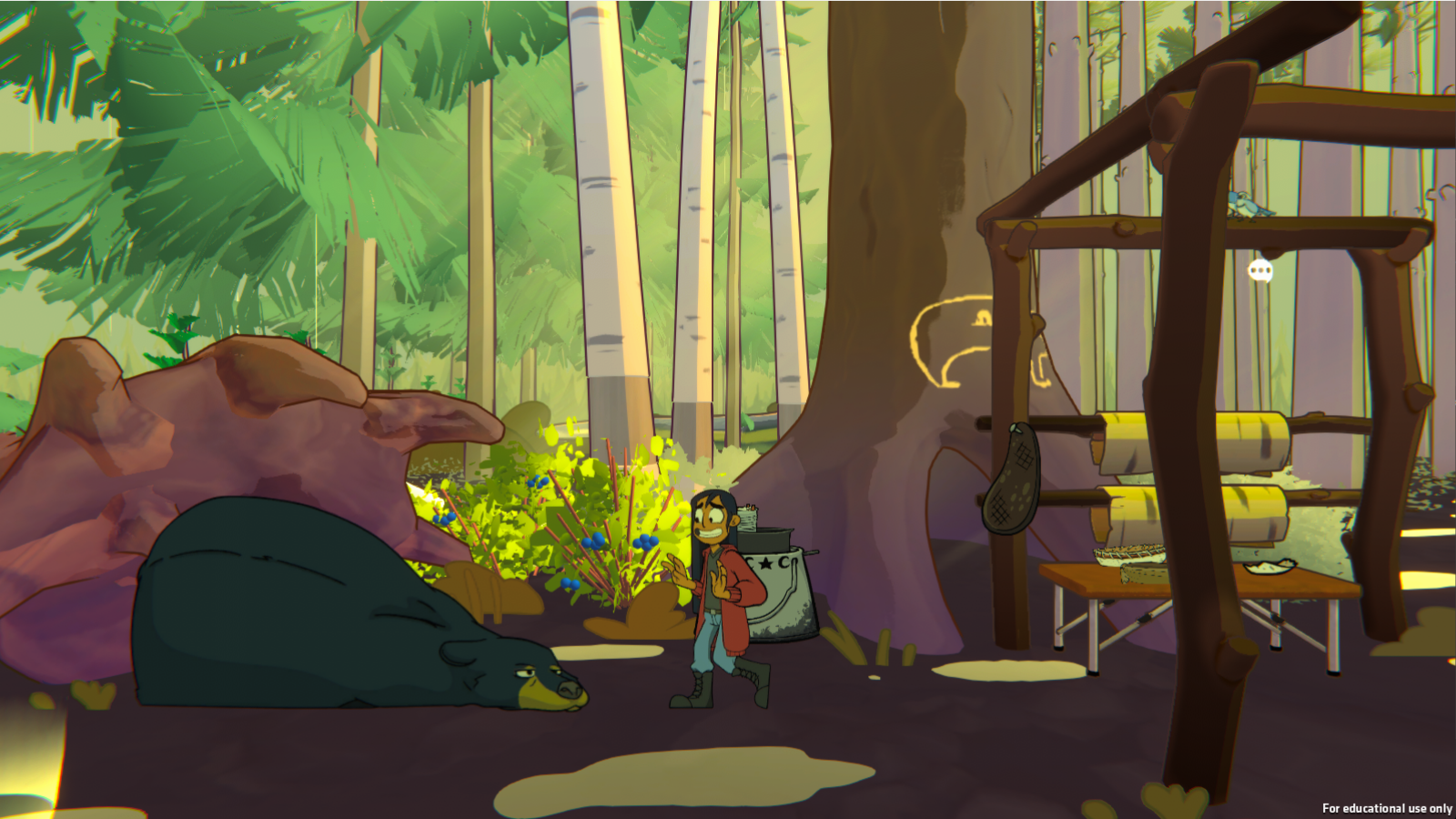
One of the more interesting aspects is how the game uses interaction to support learning. You might come across an object or a phrase that doesn’t immediately make sense. Instead of handing you a tooltip or a codex entry, the game encourages exploration and reflection. Sometimes the answer comes later, sometimes it’s implied, and sometimes it’s left open-ended. That design choice won’t be for everyone. Players looking for clear objectives and constant feedback might find the pacing slow or even ambiguous. But for those willing to lean into the experience, it creates a much deeper sense of immersion.
The interface itself is clean and doesn’t hold players back. Dialogue choices feel meaningful without being overly gamified, mostly since there’s no “good vs bad” morality system here (like Fable), just different ways of engaging with the world. And importantly, the game respects your time. There’s no padding, no artificial difficulty spikes, just a steady, deliberate rhythm and room to learn about how and why the Anishinaabe are what they are.
Why Point-and-Click still works
It’s worth pausing for a moment to talk about the genre itself. Point-and-click adventures have been around for decades, often associated with nostalgia rather than innovation. But Reclaim! is a great example of why the format still matters. At its core, point-and-click is about observation. It slows you down, forces you to look, to listen, to think. In a game so heavily focused on culture and narrative, that’s not just beneficial, it’s essential. Imagine this game with fast-paced mechanics or action-heavy gameplay. It would completely undermine the tone. The deliberate pace allows moments to breathe. It gives weight to silence, to stillness, to the spaces between interactions. In that sense, the genre isn’t just a design choice; it’s a thematic one. Even the Assassin’s Creed educational materials aren’t quick-action-paced; they fall in line with another ‘point and click ’ style system.
Subtle but effective
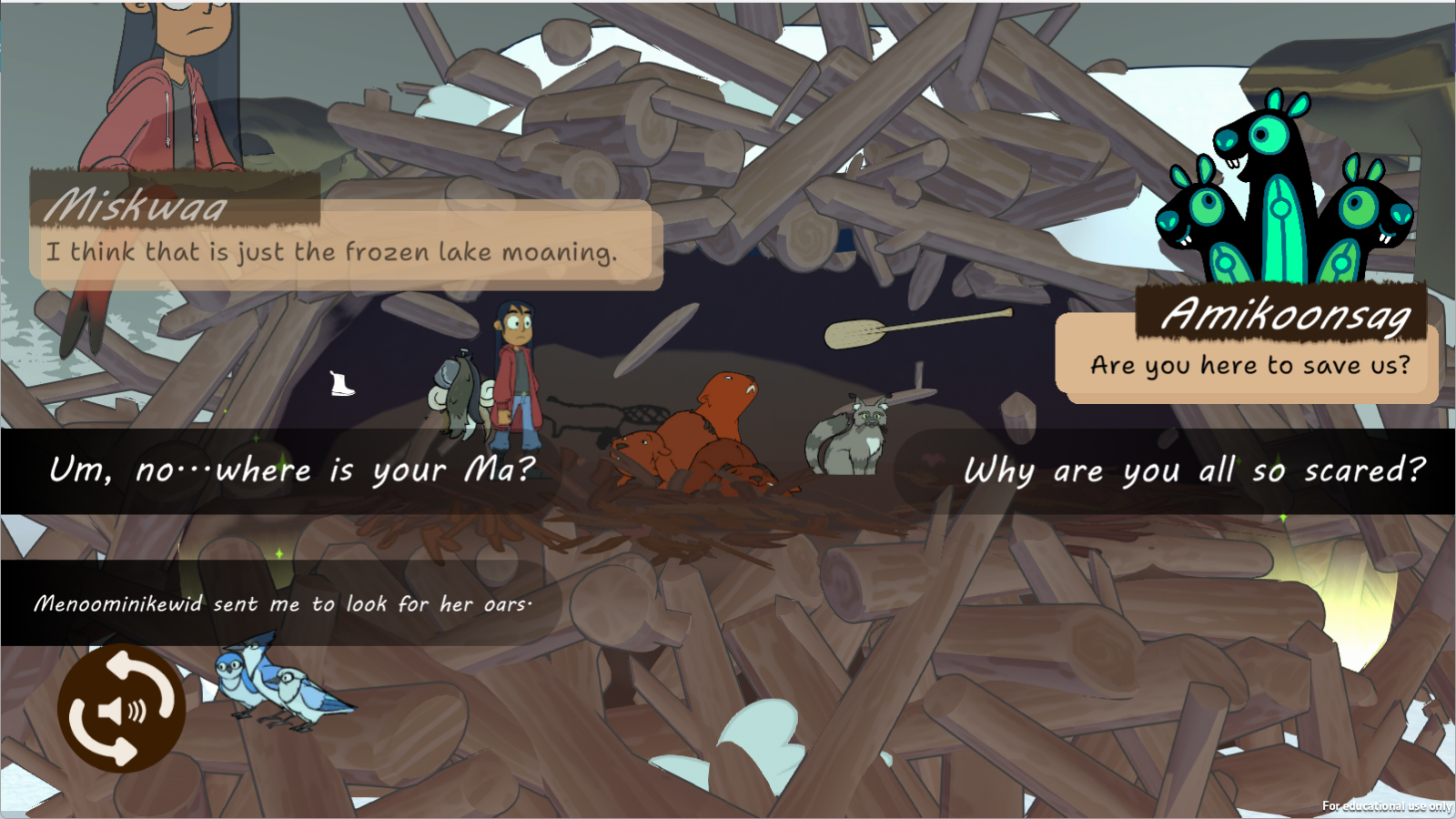
While not a graphical powerhouse, Reclaim! Azhe-giiwewining excels in its art direction. The visual style leans into a slightly stylized realism (think Graphic Novel, while still handling the comic style), with a focus on atmosphere rather than detail density. Colores are used intentionally, often reflecting the cultural setting and making the shift between what you see and what the game wants you to see (animal versus spirit). Sound design plays a crucial role as well. Ambient audio, natural sounds, and carefully placed music all contribute to the sense of place. There are moments where the absence of sound speaks louder than any soundtrack could. Voice acting deserves another note, since this game is fully voiced in the Anishinaabe peoples’ language. Which is a joy to listen to, even though I couldn’t make out any words that ‘clicked’ in my head after finishing the game. Even though it’s a great way to conserve a culture and language in a modern format, and there’s a noticeable effort to maintain authenticity in the way the dialogue is written, which goes a long way in a game like this.
Where it stumbles (slightly)
No game is without its flaws, and Reclaim! does have a few rough edges. The pacing, while intentional, can occasionally feel a bit too slow. There are moments where the game lingers just a little longer than necessary, which might test the patience of some players. Additionally, the lack of clear direction at times can lead to minor frustration, especially if you’re unsure whether you’ve missed something or if the ambiguity is by design (like missing the point of walking past a tree to discover a new area). From a mechanical standpoint, the simplicity might also be a double-edged sword. Players expecting deeper systems or more complex interactions may find the experience a bit limited. But, and this is important, these issues never overshadow the core experience. They’re small bumps on an otherwise very intentional road.
Conclusion
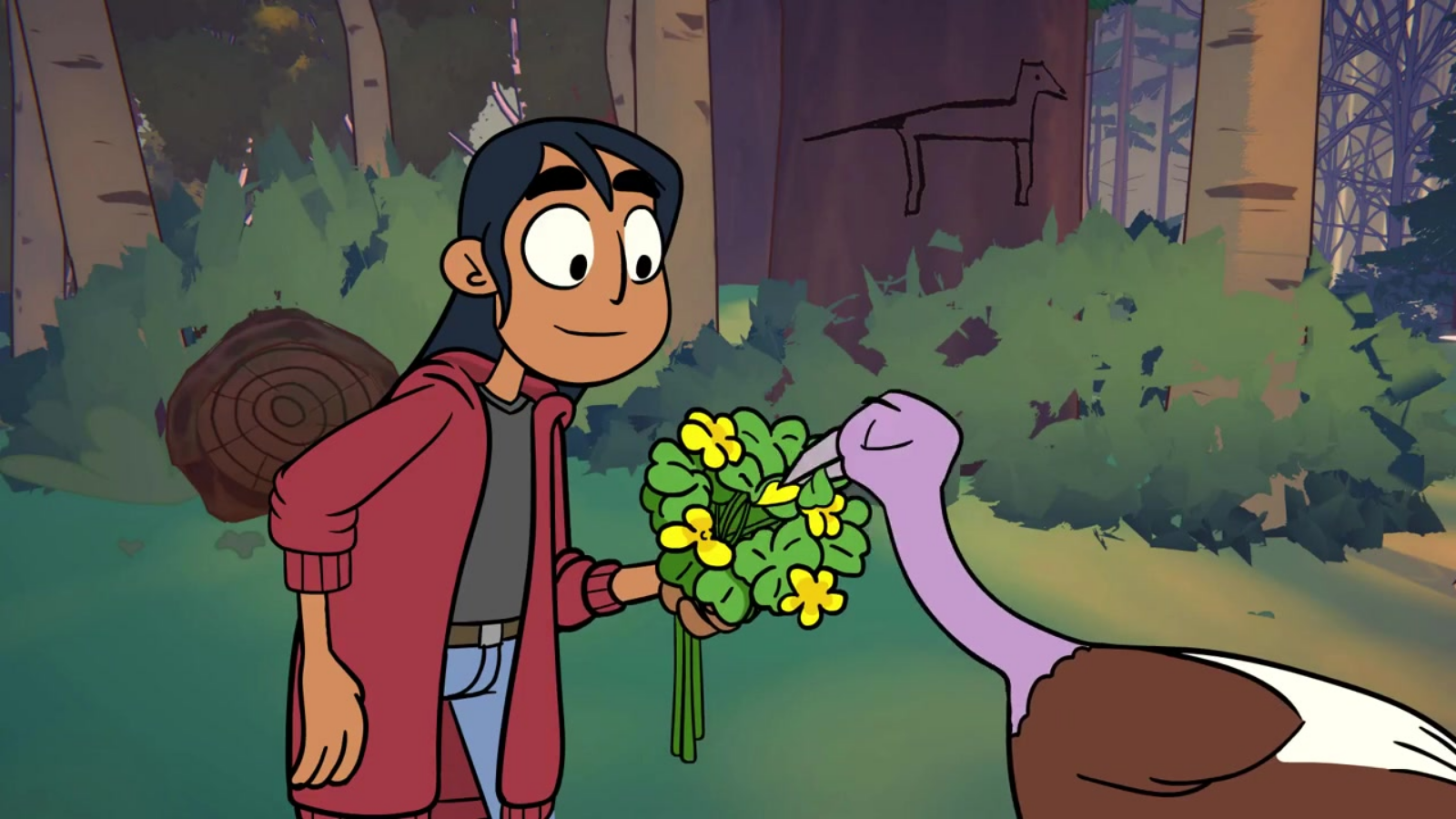
Reclaim! Azhe-giiwewining is not your typical game, and that’s precisely why it matters. It’s a thoughtful, culturally grounded experience that prioritizes meaning over spectacle. It doesn’t try to be everything for everyone, and in doing so, it becomes something far more impactful. The combination of narrative depth, respectful representation, and deliberately paced gameplay creates an experience that stays with you long after you’ve finished it. This is a game that asks you to slow down, to listen, and to reflect. And if you’re willing to meet it halfway, it offers something genuinely special. It’s a quiet, powerful journey that proves games can be more than entertainment.
