
Paper Mario has always been one of my favorite non-platforming Mario lines. I can easily say that Paper Mario: The Thousand-Year Door is one of the greatest games released on the Nintendo Gamecube, with some much less popular titles on the Wii and 3DS. Luckily we have a saying in Dutch – beter goed gejat dan slecht bedacht, which roughly translates to better well stolen then poorly figured out (you can’t translate those things), and Bug Fables belongs in this category. A spiritual successor to the Paper Mario genre, and a great one for that matter.
Bug Fables:
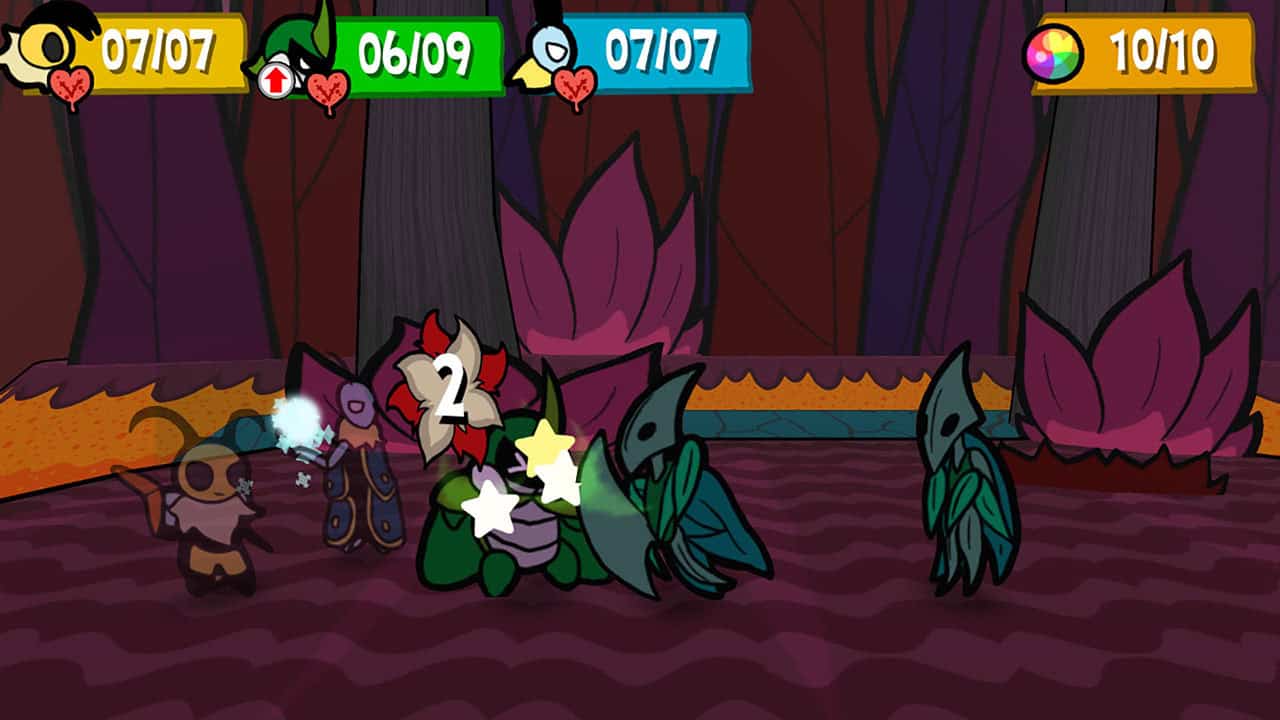
Bug Fables: The Everlasting Sapling is a role-playing video game developed by Moonsprout Games and published by Dangen Entertainment. Like I mentioned in the introduction, the game is heavily inspired in both art and gameplay from the first two Paper Mario games. Bug Fables centers itself around three bugs, each with a distinct move set and personality—Vi the Bee, Kabbu the Beetle, and Leif the Moth. Join them on an epic quest, as they search the mythical land of Bugaria in pursuit of vast treasures and eternal life (in the form of an everlasting sapling). For those familiar with the Paper Mario series, the way Bug Fables is build-up will be a walk in the park. Find artifact (CQ. Stars in Paper Mario), unlock a new part of the game, gain sidequest. Since I don’t want to spoil too much of the story, I won’t go any deeper than I already did. Bug Fables has a good narrative and kicks off after the first two chapters.

Gameplay:
Let’s talk about gameplay! The player controls three characters: Vi, the bee, Kabbu, the beetle, and Leif, the moth. When exploring the overworld, these characters can use their unique abilities to traverse the environment, solve puzzles, and find secrets, and as the game progresses, more abilities are unlocked. Vi has a boomerang, Kabbu, a horn that can be used to cut certain things, and Leif has the power to freeze. Just like in Paper Mario, enemies are visible on the overworld and can be either engaged or avoided. Attacking them gives you an advantage in battle while being attack will result in taking some extra damage at the start.
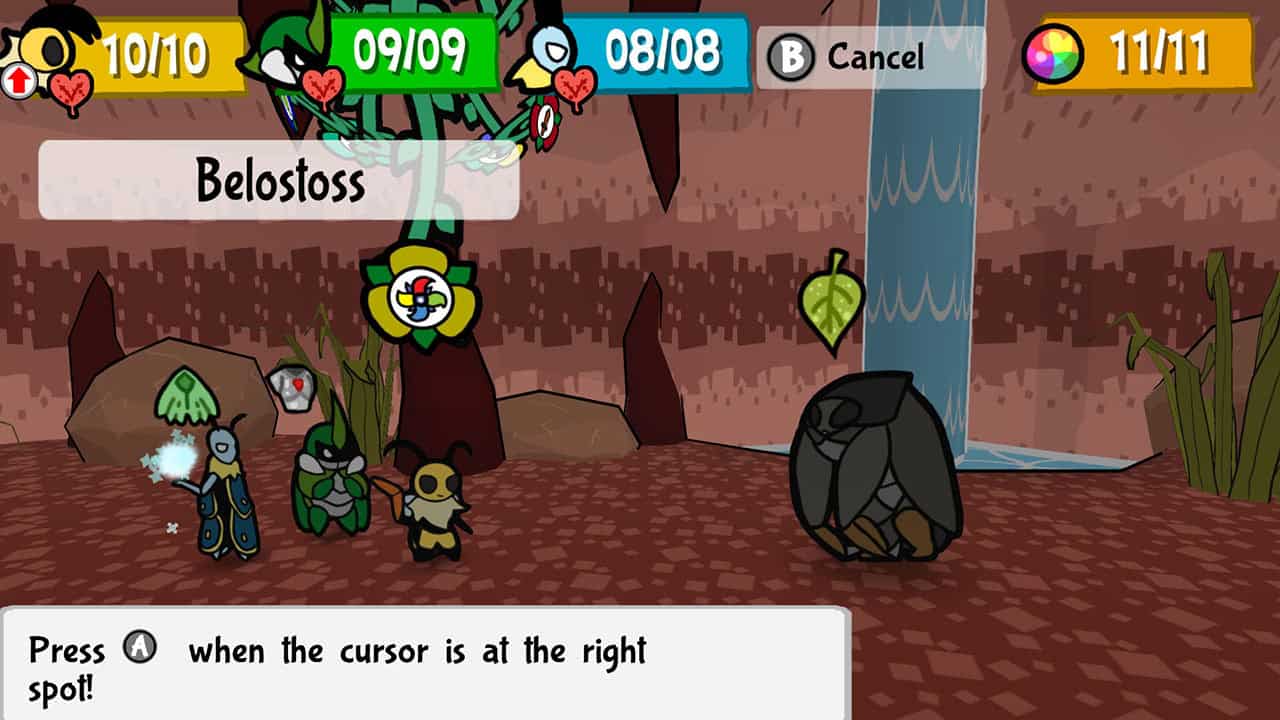
Combat is played in a turn-based format, which makes use of small minigames similar to Paper Mario, as the player must time button presses to maximize the efficacy of their moves, or to take less damage from enemy attacks. In Paper Mario, the movements of these attacks were do-able (except for the special moves), but in Bug Fables, I messed up even the spy (tattle in Paper Mario) move since it’s super sensitive. Sure, it’s an Indie, but when playing the game on Hard Mode (which I did), it can be annoying that a missed spy, results in extra damage or redoing a boss fight. Luckily it’s not all standard moves. Your party also shares Teamwork Points (TP), which are used for special attacks, as well as Medal Points (MP), which are used for equipable medals that can either enhance specific attributes, grant resistance to status debuffs, or unlock special moves. Upon winning a battle, the party is awarded Exploration Points (EP); earning enough EP will increase the party’s level, where the player can choose to increase their HP, TP, or MP. A quick heads-up on this part; be sure to complete some of the sidequests, since you will need all the EP that you can get, trust me.

Minor bugs?
Sounds good, right? Well, it’s a bug-tastic game, with some flaws. Maybe because we set the standard a little too high due to the Paper Mario bar, we use to measure this game? On the other hand, they should have known people would. I had some annoyances while playing Bug Fables, and it was nothing too serious, but a little bit of frustration that made my score lower than the average review. The controls did not always work the way you expect them too. Since it’s a 2D platforming RPG, with 3D aspects, camera-movement is a little bit wonky over time. This results in horrible jump puzzles that have to complete with extreme skill and even more luck. When falling to your doom for 20 times or so, it can become a little bit annoying, and not so much… fun? Let’s call it buggy to get it over with. The same goes for the sidequests, which are a lot. There is no real way to track them, so I had to go into the ingame menu, look them up, and see if I was able to complete them. Most of the time, I was not, even though I received them on Act I or II. A small list of quests at the top of the corner would have made the quality of life bigger and would have upped my score.
To conclude, Bug Fables: The Everlasting Sapling is a decent Paper Mario clone or spiritual successor to one of my favorite games – and that’s without nostalgia glasses on. It has everything you need and does an excellent job of capturing the humor and style of the Papercraft games. If you are in the market for this kind of play, Bug Fables will not disappoint you one bit. Just keep in mind that it’s hard (harder then Paper Mario) and requires a lot of endurance to complete all the sidequests (which has to be done to progress in the main story without running out of funds). It will certainly keep me entertained until the new Paper Mario drops.
