
I was always pretty interested in Digimon, probably because it has something Pokémon never really had for me. It’s stranger, messier, and sometimes a little too complicated for its own good, but that’s also part of the charm. You never really know what your little digital monster will become next and before you know it, you’re training something you don’t even like that much just because there’s a chance it might evolve into something ridiculous. When Digimon Story Time Stranger was announced for Nintendo Switch 2, I was curious to see if this game could run well on Nintendo’s hybrid. Let’s jump in!
Digital anomalies
In Digimon Story Time Stranger, you play as an agent of ADAMAS, a secret organisation that investigates strange phenomena connected to Digimon. Pretty early on, things go wrong in Shinjuku and the game quickly throws you into a story about time, the possible collapse of the world and the connection between humans and Digimon. It all sounds very dramatic, and the game certainly wants you to care about every little mystery it puts in front of you, but the story wasn’t always the main reason I wanted to continue. It does have interesting moments and I liked the idea of travelling between the human world and the Digital World: Iliad, but Time Stranger also has that JRPG habit of explaining things a bit too much. Some conversations are longer than they need to be and there were moments where I already understood what was going on, while the characters were still busy repeating it in a slightly different way.

That being said, the world itself did grow on me. The human world gives the game a more grounded setting, with Shinjuku and ADAMAS making everything feel a little more serious, while the Digital World is where the game finally gets to be more colourful and strange. That contrast works well, even if not every area is equally exciting to explore. Some locations are a little too straightforward and sometimes you’re mostly running from one point to the next, but the game does a good job of making Digimon feel like they belong in those spaces. They’re not just random enemies waiting around for a battle, they are part of the world and that helps a lot. I just wish the story trusted itself a little more and didn’t always feel the need to explain every single thing so carefully.
Just one more evolution
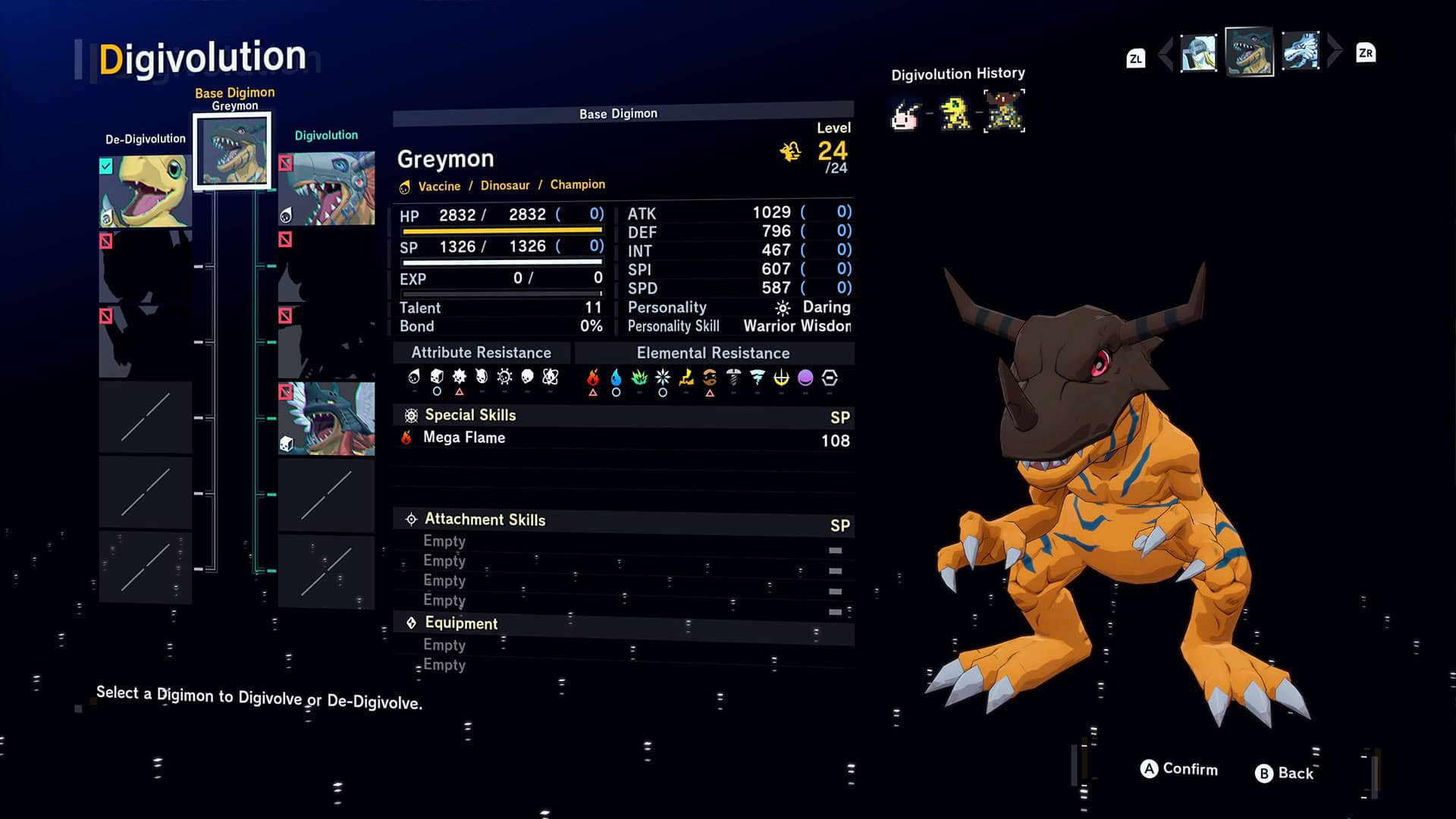
Of course, the real reason to play a Digimon Story game is the Digimon themselves, and this is where Time Stranger got me. There are more than 450 Digimon in the game, which sounds like a ridiculous number until you start playing and realise how fast you begin making plans for half of them. One Digimon is close to levelling up, another suddenly has a new evolution path available and then there’s always that one creature you keep around for way too long because you just want to know what it becomes next. That’s the dangerous part of this game. You tell yourself you’ll do one more battle, but then someone can evolve, someone else unlocks a new skill and suddenly you’re back in the menu again, changing your party for the fifth time that evening.
I really like how messy Digimon evolutions can be. In a lot of monster-collecting games, you can see the path pretty clearly from the start, but Digimon always feels a little more unpredictable. You can move forward, go back, take another route and end up with something completely different from what you expected. It means the game constantly gives you small reasons to keep playing, even when the actual objective you’re doing isn’t that exciting. A normal fight can still be important because it pushes one of your Digimon closer to something new. A side battle can still feel worth it because maybe you just need a few more levels before that one evolution finally opens up. It’s not the cleanest system in the world, but it works because curiosity keeps winning.
The battles themselves are turn-based and pretty easy to understand. You look at weaknesses, use the right attacks, heal when needed and try not to enter a bigger fight with a team that makes absolutely no sense. It’s not a battle system that will blow everyone away on its own, but I also don’t think it has to be. The fun comes from the team you bring into those battles. A fight becomes more interesting when you’re testing a new Digimon or when you’re trying to push a weaker one towards a specific evolution. Without that layer, some battles would probably feel rather basic, but because everything feeds back into your team, I rarely felt like I was just wasting time.

Boss fights are where the combat works best. Those moments forced me to think a little more about my setup instead of just picking the strongest move every turn. Sometimes I clearly brought the wrong Digimon and had to rethink my party, which is exactly when the game becomes more interesting. It’s not extremely difficult, at least not most of the time, but it asks enough from you to make the team-building matter. I do think some regular battles become a bit routine after a while, especially when you’re moving through a less interesting area, but again, the evolution system saves a lot here. If someone in my party was close to becoming something cooler, I suddenly didn’t mind fighting a couple of extra enemies.
Playing on Nintendo Switch 2
Like many ports on Nintendo Switch 2, you can pick performance or quality mode while playing, and I quickly ended up using Performance Mode most of the time. Quality Mode gives you the sharper image, but for a game like this, I would rather have smoother movement and battles. This isn’t really the game you use to show what the Switch 2 can do, but it does look clean and colourful enough. The Digimon themselves are the most important part, and they look good, especially when you finally unlock one you’ve been working towards for a while. Some environments are a little plain and don’t really invite you to explore every corner, but the game runs well enough and never got in the way of what I wanted to do.
Handheld mode might actually be the nicest way to play Time Stranger. This is exactly the kind of RPG that works well in shorter sessions. You do a couple of battles, check your Digimon, make a terrible decision in the evolution menu, and put the console back in sleep mode. Or at least that’s the plan, because it’s also very easy to keep going once you’re close to another evolution. That mechanism fits the Switch 2 very well. It’s not the most impressive version visually, but it is a comfortable one, and for a game where you’ll spend a lot of time battling, checking menus and rebuilding your team, that matters more to me.
Some old problems return
That doesn’t mean everything works. Digimon Story Time Stranger is still a slow game at times and it can talk far too much. The opening hours take a while before the game really gets moving, some objectives feel longer than needed, and a few areas are just not that fun to run through. There’s also some grinding, especially if you want to experiment with a lot of Digimon instead of using the same safe team for most of the game. I personally didn’t mind that too much because I liked the team-building, but I can imagine other players getting tired of it. If the evolution system doesn’t grab you, some parts of this game will probably feel a lot heavier. That’s the strange thing with Time Stranger. When I was in the right groove, I really enjoyed myself. Battle a little, level up, unlock something new, change the team, continue the story and repeat. But when the game slowed down for too much dialogue or sent me through a duller location, I started to notice the weaker parts a lot more. It never ruined the experience, but it happened enough that it’s worth mentioning. This is a good Digimon RPG, maybe even a very good one for fans, but it’s also not the kind of game that completely escapes the usual issues of the series.
Conclusion
Digimon Story Time Stranger gave me what I wanted most from a new Digimon Story game. It has a huge roster, too many evolution paths and that dangerous feeling that one more battle might unlock something cool. The story takes a while to get going and the pacing isn’t always great, but the team-building did a lot of work for me. I liked changing my party, chasing new evolutions and slowly turning a random group of Digimon into a team that just works. On Nintendo Switch 2, performance Mode is the one I would pick, handheld play fits the structure really well and the game becomes more addictive the longer you spend with its evolution system. It’s a little messy, sometimes too slow and definitely too talkative, but I kept coming back to it anyway.