
One year after its first release, Sucker Punch releases the Complete Edition of Atsu’s story in Ghost of Yotei. If you never played these games before like me, is this the ultimate Sony exclusive to play this fall?
Ghost of Yotei (or Yōtei for purists) was already a game that set the bar for what Sony exclusive games could achieve when talented studios like Sucker Punch get the chance to expand on what was already an amazing Ghost of Tsushima. I went and checked some gameplay and reviews of the first game before taking my very first steps into the series, with this Complete Edition that takes place 300 years after the events of the first game.
Before even starting the prologue of Atsu’s story you get an option slider with a shot of a burning tree and some golden leaves with fire particles flying across your screen. This is the game showcasing in real time what “quality-performance-raytracing” modes actually do to your gameplay experience. I found that this was very smart and should be the standard for everyone before starting a game. The Complete Edition also adds the all-new “QSSR” option, which I will elaborate on further within this review.
Ghost of Yotei follows Atsu, a woman who lost her entire family to the deadly Yotei Six, a group of bandits posing as liberators that promise that anyone can join them, enticing followers with becoming a samurai. In reality, you’re just cannon fodder to die for their own greed and power. Atsu’s story begins as her family is killed and she is left for dead, but survives, and thus she gets a taste and thirst for revenge. The story is rather classic and straightforward, less impactful than Jin’s story from the previous game. But Sucker Punch uses certain flashbacks to impact the seemingly “simple” story to a more emotional and guilt-ridden take on the classic story. They reveal things in flashbacks at crucial moments in the story, and this makes Atsu’s story even more emotional.

Echoes of romance?
Echoes of Sekigahara is the story DLC that comes with the Complete Edition and adds a segment of Atsu’s story during the beginning of the campaign. So it’s not an extra story after the main quest but rather an extra that fits right in after you kill the Kitsune and the Oni, so this opens up fairly at the beginning of the game, after 8-9 hours in. You’ll just have to look for posters with a bounty about ” a beautiful samurai,” and it’ll unlock the path to play this story part. Nagato the handsome provides some romance story and expands upon the Snake’s aftermath with a new clan called the Vipers. The events in the DLC actually feel like they complete Atsu’s vengeance, and they expand on how she became the deadly Onryo we get to know further in the story. I feel like the DLC did not feel forced but actually explains more about the lore and Atsu’s motivations. It’s not a massive story, but it’s a nice addition for the price, and there’s more to come with that price tag anyway!
Who needs more RAM when QSSR exists?
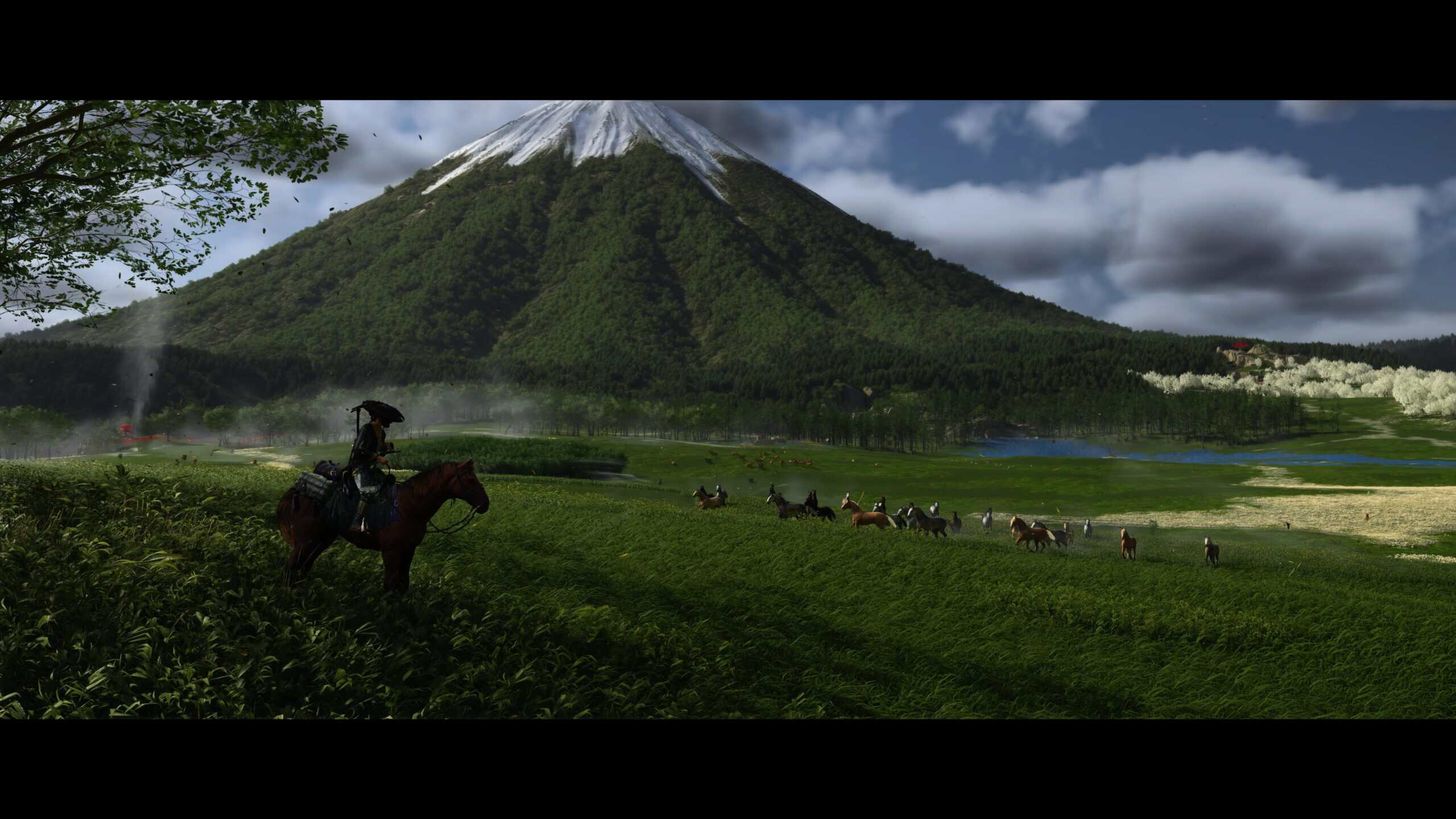
Visually Ghost of Yotei is impossible to comprehend on base PS5. It shows that Sony’s exclusives really know how to squeeze every inch of the console that is entering its 7th year of age. I think a few hours of my gameplay timer might have just been me looking around in fields and forests and just taking in this amazing rendition of historical Japan. Ezo is beautiful, from the vistas on Mount Yōtei, to the moonlit forests and flower-filled fields or countryside. Mount Yōtei is always there and visible, and it also changes with the time of day, weather, or even when you just forget it’s there and the light and detailed forests around it catch your eye from afar. Everything feels just so cinematic, not only battles with the typical “Samurai movie” styled camera positions. Also when taking in the beauty of Ezo or riding your horse the game continually amazes. Petals, loose grass, fireflies, birds, deer, wild horses and more. Every flower is rendered as a 3D object that is physically there, something that could have been an early PS5 tech demo, but this game actually translates this graphical power into functional gameplay.
QSSR is the graphical update the PS5 needed, and it lifts the already beautiful Ghost of Yotei to an even higher standard for the industry.
Where the visuals really come together is within the options with the different modes you can choose from. Performance was my go-to when fighting bosses, when I needed that FPS boost to time my parrying just right. Enemies, even on medium, will cleave into your health bar with 2-3 strikes when you’re early in the game and haven’t got most of your skill tree unlocked. This will get you those 60 fps you will need in battles. After battles, I’d go for quality or even ray tracing mode. This will cause a noticeable drop towards or sometimes below 30 fps but is ideal for roaming around and taking in Ezo’s beauty.
And then Sony thought of something to bring it all together: QSSR.
QSSR will render the game at a lower resolution so as to boost your FPS, but it’ll use AI (not generative!) to rebuild the image to a much sharper and thus closer to quality mode without sacrificing as much FPS as you would initially. This is something really groundbreaking as the base PS5 user can now use this Quick Spectral Super Resolution to boost this 6-7 year old console’s power towards the visuals. It’s a bit reminiscent of what Nintendo does with the Switch 2, and it seems Sony is testing the grounds of what is possible on the hardware side. More visual power without the need for more powerful hardware sounds like what we need in this RAM-scarcity period… Might even change how the PS6 might operate?
Ghost of Yotei and Wolverine are the only games to use the QSSR mode at the moment and there’s no word on retroactively adding it to other first party games or even making it available to other 3rd party devs. QSSR is the graphical update the PS5 needed, and it lifts the already beautiful Ghost of Yotei to an even higher standard for the industry.
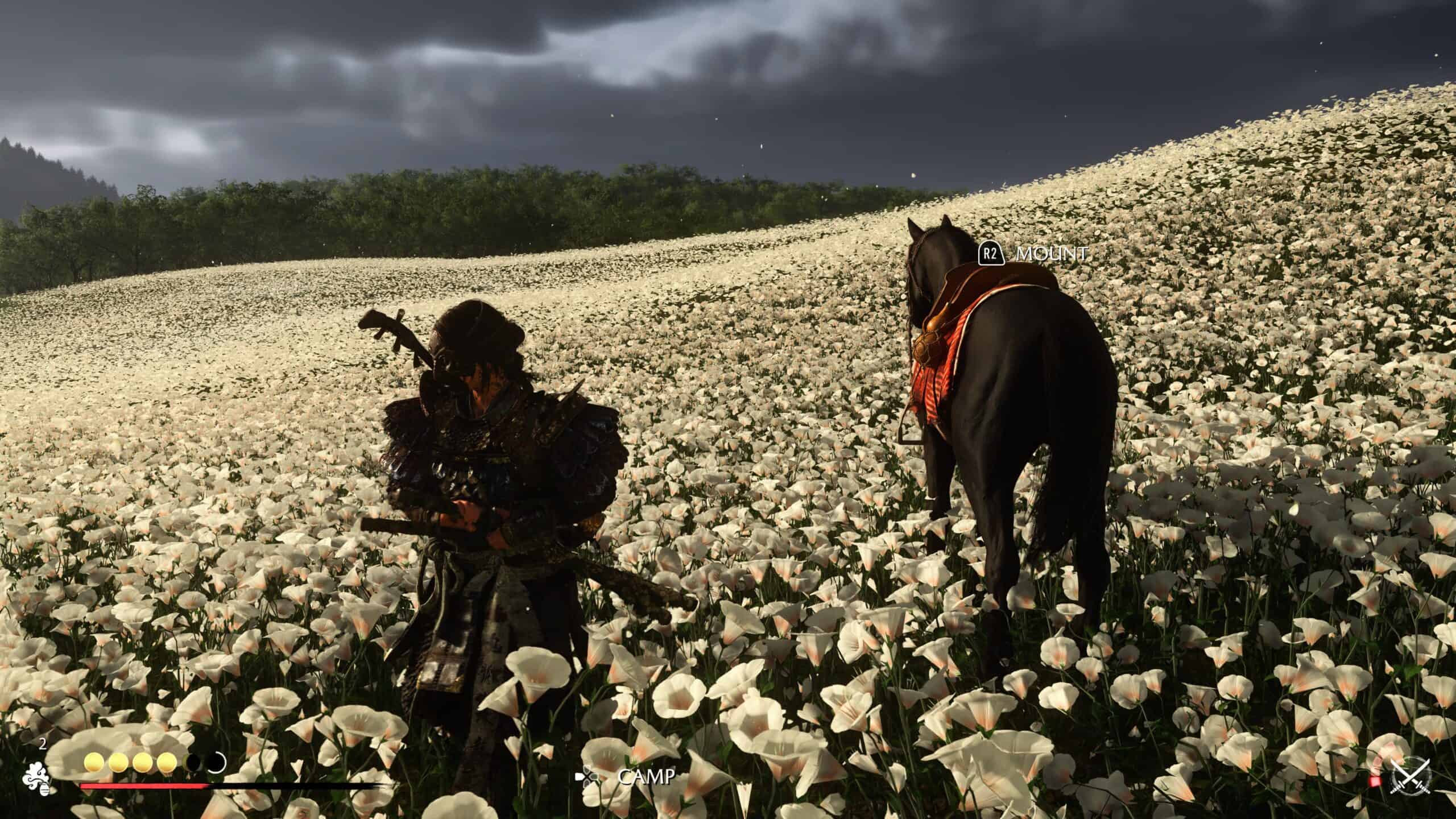
Furthermore, the game still has the Kurosawa mode, which changes the game into a classic B&W Samurai movie, with added grain, dust-on-film effects and even the sound is muted as if it came from an old TV. It makes the duels and character introductions very aesthetically pleasing as if they weren’t already beautiful enough and well directed! There’s also a Miike mode that adds more blood and mud. This mode looks great in battles, but the mud that’s thrown up when walking around is a bit too ridiculous sometimes. There’s also a Beauty of Yotei feature that you can use as a screensaver on your TV. It’s always accessible from the options screen, and it’ll showcase areas from the game in stunning visuals, and the slow and historical music that accompanies this mode is just perfect. All of these add to the care that the game takes to include real Japanese culture.
You gotta fight for your right to progress
The combat is the heart of the game and is fairly challenging, to say the least. I might get old, but my reflexes were definitely tested in this game. If you’re looking for a button masher or a game where you just cut through enemies, this won’t be it. The game heavily relies on reading enemy movements (with some visual cues to help you) and you’ll have to react within that split second by using the correct parry, heavy or normal attack, dodge or other abilities and weapons. If not, you die. If you don’t upgrade your skill tree often enough, you die. If you don’t switch your weapon when the enemy does (look at it as pokémon type advantages) well, you get the idea. It’s a steep learning curve and the game becomes increasingly more complex with more weapons and items to use. Luckily it does so in segments. You unlock more weapon styles and items as you progress and you get enough time to learn how it all works. You’ll be 10 hours into the game and still not unlocking 50% of the available weapon styles. Luckily when you do, it opens more advantageous and more varied combat possibilities so it doesn’t become frustrating or too repetitive later in the game. The game relies heavily on timing for parrying and staggering enemies before you can actually damage them. You can also take the stealth approach, as Assassin’s Creed Shadows offers, but the game is so deep in its combat and visually so rewarding when using all your skills and wolf unlocks that you just want to fight rather than assassinate everyone. The skill trees really open up how you fight and are a reward for dying and persevering during the first hours of the game where you definitely feel underpowered. You grow as a player with Atsu and unlock her skills as you go. Even late in the game or post-game, you can still find unlocks, cosmetics, and upgrades to tackle foes in a new way. Once you invest in the wolf dens and their separate skill tree, you feel like you’re no longer playing the game alone. Even duelling at the start of a fight becomes a whole different experience!

Follow the wind, follow the birds
Ezo offers a whole list of places and other secrets you can discover to boost your combat skills. Shrines will unlock skill points, hot springs will expand your health bar, and bamboo strikes are hard but will add spirit spheres, which you’ll need for advanced techniques during those battles. The world is filled with opportunities to help you get stronger if you invest in it. Ezo is filled with secrets and everything that looks special or looks like a fun place to go to from afar will eventually reward you for exploring and sidetracking. Sometimes even nature tells you where to go, like birds guiding you to secrets or fireflies and butterflies flying around in the moonlit sky. You’ll always be rewarded with something cosmetic or skill points to help you in the harsh combat the game offers.
Most Wanted DLC
If you really want to focus on combat, the new Most Wanted mode is your new guilty pleasure. This DLC, which is included in the Complete Edition, is all about combat and is sort of a bounty horde mode with a few bosses you can fight after each group of grunts is defeated. This mode even has its own monetary system, skill tree and progression separate from the main story game. Where the story mode has you fighting for the story and revenge, this Most Wanted mode strips all of that away and lets you fight how you really want. It unlocks all weapon types from the start, and you get to experiment. There are even buffs and perks that can unlock after each part of the bounty. These change the next fight completely and will make you want to replay a certain bounty to experience it differently. Some smaller bosses even change within the same bounty, I noticed. You can also unlock other characters, even Jin from the first game. He has all of his stances and skills as he did back then, so it’s a great way to expand your experience within this mode.

Atsu’s song
Lastly, I want to talk about the sound design. The sound is just another layer that makes this game the experience it is. Music and sounds are linked to the story and gameplay just as much as the visuals are. They are lore-bound and come and go when needed. It’s a fluid experience and almost feels like an extra entity that accompanies you on your journey. The songs you learn in-game are also a gameplay element and tie into the lore and mechanics, even for combat.
The DualSense controller uses everything it can to complement the game. Sound-wise of course with the sounds from the controller, but also the haptic feedback that is noticeable and gives you more immersion. What I really liked was the inclusion of the touchpad. Where stroking in 4 directions actually adds 4 extra “buttons” that are mapped to “bowing” or playing the shamisen, (un)sheathing your katana etc. I wish more games used these extra buttons that are right there on the controller and barely used. This is another noticeable first-party advantage of this Sony exclusive title.

Conclusion
Ghost of Yotei Complete Edition is the best way to experience Atsu’s adventure for the first time. It’s even great as a start into the series without playing Tsushima first. Atsu’s story is emotional, and Sucker Punch’s direction is cinematic and lets you experience flashbacks at the most impactful times. With the addition of QSSR, the game looks and runs smoother as the ultimate way to play Atsu’s story. The Echoes of Sekigahara DLC fits into the existing narrative and doesn’t feel forced. If anything, it adds more fire to Atsu’s revenge, even if it’s a short addition to the overall story that was already filled to the brim. And if you’re more into combat, the Most Wanted mode will not disappoint with its own progression and skill tree, where you get to fight against hordes of enemies and bosses more than once and always have a different experience. My only complaint is that the game’s fights can be hard and repetitive at first, but if you persevere and invest in its deeper system, you’ll feel like the samurai you need to be. No pain, no gain.