
It will come as no surprise to avid gamers, but the medium is excellent for emotional storytelling. The ability to immerse you in the events of a story by taking control of the main character is something that other types of media can only dream of. However, I can’t remember ever being emotionally touched by a puzzle game before playing Swan Song. I felt the grief and loss of a family sweep me off my feet. And they do this by only showing a music box, some objects, and a few audio logs.
Little Duckling
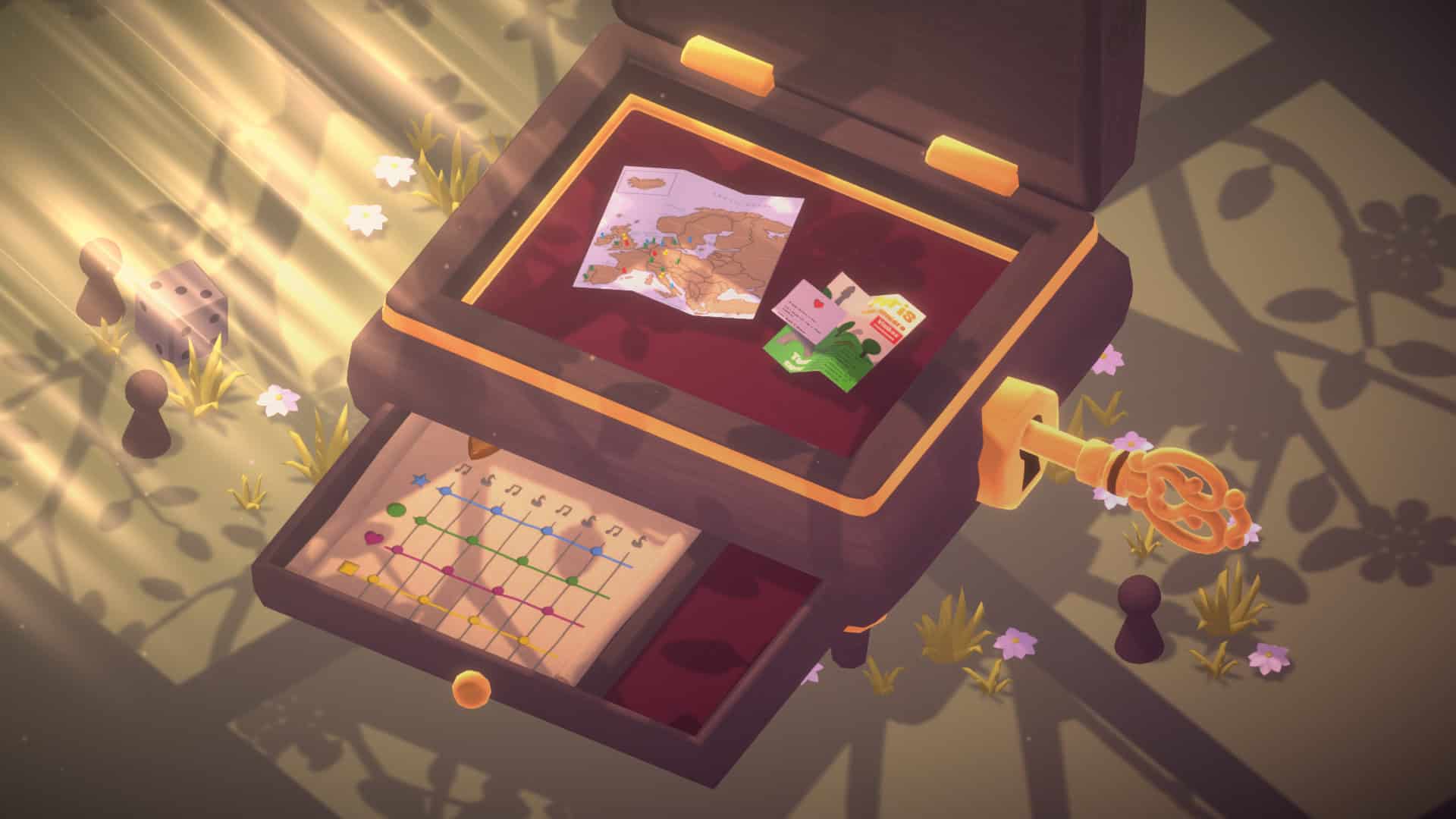
Swan Song is a cosy puzzle game developed by Business Goose. A studio from Hasselt, the capital of Belgium’s friendliest province: Limburg. Set in a magical music box, the game involves solving puzzles to guide a swan meeple across a tile-based grid. Some tiles are coloured pink, blue, yellow or green and can be activated to alter the swan’s automatic movement. Sliding into another position, turning, disappearing, and much more. Every movement on the board is controlled by a musical sheet found underneath the game board, with bars of the same colour as the respective movable tiles. It is your job to place musical notes on the sheet to manipulate the flow of movement and get the swan safely to the other side.
The game is split into nine chapters, which tell the story of a family of three. Between puzzles, you get a glimpse into the lives of these people and see how they deal with grief. It’s important to note that the story could happen to any ordinary family, so if you’re not interested in stories about loss, you might not find it appealing. However, bear with me, because this game is exceptional in more ways than one.

Musical maestro
In terms of gameplay, Swan Song is pretty straightforward, which isn’t necessarily a bad thing for a puzzle game. Level concepts are introduced gradually, starting with a standard sliding tiles and then adding new elements to the mix. These include rotating tiles and other moving objects. However, things get crazier and crazier, eventually involving catapults that launch your swan and hunters that shoot it if you activate their corresponding note at the wrong time. At the start of the game, everything is easy to manage because the puzzles only take a few steps. However, around the halfway mark, I found myself thinking in beats in the note sequence rather than skips on the board. Creating a musical flow. This was necessary because the notes you can put on the sheet change as well, adding ghost notes that only trigger the second time around, glass notes that break after one use, and combined notes that can only be placed together. This refreshing change of pace made me retry some levels a couple of times, knowing I would fail halfway through, just to see the music play out and visualise the sequence. There isn’t a star system or a perfect score, so failure isn’t punished; just take your time and relax. It’s like doing a newspaper Sudoku on a lazy Sunday afternoon.
I found myself thinking in beats in the note sequence rather than skips on the board. Creating a musical flow.
However, the strongest aspect of this puzzle game isn’t the sheer abundance of mechanics. It is how they are used. Swan Song is a prime example of excellent level design, as a mechanic will appear, gradually become more challenging, and then disappear once you have mastered them. This sometimes made me yearn for more, but it keeps everything fresh by rotating the key mechanics, forcing me to learn new patterns. Best of all, some mechanics return from time to time to interact with what you have learned in previous levels in a new and different way. For example, the hunters disappear once you have learned how to deal with them. They then reappear ten levels later, showing a new interaction with the disappearing tile, a mechanic introduced earlier.
In my three hours of gameplay, I never once felt the urge to turn the game off due to boredom or frustration. In fact, I completed Swan Song in one sitting because of the game’s other strength: its emotional storyline.

Moving on
My praise for the gameplay mechanics might be high, but my appreciation for the story is equally great. Without giving too much away, Swan Song is a story about death and loss. The music box that you play is a gift from a father to his daughter after his wife dies of a disease. Due to the magical nature of the box, artefacts from throughout the grieving process start to appear, including medical documents and memories of the parents choosing their daughter’s name. This gives you insight into their lives without ever seeing them interact directly. The closest thing to a conversation is voice recordings of past interactions. I’m not usually moved by games; I hardly ever feel sad when a character goes through something. But even though I only saw glimpses of these people’s lives, I had to fight back tears by the end when I saw how the story was turning out. A big part of this was the vocal performances by the main cast, who I discovered in the end credits, were mostly first-time voice actors. It was great to hear them embody this ordinary family, and I hope to hear them all in another project soon if they can deliver such quality consistently. The death of a family member might hit close to home; I think that’s what struck an emotional chord with me initially. But, as hard and confrontational as some things might be, it’s worth persevering. The five minutes you spend between reading a mundane yet heartbreaking letter and solving your next puzzle might create a gaming memory that sticks with you for a while.
Conclusion
Swan Song is a masterfully composed puzzle game. The level design, with its fun and engaging mechanics, is a masterclass in game design because the concepts are gradually introduced and made more challenging. These concepts synergise beautifully and never overstay their welcome. The emotional story of grief and loss presented between puzzles brought tears to my eyes. Although it is a difficult subject, the subtle way it is presented through family artefacts and the excellent voice acting will ensure that Swan Song will stick with me for years to come.
