
After almost nine years of silence, everyone’s favourite green-skinned cynic is back. Styx: Blades of Greed marks the long-awaited continuation of the stealth saga that began with Styx: Master of Shadows in 2014 and continued with Styx: Shards of Darkness in 2017. Developed by Cyanide Studio and published by Nacon, this new chapter doesn’t attempt to reinvent Styx; instead, it sharpens his dagger, polishes his sarcasm, and pushes his stealth playground into more vertical and open territory. But after nearly a decade, is it enough?
From Pawn to Power
Gone are the days of Styx merely working for others. In Styx: Blades of Greed, our goblin anti-hero takes control of his own destiny, commanding a crew from aboard his zeppelin while chasing a powerful new resource: Quartz. The story cleverly bridges the gap toward the events of Of Orcs and Men (2012), gradually shaping Styx into the more complex figure we know from that timeline.
Narratively, this is very much a direct sequel. Helledryn and Djarak return, new characters flesh out the world, and Styx himself remains the sarcastic, cynical narrator we’ve come to love. His one-liners still land, and the voice acting carries his personality with confidence. Importantly, the game references past events without alienating newcomers. Veterans will appreciate the callbacks; newcomers get enough context to stay grounded. The central focus revolves around Quartz, a dangerous power source that Styx can now absorb, unlocking new abilities such as Mind Control and Time Shift. These powers complement his familiar Amber-based toolkit, like invisibility and cloning. It’s a smart narrative excuse to expand gameplay while staying consistent with the established lore. While the plot does its job and pushes Styx’s character development forward, it rarely surprises. It’s solid, cohesive, but not groundbreaking… much like the game itself.

Vertical ambition
One of the biggest evolutions in Styx: Blades of Greed lies in its level design. The three main explorable areas: The Wall (human bastion), Turquoise Dawn (orc territory), and the ruined elven capital Akenash, each have a distinct visual identity. The Wall stands out in particular, with its towering architecture and multiple high vantage points enhanced by vibrant lighting effects. The verticality isn’t just cosmetic; it defines how you approach objectives. Missions feel multi-layered, offering various infiltration routes that reward scouting and patience.
Traversal has been meaningfully improved. A grappling hook and glider reduce backtracking and encourage fluid movement across rooftops and cliffs. Fast travel points via balloon wharfs streamline navigation within each zone, while the airship hub ties everything together neatly. There’s even a light Metroidvania-style progression system, where newly acquired tools open up previously unreachable areas. It’s not revolutionary, but it adds structure and incentive to revisit locations.

Stealth, not Slaughter
Let’s be clear: Styx: Blades of Greed remains a stealth-first experience. Combat is intentionally sluggish and ineffective; charging headfirst into enemies is rarely viable. But unlike some hardcore stealth titles, mistakes here aren’t automatically punished with a reload screen. Improvisation is possible. Get spotted? You can escape vertically, use invisibility, drop a clone as a distraction, or simply outmanoeuvre your pursuers with smart platforming. This flexibility makes the experience far less frustrating than many genre counterparts. Planning is still crucial, scouting patrol routes and timing movements remain essential, but the game allows recovery, which keeps tension high without becoming punishing.
The returning crafting system further broadens your options. Blowdarts, acid vials, glass bottles and other tools add layers to each stealth puzzle. Combined with Quartz abilities like Time Shift and Mind Control, encounters can be approached in multiple creative ways. However, here’s where the cracks begin to show.
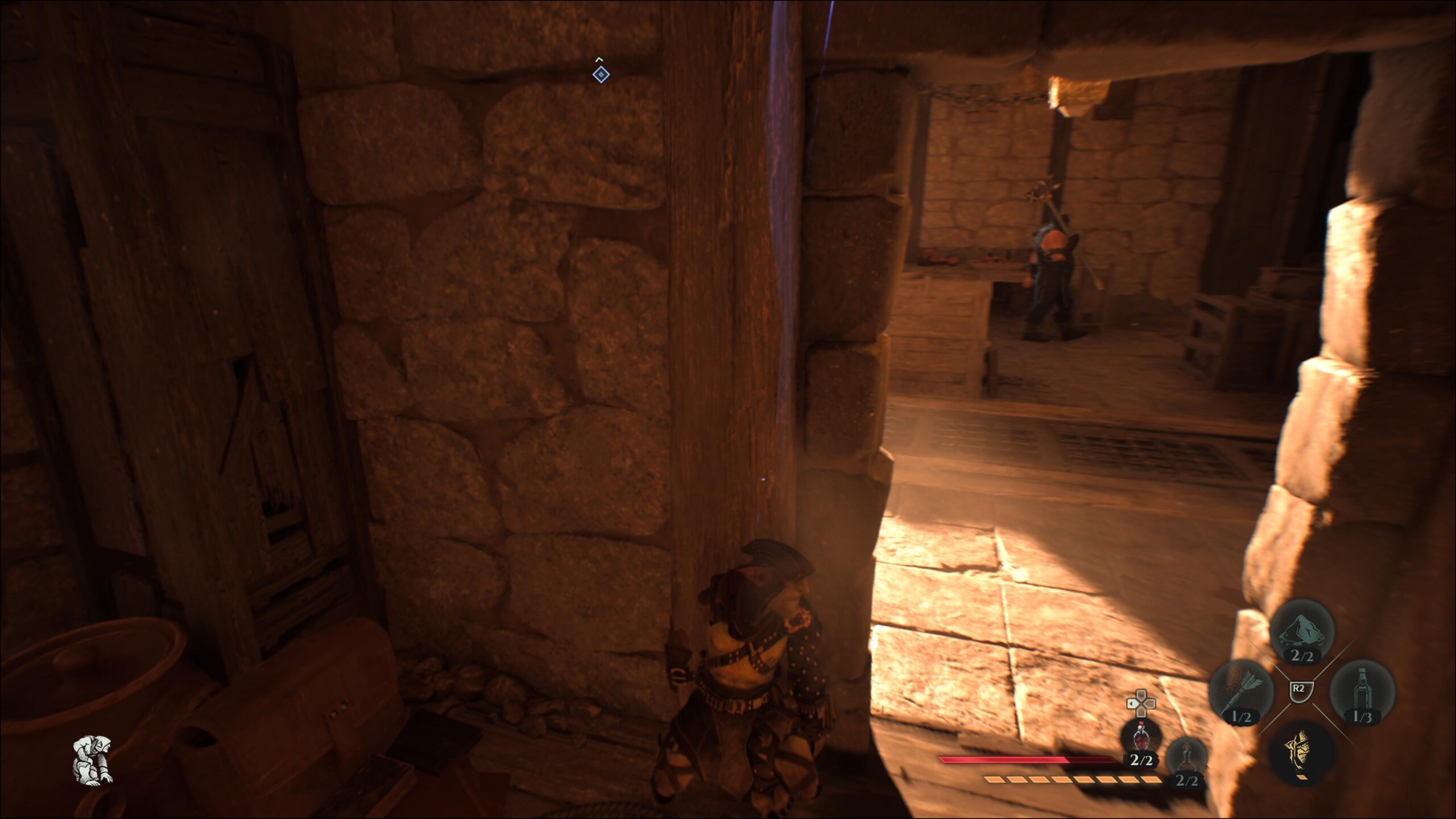
After several hours, the gameplay loop starts feeling familiar… perhaps too familiar. The structure of scouting, isolating, eliminating, and progressing repeats itself with limited variation. The tools are plentiful, but the scenarios rarely demand dramatically different strategies. The freedom is there, yet the game doesn’t consistently push players to experiment beyond their comfort zone. It plays great. It just doesn’t evolve enough over time.
Looks good, sounds ok
Each of the three main regions maintains a distinct atmosphere, with lighting and environmental detail doing much of the heavy lifting. The Wall’s vertical cityscape is visually the strongest showcase. Turquoise Dawn feels earthy and organic, while Akenash leans into sombre, ruined elegance.
Audio is functional but rarely stands out. Styx’s voice performance carries personality, while the broader cast is serviceable. The soundtrack heightens tension when needed, but doesn’t leave a lasting impression.
Conclusion
Styx: Blades of Greed successfully brings the goblin anti-hero back into the spotlight with refined mechanics, strong vertical level design, and flexible stealth gameplay. The addition of Quartz abilities adds fresh tactical options, and the semi-open environments encourage exploration more than ever before. However, while the game plays smoothly and offers a consistently enjoyable stealth experience, it rarely dares to surprise. The core loop begins to feel repetitive, and the innovation expected after such a long hiatus simply isn’t fully realised. For fans of the series, this is a worthy continuation. For the genre at large, it’s a solid entry rather than a defining one.
7/10
tested on PlayStation 5
