
When I decided to upgrade to the PlayStation VR2, there was one game I wanted to test the most and that was Horizon: Call of the Mountain. Is this the game that will convince people to buy the rather pricy PSVR2? Let’s find out!
A gorgeous world
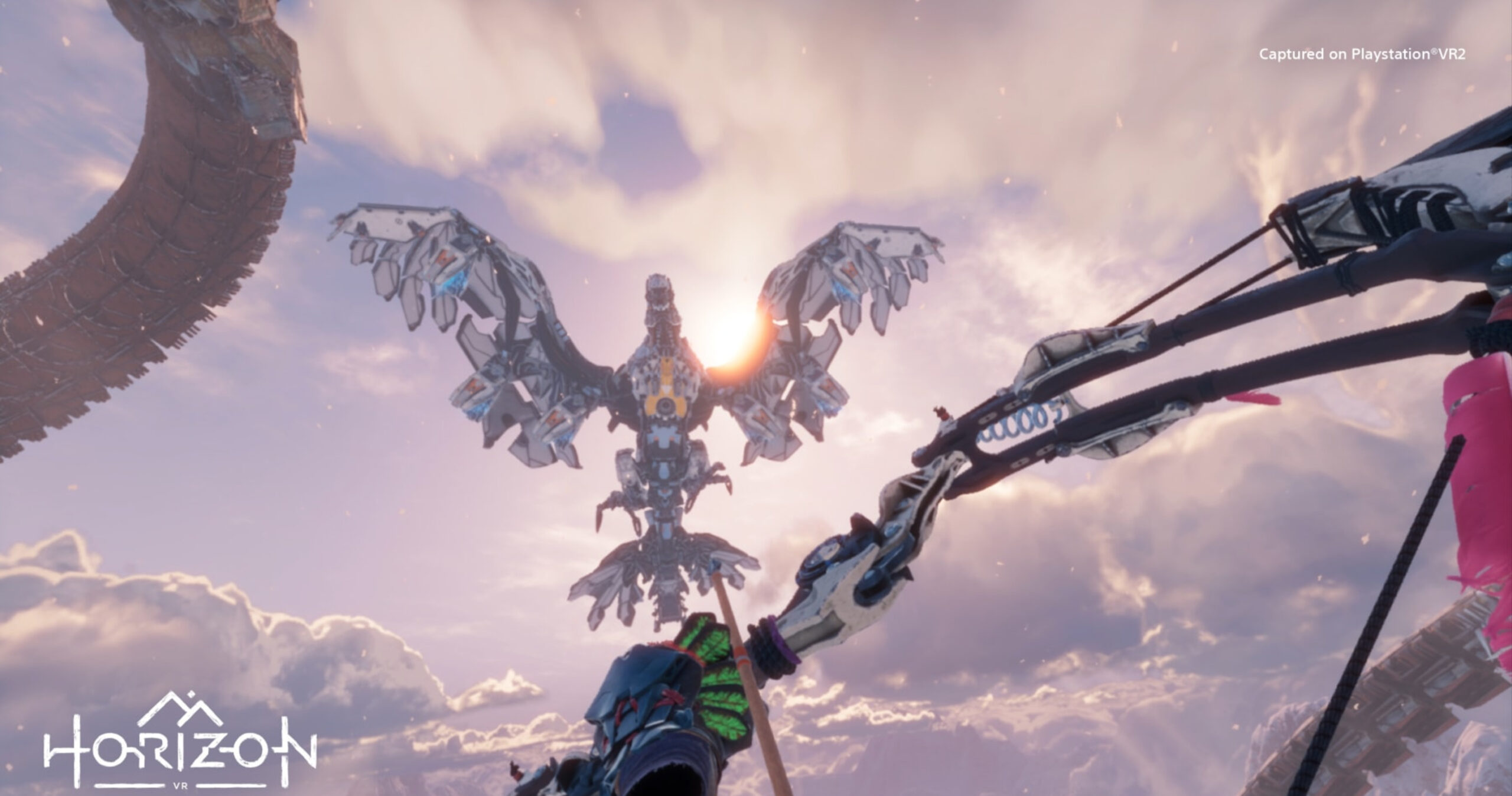
The moment you start Horizon: Call of the Mountain on your PSVR2, you’ll be blown away by its graphics. It’s clear that this game was created to showcase how much better the PSVR2 is compared to its predecessor. The graphics are unreal and without a doubt the best I’ve seen so far in a VR game. It all looks so realistic and all of the small little details elevate the immersion. You’re not just playing a game, you’re part of the game. During the opening minutes, you’ll find yourself on a small boat maneuvring through the gorgeous jungle of Horizon. After some peaceful traveling, you’ll encounter some of the iconic creatures the world of Horizon has to offer and it all feels overwhelming and exciting. I played it in awe and couldn’t get over the fact of how good it all looked. It’s a huge leap forward compared to the first PSVR and I couldn’t wait to start my adventure for real. In this one, you’re not playing as Aloy but as Ryas, a former Shadow Carja who’s pleading for forgiveness by clearing a special mission for Aloy and the Sun Carja. The story doesn’t go much deeper than that so don’t expect a lot of extra lore. There are some familiar faces on your way to victory but don’t expect an epic story.

Time for some climbing
Once you’re over the gorgeous graphics, it’s time to explore the gameplay mechanics. The game allows you to adjust the way you control your character in a couple of ways, after experimenting I preferred eye-tracking with traditional stick controls. This allowed me to walk around without too many hard breaks while the eye-tracking did wonders for my accuracy in combat, it felt very natural and I love the fact that the team inserted a couple of control options so everyone can find their preferred style. What I did most in the game was climbing virtual mountains, no surprise since it’s literally in the title, and being a climber myself, I loved the realistic approach to climbing. The holds are all realistically created and the way you grab them really adds to the level of realism. That being said, as a climber I did feel a bit wrong to only use my hands and arms, and my position on the rock wasn’t always as realistic as it should be. This took me out of the immersion a couple of times, of course, I can’t expect the same thrills as real climbing but it’s rather painful to see and experience everything that’s off about the climbing segments. If you’re not a fan of climbing, you won’t enjoy this game that much since there’s a lot of climbing going on, at certain points, it even reminded me more of a climbing simulator than a Horizon game. A bit of an odd choice because you’re constantly extremely close to the rock you’re climbing on, which is a shame since the rest of the world is masterfully crafted. I don’t get why the developers decided to let you stare at brown rocks up close for so much of the gameplay.

Immersive combat
Where the climbing segments let me down a bit, the combat segments worked better than anticipated. You’ll fight with your bow and arrow most of the time and this works like a charm. The realism of the bow and arrow is extremely accurate. By moving one Sense Controller to your back, you can grab an arrow that you can easily load and pull onto your bow. Since the PSVR2 tracks the movement of your eyes, the accuracy of your shots is as close to the real deal as it gets. It’s all pretty amazing and it truly shines some light on the potential of the Sense controllers in combination with the eye-tracking of the headset itself. Everything about combat feels natural and the HUD is crafted with a lot of attention. You can see your health on the small feathers of your left hand and you can change your arrow type by flicking your bow which all adds a lot of ease in controlling and managing your character. It’s in these moments of realism that Horizon: Call of the Mountain highlights the potential of the PSVR2.
In those moments of combat or free exploration where you start picking up apples in order to eat them and heal yourself lies the true power of the game. Without explaining all of the gameplay mechanics, you automatically know what to do because you actually became part of this gorgeous world. The immersion of it all really blows my mind, it’s even that good that I needed to adapt to my ‘real’ environment again once I stopped playing this. The potential of the PSV2 is insane and in the better moments, Horizon: Call of the Mountain is unlike anything else I played before. It’s a shame the gameplay variation isn’t as balanced as it should have been.
Conclusion:
Horizon: Call of the Mountain certainly has a lot of amazing moments which showcase the true power of the PSVR2 where you’re completely immersed in a gorgeously created virtual world. Combat and exploration are near perfect but the amount of rock climbing takes you out of the flow. If the team managed to balance the gameplay a bit more, this would have been a masterclass in VR. As it is right now, this still is a must-have for PSVR2 owners but it could have been so much more than just that.
