
Welcome to our Dreadful review of Metroid Dread! So, I got that one out of my system. Metroid Dread is the latest installment in the Metroid Quintology, in which the last entry is over 20 years old! Of course, that’s still not as old as me, but still, it’s a long time for a game to receive a new addition. Dread is a direct sequel to Metroid Fusion, currently only available on the Nintendo Gameboy Advance (and the late Wii U eShop), and it’s one of the best Metroid games I played, just not the best Metroidvania. Hear me out, ok?
Metroid Dread is an action-adventure game developed by MercurySteam and Nintendo EPD. You control bounty hunter Samus Aran as she faces a robotic enemy on the planet Z.D.R. Like, in previous installments, it retains the side-scrolling gameplay of the last 2D Metroid games and adds stealth elements. Before diving into the mechanics of Dread, you can either check out Lander’s Hand-On on the Switch OLED or read about the history of Dread’s development. Otherwise, skip to the … paragraph.

Dreadful History
Dread was conceived as a Nintendo DS game in the mid-2000s but was canceled due to technical limitations. However, industry commentators expressed interest in a new 2D Metroid game and listed Dread in their “most-wanted” lists. After their work on Metroid: Samus Returns in 2017, Metroid producer Yoshio Sakamoto appointed MercurySteam to develop Dread, the first original side-scrolling Metroid game since Metroid Fusion (2002). Nintendo announced the game at E3 2021, and boy are we happy that they soft canceled the game back in the 2000s.

Sakamoto attempted to have Dread developed for the DS at least twice, but the technology was too limited to create his envisioned game. The first attempt was made around 2005, while a second attempt was made around 2008. Finally, a playable prototype was shown to Nintendo Software Technology and Nintendo of America staff at E3 2009. The project was reportedly not titled Metroid Dread and had an art style similar to Metroid Fusion. However, the prototype did not meet Sakamoto’s expectations, so development was halted. A significant reason for this was that Sakamoto’s desire for an intimidating, unsettling antagonist was challenging to achieve with the D.S.’s limited hardware.
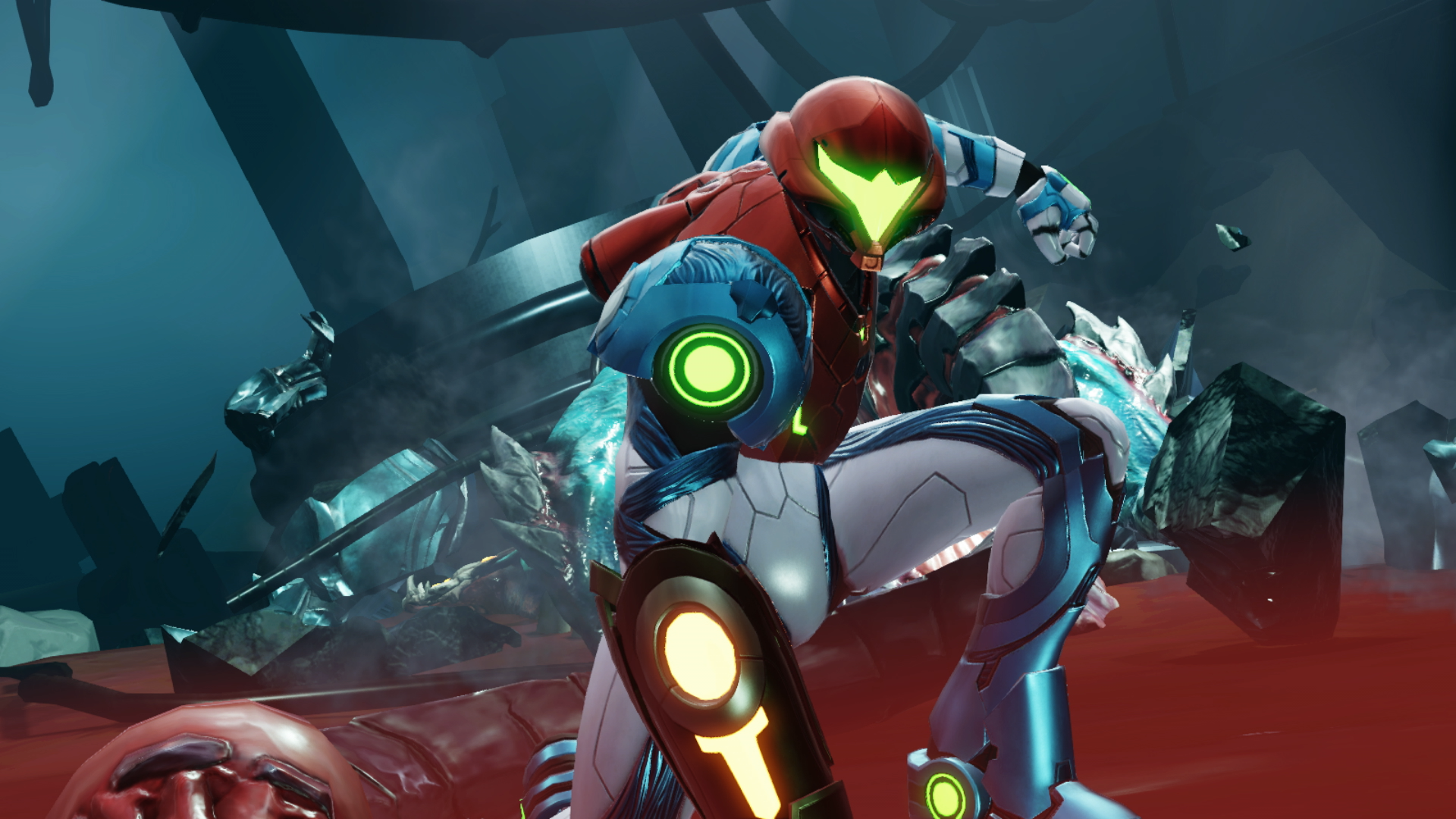
Fast-forward to 2010; Sakamoto confirmed that Dread had existed but said Nintendo would “start from scratch” if they returned to it. He also stated that they were “waiting and watching and reading the comments to see what people are interested in before we make any comment on the project.” In other interviews, he denied that the Wii game Metroid: Other M (2010) and the Nintendo 3DS game Metroid: Samus Returns were connected to Dread. Finally, in May 2010, I.G.N.’s Craig Harris said that the story for Metroid Dread was complete and that Nintendo was able to “bring it back at any time.”
Dread Reports
It took Nintendo 10 years to ‘revive’ Metroid to its original 2D glory, bringing an epic conclusion to the Metroid saga. And to build up the hype, they released a total of 10 volumes called the Metroid Dread reports, giving away snippets of the story and talking about certain aspects of the game. This gave a great insight into the thematic of Dread and built up my hopes for the game even more.

To do a quick summary of the plot would be an impressive feat, but I’m going to try to give the highlights for those unfamiliar with the reports of Metroid as a whole:
The Galactic Federation receives video evidence that the X, a dangerous species of parasite that can mimic any creature it infects, still exist on the remote planet of ZDR (the X having thought to have gone extinct after the events of Metroid Fusion). They dispatch research robots called E.M.M.I. (Extraplanetary Multiform Mobile Identifier) to ZDR to investigate, but lose contact with them shortly after. The Federation then sends Samus Aran to ZDR to investigate. Upon arriving at ZDR, Samus encounters a Chozo warrior who defeats her in combat and strips her of most of her abilities. After waking up, Samus is instructed by her ship’s computer, Adam, to escape to the surface of ZDR and return to her ship. While exploring ZDR, Samus is attacked by one of the E.M.M.I. robots, which have been hacked and are now hostile. She escapes and discovers one of the planet’s central units, from which she absorbs a mysterious energy that allows her to temporarily gain the ability to destroy the E.M.M.I. and regain some of her abilities in the process.
Any more would be a spoiler, in my opinion. The strength of a good Metroidvania is all about finding out the pieces of the puzzle by yourself. Luckily Dread is very good at doing so since it’s the strength of the genre to give the player no helping hand whatsoever. However, remember when I called Dread not the best Metroidvania I played? So let’s elaborate a bit.

Dread Gameplay
Metroidvania is a term used to describe platforming games that feature a single large, interconnected map, generally with discrete rooms or sections. Not all areas of this map are available at the start, often requiring the player to obtain an item (such as a weapon or key) or a new character ability to remove some obstacle blocking the path forward. Often, this item is protected by a boss character, providing story-driven challenges throughout the game. Maps are non-linear and often require the player to traverse the map multiple times during the game. Weaker monsters will inhabit other parts of the level, re-spawning when the player revisits those rooms and often can be defeated to gain health, ammunition, or experience points.

With the birth of the indie genre, the Nintendo Switch (and other consoles) are flooded with high-level Metroidvania that capture the essence of Metroidvania’s better than Metroid Dread. The gameplay in Dread is very fluent, with Samus moving through the different areas like a figure skater in the Winter Olympics. The sites look very lively and are distinctly different from one another, even featuring elements that make you wonder if you are still playing a 2D game. However, Dread feels like you’re playing a Metroidvania on Time Attack mode – I read online that many people struggle with the difficulty setting of Metroid Dread, and I’m confused. The complex parts are the bosses for sure, and some of the puzzles to gain upgrades – but the general difficulty feels like kindergarten compared to games like Salt & Sanctuary or specific aspects of Hollow Knight.
Both these games I mentioned above have a great deal of freedom – yes, you have to pick up certain items and defeat certain bosses. Still, you can skip certain areas or complete them differently than the developers initially developed. Samus always has one path to the next area, and yes, you can traverse to get upgrades or missed sections, but you will have to walk from A to B to beat Crow-boss X to get to Brain-Blob-Z. The whole Metroidvania feel feels a bit like a hollow sense of freedom, open world, but … then again … not really?
Dread Abilities
Does this mean Metroid Dread is a ‘bad’ game? No, the opposite! It’s one of the best Metroid games I have played in years (pun intended). Like I mentioned above, Samus’ movements are incredibly fluid and combined with her wide range of abilities, you are in for a treat. Some old favorites are making a comeback, but the new stealth options to avoid the E.M.M.I.’s are also pretty neat. Dread keeps itself fresh and challenging by gradually unlocking upgrades, like the morph ball and plasma beam. Even though the map is enormous, you have a very detailed look at each region, which helps you seek out certain hidden clues. If you still can’t find them all or are lost on finding access to a specific item, fret not; the game offers a sensor ability that can track breakable blocks, etc., just before reaching the final boss fights of the game. This should help rack up some upgrades, which helps fight off the final bosses in the game.
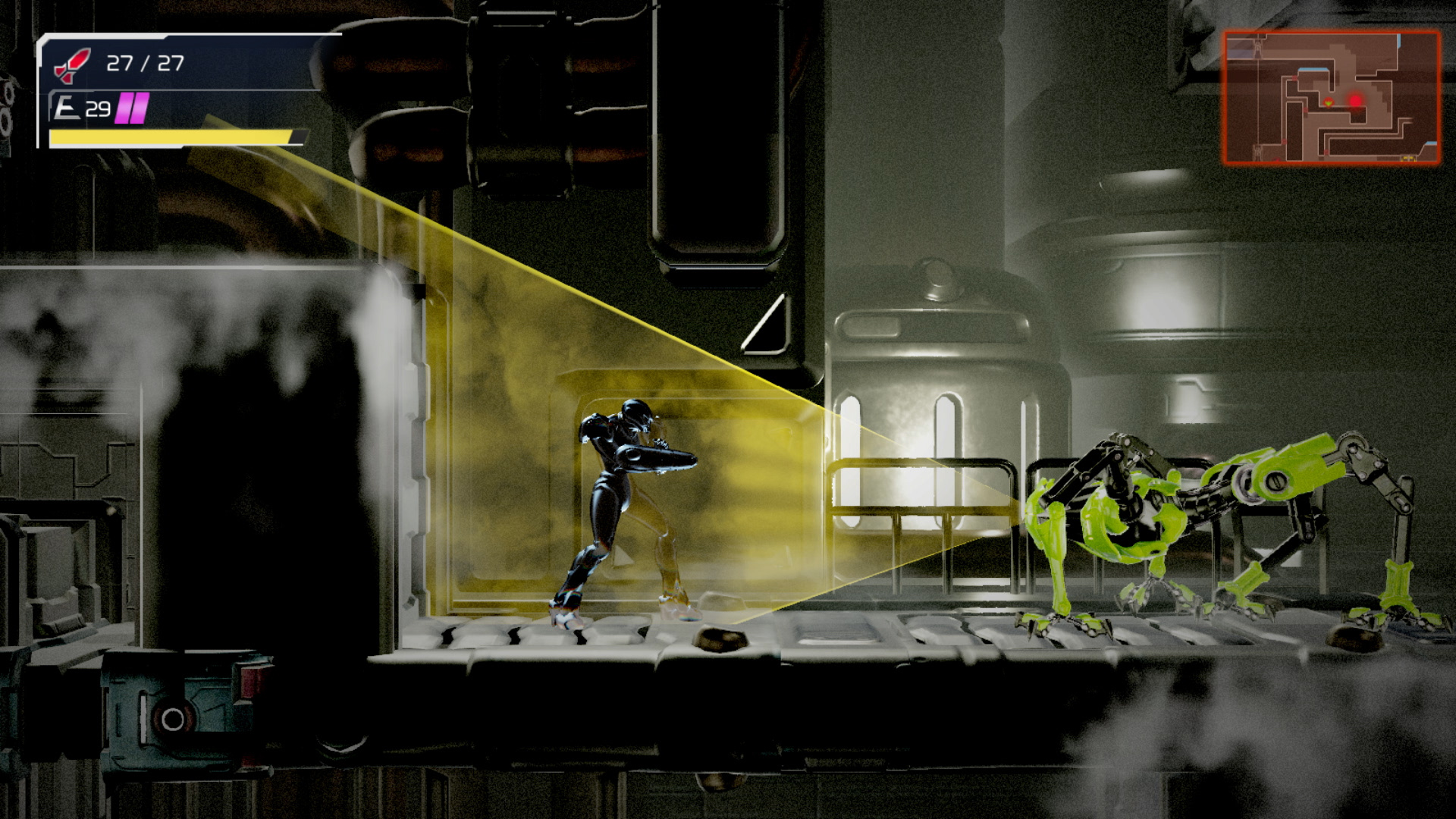
Those seeking a game with much exploration and a casual fighting game are at the wrong address with Metroid Dread. When you gain more upgrades, the fights with both the environment and the sub-bosses and bosses become more challenging and require some exquisite platforming skills. Since most beams, bombs, and rockets are hidden on the shoulder buttons, you may want to dash but instead, fire a missile. So don’t be discouraged by a Game Over screen – I have seen plenty of them – and not only with the E.M.M.I.’s. In which I must applaud Nintendo for not overstating that an encounter with and E.M.M.I will result in a 99% chance of death. I do, however, highly compliment the counter-move by Samus on both the E.M.M.I. as the creatures found in the wild – it gives high dopamine feel towards the combat since most of the time, this is a one-shot kill with high rewards (and high risk).

Dread Art & Soundtrack
Before spin jumping towards a conclusion, I want to spend a brief moment on both the artwork and soundtrack of Metroid Dread. The environments all look vibrant and pack a serious punch of awesomeness. Each region has its features, ranging from volcanic to jungles, ice, and palace themes. It fits the Metroid series, and it feels like returning home from a long trip (not counting Metroid Prime). The same goes for the soundtrack, which I listened to while writing this review. It fits the gameplay exceptionally well – and the E.M.M.I. room soundtrack feels dreadful (ok, last one). You should buy this game just for its artwork and soundtrack – and that’s one of the things that sets it apart from the Indies I mentioned.
Conclusion
Metroid Dread is the conclusion in a game series that spanned over five different titles, starting on the N.E.S. (or is it). It’s a fitting end for a series and feels right at home with the other Metroid games in the Metroid pantheon. Metroid Dread, however, made me long for the old Castlevania games I’m going to review after writing this one – which will make me long for a new Castlevania as well (Konami, listen up and do this in Dread style, oke?). Metroid Dread is an excellent Metroidvania, a perfect labyrinth science-fiction game, but still not the best Metroidvania out there. It lacks aspects that some other Indies polished and refined in their way. Is it still one of the best ‘hardcore’ releases of Nintendo this year? By a longshot. I can’t shake that dreadful feeling I had when I looked at the timer when I entered the final stages of the game, only ticking at a mere five and a half hours.. that doesn’t feel… very Metroidvania does it?