
When one talks about one of the most heard of revolutions of modern times, it’s probably the French Revolution. It’s actually not even modern since we classify modern as everything after 1800>, but hey, let’s not nitpick too much. The French Revolution did propel Europe into a new age of modernism though. So, is We. The Revolution the ultimate revolution simulator? Let’s find out. Or like Domela Nieuwenhuis once said, you can’t make an omelet without breaking some eggs (famous Dutch Communist revolutionary).
Revolution!
Paris, 18th century, the times of the French Revolution. You control a Judge – an alcoholic and a gambler – of The Revolutionary Tribunal. His objective is to preside over court proceedings, judging people brought in front of him – revolutionaries and their enemies, criminals and ordinary citizens. Along the course of the story, the protagonist will be expanding his influence over 18-century Paris, but at the same time will be forced to fight for the lives of his family and his own. Or, so is the premise of We. The Revolution. And that’s basically what you do.
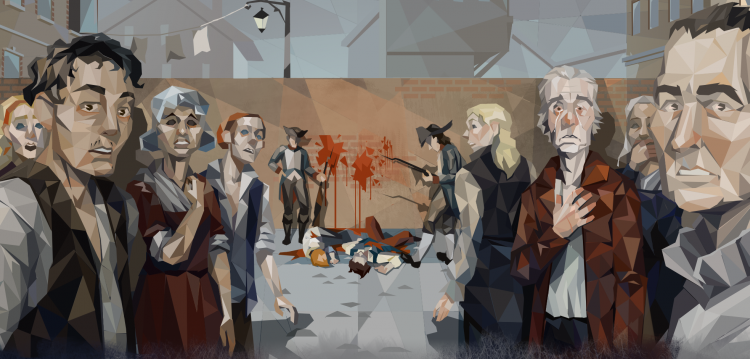
Game or history lesson?
We. The Revolution is a text-based adventurish game – with some strategic and even management factors build in. With each case, you are to judge criminals and counter-revolutionaries, but also innocent Parisians. The Judge has to peruse case files, study evidence, and interrogate the defendants in a way that ensures either justice… or the player’s profit. Each decision will have an impact on the factions in Paris, the player’s family, or the player themselves. The game will reward clever decision-making, allowing the player to – for example – outwit and defeat more powerful enemies.

Layers:
But hey, it’s France during the French Revolution. The monarchy is crumbling, the king is trying to flee the country and Robespierre is trying to put in some overtime with his new toy, the Guillotine. When you are presented with a case, you are given a brief summary of the case and you can see how the jury would vote. Going along with the jury can win you influence with the people, but can hurt your relations with the ones in power. To influence the public opinion, you can interrogate the witness, by connecting the dots of what happened. Was there an altered motive? Was the victim, really the victim? Was there a situation in which the perpetrator could not have been, although a certain witness states it as such? By deducing these options, you will get questions to ask the defendant. Each question will grant points towards acquittal, prison or death sentence.
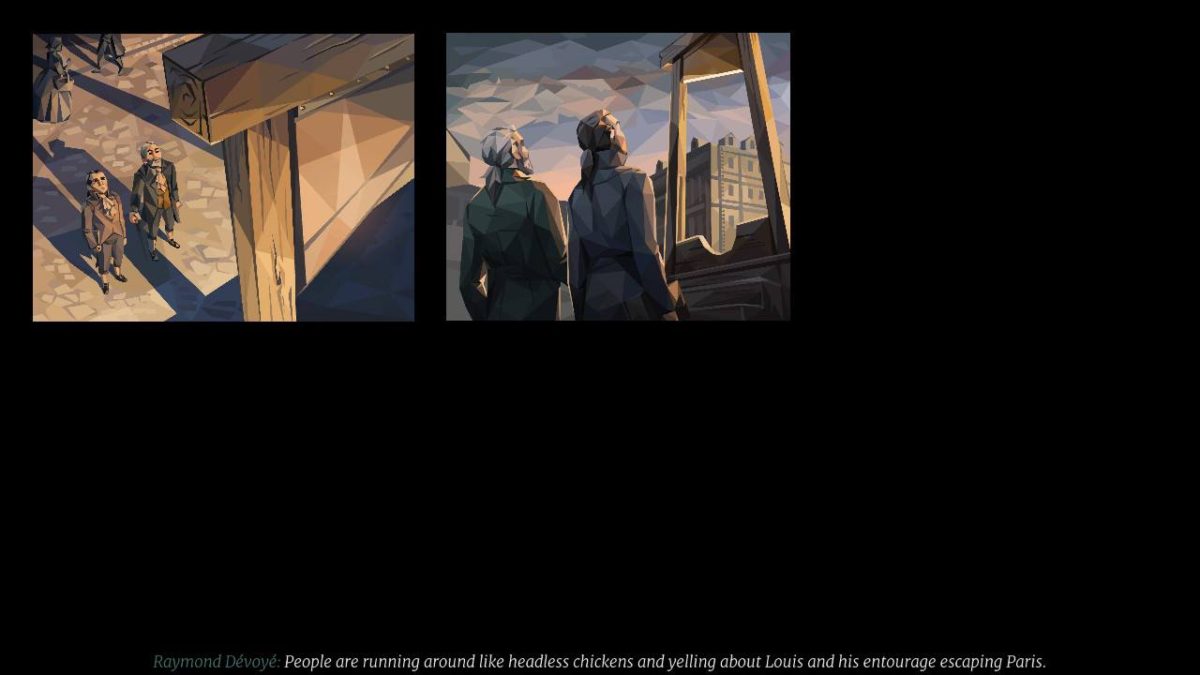
When you are sure which verdict to deliver, sign the papers and fill in the verdict. Once the verdict is signed, the public opinion and the opinion of the ruling class will shift towards your decision. This can then again change the storyline, since choosing the peoples side strengthens them and will make the revolutionary sound much more clear. You can even choose to attend revolutionary marches with them, further distancing yourself from your political friends, but bringing you closer towards your family (for example).

We. The Revolution is a layered game and not a game for everyone. To truly enjoy the game, you will need some background information on France during the French Revolution and the periods following after under the rule of Robespierre and such. Sure, you can play it without this knowledge, but you won’t get the full ‘French Revolution’ experience the developers are aiming for. Since the game is really heavy text-based, it can be hard to play it in handheld mode only, since the writing is a bit tiny by time. This did not really change my feeling about the game though. If we gave a game like Phoenix Wright a historically accurate and more serious make-over, we would probably get something like We. The Revolution – and that’s a big compliment.

Revoclusion:
So, if you are into interactive storytelling games, with multilayered decision making and even some Sim City or Tropico/Anno style management options, you should really pick up this game. It looks good, feels good, but is just not for everyone. Luckily, as a historian, I really enjoyed the fine line between fiction and non-fiction.
