
Take the survival aspect and inject it with a Nordic background, you’ll create “Dead in Vinland”. This game is a simulation of “rebuilding” what you’ve once lost and try to survive while doing so. After the events of a raiding party, a Scandinavian family has been forced to leave their homeland and set sail far away from the desecrated land. If the raiding party wasn’t enough, their ship is caught in a storm and the family fear for the worst. Their ship crashes and the family have washed ashore on an island in the middle of nowhere. With knowing nothing of their whereabouts, it’s up to Eirik to guide his family and build up society once again…

Building up a base of operations from scratch might be harder than you think. Dead in Vinland’s system is all about monitoring your family members, giving them a task while keeping an eye on their mental health and primitive needs. Micromanagement is very important if you want to maintain the stability of your survival camp. The game starts you off with 4 characters that can take up tasks (as you see fit) and help rebuild your society. Along the road, you’ll find new people to recruit and you’ll have the chance to expand your community. Each character will offer different skills and traits, giving you the opportunity to build up your society as you see fit. While expanding your community is a good thing, you’ll also have to gather a lot more resources to fulfill everyone’s need. You’ll have to make a lot of decisions that probably won’t be appreciated by everyone. As a leader, it’s your job to take care of your workers that form the pillars of your base of operations.
“Hostile elements are right behind the corner.”
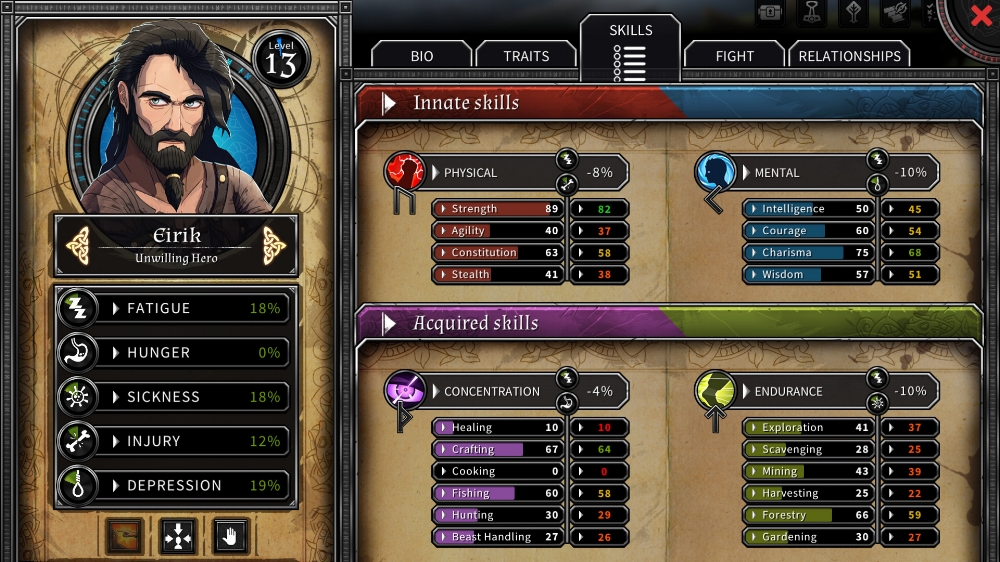
Every community member has a sheet of statuses. This sheet shows off sickness, injury, fatigue, … and many more. You’ll have to watch the health of your members very closely if you don’t want any surprises that could ruin your organization. Even though all of these elements might scare the player off due to its complexity, the game has a great tutorial that’ll help you connect the dots. It’s all about what comes first and what comes second. You can’t fix all of these statuses at once and be done with it. Every decision you make or every task you let them fulfill will have a positive/ negative impact on your character’s total health. The game does a great job in keeping you at bay with all of these variables to deal with. Seeing the sunrise up again with minimal casualties or disruptions in the balance should always be a thought in the back of your mind. You’ll have to consider that everything in the environment can be a threat to your society, going from weather happenings to the inhabitants of the island. Hostile elements are right behind the corner.

Dead in Vinland works with a turn-based feature. You give out 2 tasks per person each day and end your turn. The moment a new day rises, the game shows the progression of your community’s tasks. Every decision you make will have consequences. Thinking ahead is the only way to make your camp successful. Each character can become good in a certain “job”. The better a person handles a certain job, the more resources he or she will gather. Gathering resources isn’t without harm. If a person is unfit for a certain job and you let that person do something they aren’t used to, you’ll have a greater chance of creating injuries. Injuries aren’t good and can easily become far more dangerous than you would think. Injuries need to be taken care of because they can become lethal. If an injured person goes out to fulfill its job and somehow the wound gets infected due to the area, it’ll probably be game over for that character. Now, this is something specific but with each task completed, statuses like depression and fatigue can rise. Characters can rank up and get skilled in a specific job which is a good way of RPG progression.
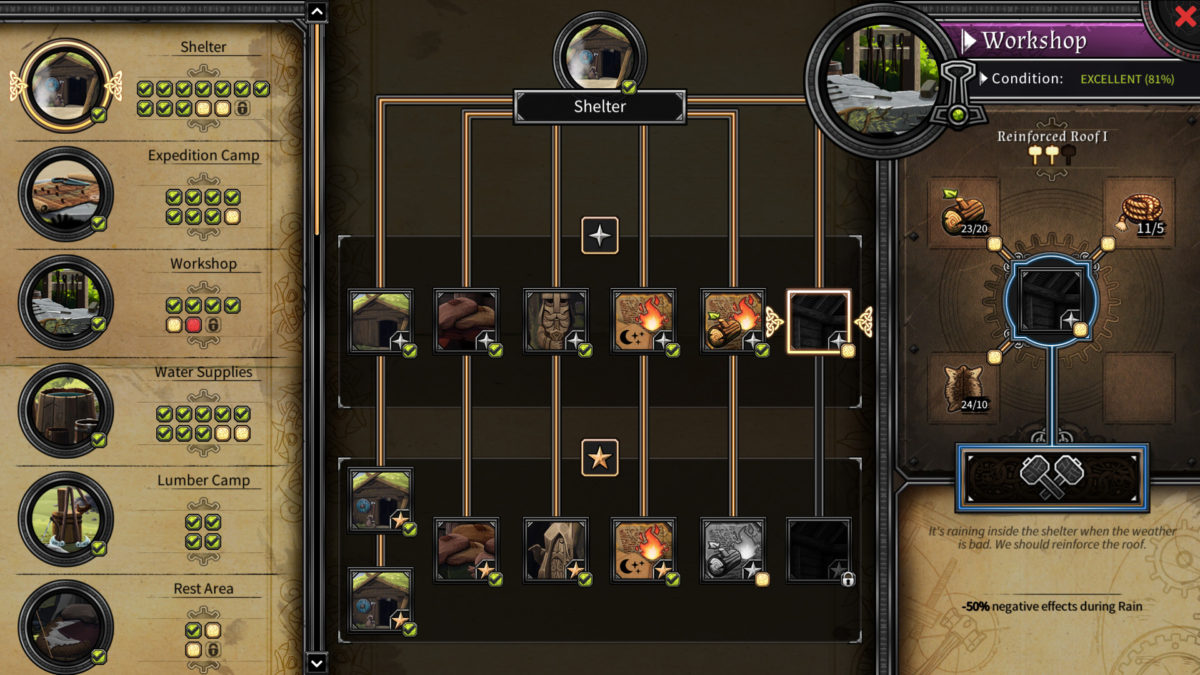
Building your society comes with a lot of managing. During your playthrough, you’ll be able to craft items and build areas to expand your camp and improve your “quality of life” by doing so. Each building has a talent tree which can be used to improve the building’s utility. This is fairly common in a surviving kind of game. While building up your town is very important, it’s also important to scavenge your surroundings to gather resources. Some scavenging areas will offer you opportunities to give the player a chance to gather even more resources, but this comes with a catch. These opportunities will have to be investigated to make sure it’s safe, of course, this is easier said than done. After the investigation, as a player, you’ll have to decide how to handle a certain situation. For example: open up a chest carefully or force the lock. Whatever you decide, it’ll have an impact on your game. There are also the basic needs of a village to consider. People need water to survive but as you probably already know, not every puddle of water is safe. You’ll have to purify the water in order for you to drink it. To purify water, you’ll need to use fire to sterilize it. To make a fire, you’ll need wood. Keeping the fire lit is also an important task to maintain the total health of your society. In other words, how you use the wood or other items, it’s all up to you but you’ll have to think it through. This is a big example of how the micromanaging system works and can lead to some difficult decisions. One decision or one wrong strategy during a battle can erase your camp’s progression very quickly.
Speaking of battles, there’s also the combat feature. Most of the time, a team of three of your members will have to defend society from outcasts or other threats. This combat feature uses the same turn-based mechanic as the game’s very core. During a battle, you’ll have to place your characters into 2 rows: melee and ranged. Some characters act better on certain rows but there’s always a chance that characters have to be moved out of their comfort zones. Each character has a health bar, action points, and skills. A character can perform actions as long as they have AP left. Getting a combat sequence is very random and doesn’t come along too often but it’s a nice change of scenery. Just make sure that you make the right moves because defeat will give your characters negative conditions.

Artistically speaking, the game looks great and I love the art style. The use of the color palette suits the game perfectly and sound quality is top-notch. I haven’t been confronted with a lot of bugs, so in my opinion, the game runs perfectly on the switch. If there’s one negative side of this game, it’s probably the randomness of it all. Of course, this is something you can expect from a survival game. In other words, you can spend hours building up your camp, but it takes a certain event to ruin your progress. Some encounters are inevitable, like the growing community problem for example. Expanding communities are great but you’ll have to feed every mouth, look into everyone’s health problems and this can be very challenging.

Conclusion:
I’ve enjoyed my time building up this society from the ground up. The moment you start the game is probably the hardest moment you’ll have to face during your whole playthrough. Why? You start from nothing, but you gain so many elements and bits of information that it can be challenging to put all of these elements in place. It takes a while before you get used to it all, but when the moment is there, you’ll enjoy every aspect of the game. Dead in Vinland looks great and it runs smooth. Yes, the randomness can be a problem for some, but this also gives the game a lot of replayability. Every action you take has a different outcome, so every startup will be different. This means for a lot of play hours.
