
Metroidvania usually comes in two types. There is one that blows you away from the start, mostly since they are household names. And then there’s a certain kind of game that doesn’t try to win you over in the first hour. There’s no big introduction or cinematic hand-holding here, you’re dropped into a strange world with a vague sense of purpose and left to figure things out on your own. Think Hollow Knight, but less cartoon-drawn? My latest addition to the Metroidvania list, GRIME II, falls squarely into that category. It’s the kind of sequel that expands, deepens, and occasionally stumbles under the weight of its own ambition (just like the beings you encounter in the game). And yet, despite those rough edges, there’s something undeniably fascinating about it, and it was hard to put it down.
Clover Bite
Before diving into what GRIME II does (and doesn’t) do well, it’s worth taking a step back. The original GRIME emerged from Clover Bite, a relatively small but creatively ambitious studio with roots in the Tiltan School of Design. That DNA is still very much present here: a strong focus on artistic direction, experimental mechanics, and a willingness to embrace the weird (in a good way). On the publishing side, Kwalee brings a bit more structure and scale into the equation. Known for backing a wide range of indie projects, Kwalee’s involvement is noticeable, not in a way that dilutes the vision, but in how GRIME II feels just a bit more “complete” in its systems compared to its predecessor. The result is a sequel that clearly builds on the cult success of the first game while pushing its identity further toward something more expansive and, at times, more accessible.
A world that speaks in whispers
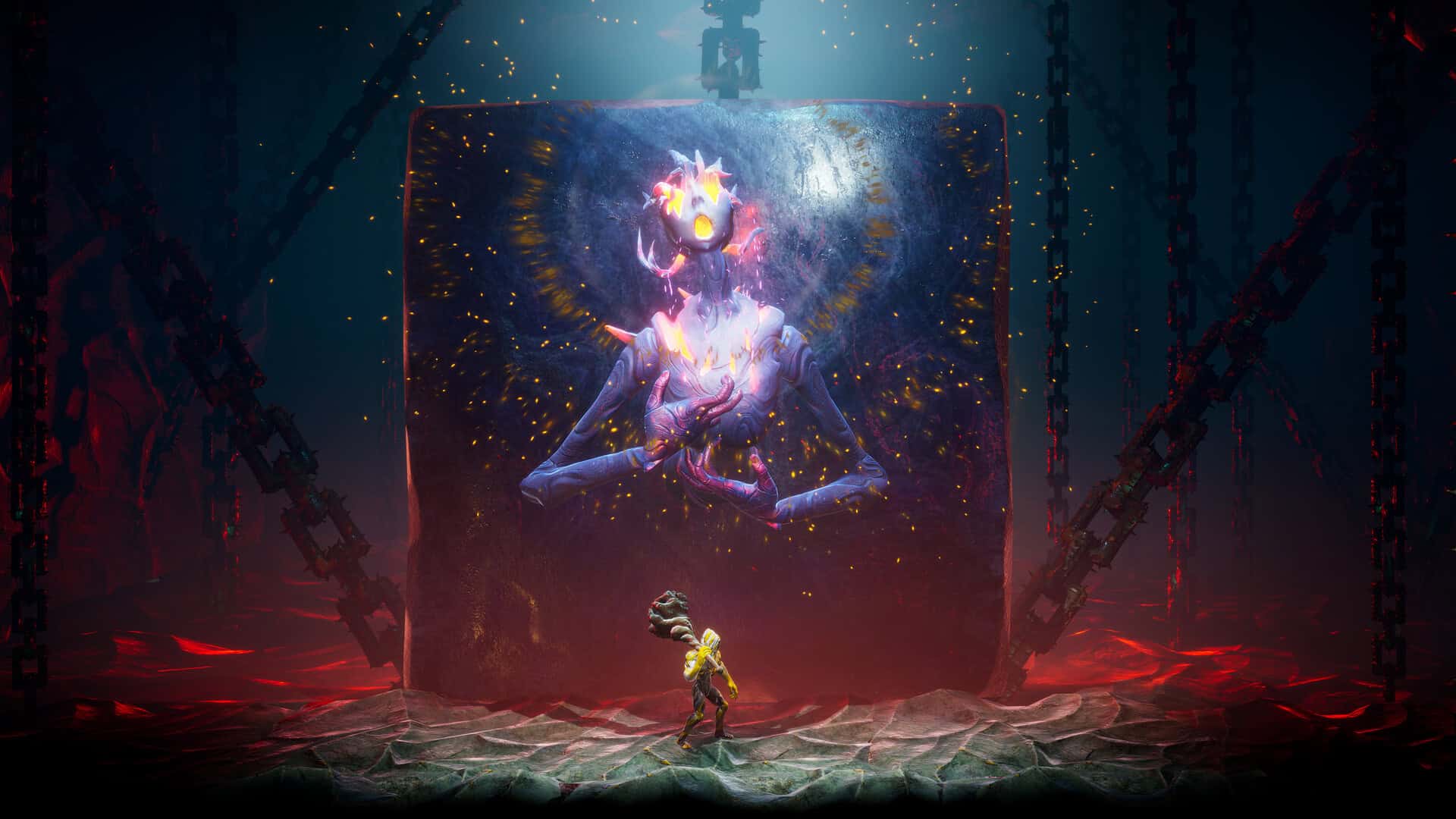
If you played the original GRIME, you’ll know that storytelling wasn’t exactly handed to you on a silver platter, and that hasn’t changed. In GRIME II, you once again step into an abstract, almost incomprehensible world, but this time as a “Formless,” an entity capable of mimicking and absorbing the shapes of others (Et tu, Ditto?). This concept ties directly into the themes of the first game, in which identity, transformation, and consumption played central roles. The sequel doesn’t so much continue the story in a traditional sense as it echoes it, expanding the universe sideways rather than forward.
Like a lot of other games are doing these days, there are hints of deeper lore scattered throughout: civilizations embedded in bizarre environments, characters that feel like fragments of a larger mythos, and a world that seems to exist independently of your presence. The whole idea behind the setting is that this new land is meant to feel “lived-in,” filled with its own cultures and histories, and to an extent, it succeeds. But here’s the thing: GRIME II still leans heavily on environmental storytelling. That’s great if you enjoy piecing things together yourself, but if you’re looking for a more structured narrative, you might find yourself wanting more. The story is there, it just rarely steps into the spotlight. And in a world where it’s harder and harder to find the time to actually start puzzling things together, it would be nice to play a Metroidvania that at least showed you a bit of the silver platter’s second course. Especially when a game offers more than one dialogue option, but it rarely changes the outcome of the scene.
Assimilation as a core mechanic
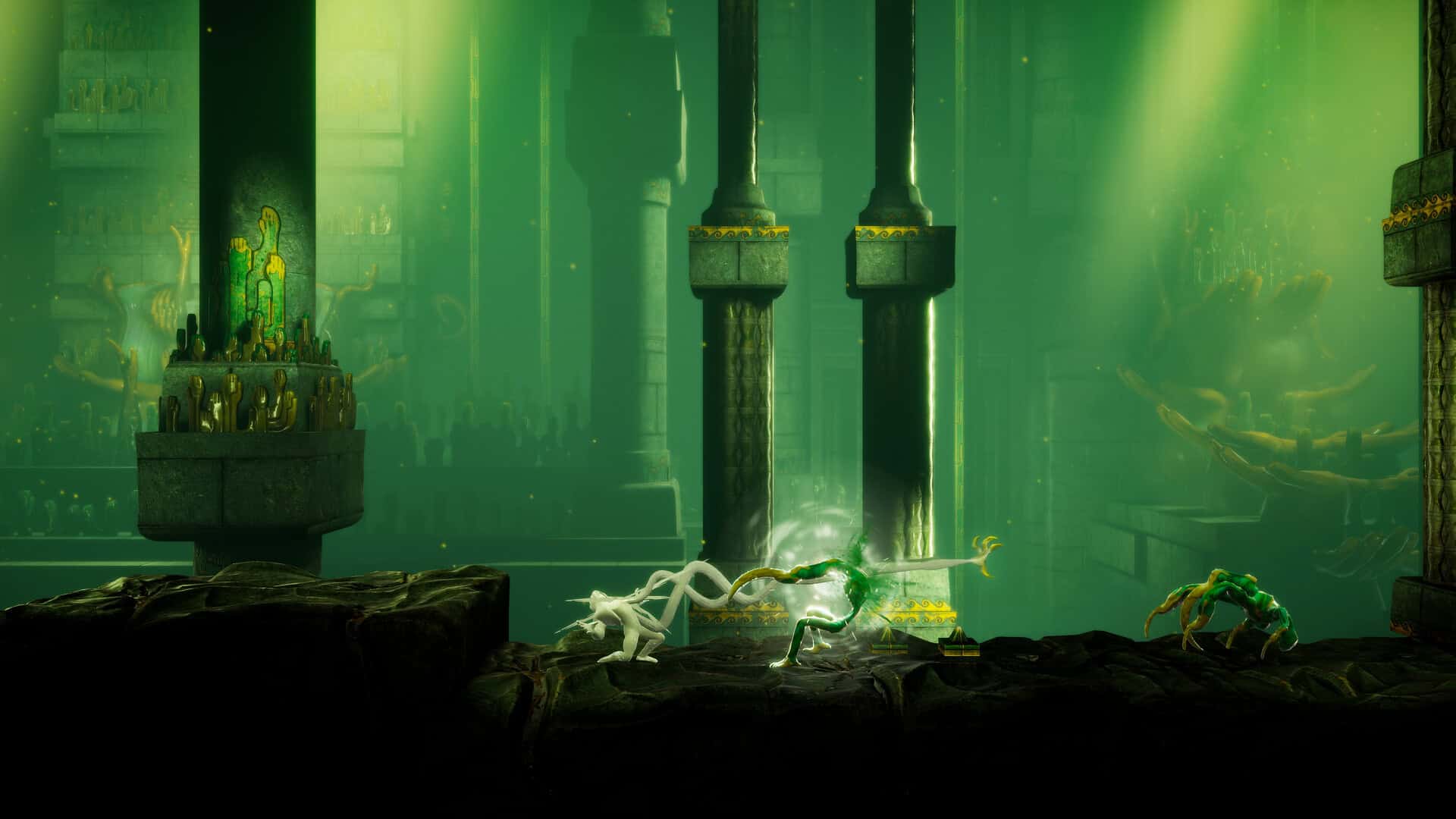
Where GRIME II truly distinguishes itself is in its gameplay loop, and more specifically, in how it evolves the idea of “becoming” your enemies. At its core, the game revolves around absorbing defeated foes and turning them into “molds”, which are abilities that can be used offensively, defensively, or even for traversal. It’s a system that feels both mechanical and thematic, reinforcing the idea that your character is constantly reshaping itself through conflict. And it works, really well, in fact.
There’s a satisfying rhythm to combat: observe, engage, absorb (if it lets you), adapt (like a Ditto!). Some enemies grant projectile abilities, others allow you to stun or manipulate the battlefield, and a few even function as temporary summons. It adds a layer of strategic depth that goes beyond the usual Metroidvania toolkit and reminds me a bit of the mechanics found in some older Castlevania games, like Aria of Sorrow (and its sequel, Dawn of Sorrow).
The inclusion of environmental combat, using your surroundings to damage enemies or gain positional advantage, further reinforces this sense of improvisation. Destroying the footing of an enemy, pushing them into the spike pit, and launching their projectiles back at them. Combined with mechanics like parrying and grasping enemies from a distance, combat feels dynamic and, at times, surprisingly fluid. But, and this is a big one, the game isn’t always fair about it.
The difficulty curve:
Let’s address the elephant in the room: GRIME II can be tough. Not in a “this boss took me five tries” kind of way, but more in a “why is this spike happening right now?” kind of way. The early to mid-game introduces a noticeable difficulty curve that can feel uneven. One moment you’re comfortably experimenting with different molds and abilities, and the next you’re getting punished for not having optimized your build in a very specific way. To be clear, this isn’t uncommon for the genre. Metroidvanias, especially those with soulslike influences, often rely on trial and error.
But GRIME II occasionally crosses the line from challenging to restrictive. Instead of encouraging experimentation, certain encounters subtly push you toward particular playstyles or upgrades. And that ties into another issue: progression. Unlocking new abilities, upgrading equipment, and fully exploring your build options often requires a fair amount of grinding. Not excessive, but enough to break the pacing. There were moments when I found myself retracing my steps, not out of curiosity but out of necessity, to gather enough resources to move forward comfortably. Think: understanding the pattern and mechanics of the next boss you are supposed to take down, but not being able to move forward because you don’t have enough damage output (and the weapons available for purchase require a specific build pattern). It’s not a dealbreaker, but it does chip away at the otherwise strong gameplay loop.

A world painted in the uncanny
If there’s one area where GRIME II rarely misses, it’s in its visual identity. The world is, for lack of a better word, bizarre, in the best possible way. Environments feel handcrafted and surreal, with locations that range from eerie organic structures to almost painterly landscapes. At one time, you walk among what feels like an alien cadaver splattered into the background, followed by a room full of Delft Blue and paintings from the Rijksmuseum of the Netherlands.
There’s a strong sense of cohesion in how everything looks and feels. Enemy designs are unsettling without being overdesigned, and animations carry just enough weight to make combat feel impactful. At the same time, the game doesn’t always run as smoothly as you’d hope. The game is technically demanding on my ASUS ROG Ally, and I had to plug it in to use the system’s boost function to push the device to its limits. Once I did, the framerate got a lot better, and small hiccups in inputs were gone, but it’s frustrating to play a game ‘on the go’ and not be able to play the game (which makes it feel a bit unoptimized?). But even with those technical hiccups, the artistic direction remains one of its strongest assets. I didn’t want to sound too negative, since it’s also the kind of game where you’ll occasionally stop because you’re genuinely curious about what you’re looking at.
Conclusion
So, to conclude! GRIME II is a fascinating, sometimes frustrating, but ultimately worthwhile experience. It builds on the original in meaningful ways, especially in its gameplay systems and world-building. The mold system, which absorbs enemies and turns them into tools, is a standout mechanic that adds both depth and identity. The world is rich, strange, and consistently intriguing. And the studio behind it clearly understands what makes this universe unique. But it’s not without its flaws. The lack of direct storytelling can make the experience feel distant at times, especially for players who prefer a more guided narrative. The difficulty curve, while not unexpected, can feel uneven. And the grind required for certain upgrades occasionally disrupts the flow. Still, there’s something here that sticks with you. Maybe it’s the atmosphere, maybe it’s the mechanics, or maybe it’s just the sheer commitment to doing something different. Whatever it is, GRIME II earns its place, not as a flawless sequel, but as a bold one.
