
Few gaming franchises carry the same mystique, legacy, and quiet prestige as Metroid. For nearly forty years, the series has shaped a genre while refusing to follow trends. Its tone is solemn rather than bombastic, its pacing deliberate rather than frantic, and its heroine a stoic symbol of perseverance rather than blazing bravado. With Metroid Prime 4 finally arriving on the Nintendo Switch (2), fans are treated not only to a long-awaited continuation of the Prime saga but also to a modern reaffirmation of what makes Metroid special. After restarts, restructuring, and years of silence, Samus Aran steps back into the Prime spotlight, and the result is a game that feels confident, atmospheric, and surprisingly bold in the right places.
This fourth Prime entry feels like a direct philosophical successor to the original trilogy. The well-crafted dystopic environments, methodical exploration, and softly simmering tension all return, polished through the lens of modern hardware and refined mechanics. But the game also nods to the evolution of the 2D Metroid titles and to the movement innovations introduced in Dread. The result is a hybrid approach: still unmistakably Prime, yet slightly sharper, smoother, and more energetic. But to truly understand what Metroid Prime 4 accomplishes, you must first understand what it inherits, because no Metroid game exists in isolation, and Prime 4 in particular seems deeply aware of the franchise’s dual identity.
A look back: The dual identity of Metroid
The Metroid series has always been defined by two creative bloodlines: the 2D mainline games (Metroid, Super, Fusion, Samus Returns, Dread) and the 3D Prime titles. While they share thematic DNA, like nonlinear exploration, ability-locked progression, and environmental storytelling, they approach their ideas through very different design philosophies.
2D Metroid: Precision, momentum, aggression
The 2D entries are fast, sharp, and mechanically exact. They thrive on immediacy: wall jumps executed at the perfect height, counters timed with reflex-level precision, and tight arenas that test a player’s ability to read enemy intent in an instant. Metroid Dread elevated this to an art form. Samus moved quicker than ever, the E.M.M.I. zones introduced thrilling moments of urgency, and the game pushed players to maintain rhythm and flow. It’s energetic, sometimes intense, sometimes punishing, always exhilarating.
3D Metroid: Atmosphere, observation, immersion
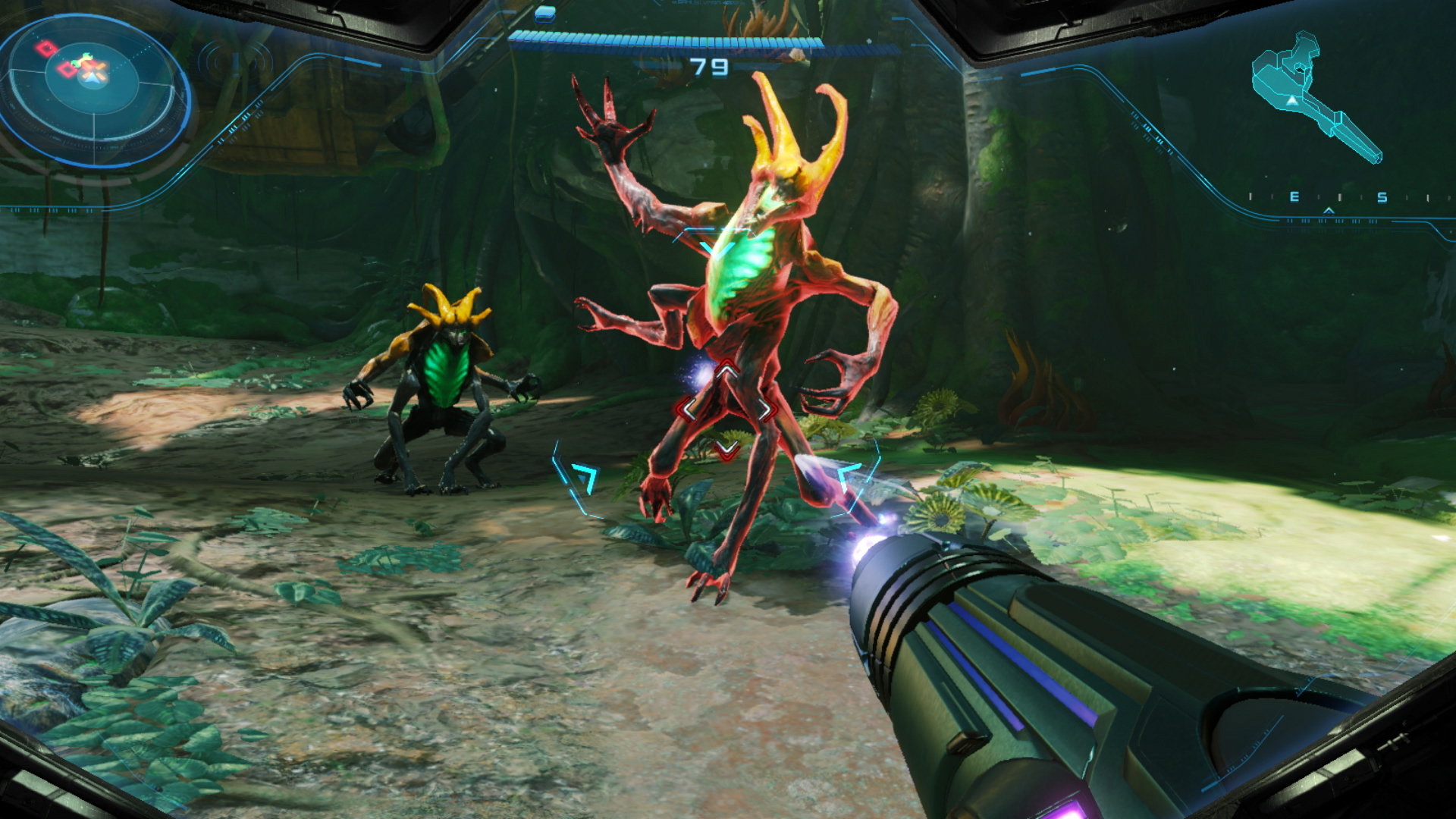
In its core, the Prime games emphasize immersion and introspection. The first-person perspective isn’t simply a viewpoint; it’s a narrative tool. The visor isn’t just UI, it’s Samus’s consciousness, filtering the world through her technology and silence. The pacing is slower, more meditative. Combat encourages careful positioning over twitch reactions. Scanning is as much a method of storytelling as it is a mechanic. Metroid Prime 4 understands both identities. It preserves the contemplative heart of Prime, with environmental puzzles, dystopic world-building, and intricate scanning. But it also borrows subtle momentum-enhancing touches from the 2D lineage. Samus’s movement is more fluid, her dodge options more responsive, and her combat rhythm more engaging. This blending of identities becomes especially clear when the game pivots from mystery to tension, from exploration to conflict. Retro Studios has learned from both branches of the franchise, and Prime 4 feels richer for it.

Story: A minimalist mystery told through exploration
Metroid Prime 4 begins by throwing Samus into the aftermath of escalating Space Pirate aggression. Following the catastrophic failure of a previous Pirate operation, their forces have begun exploiting Metroids in increasingly dangerous ways, infusing them directly into subjects to gain power at the cost of their free will. After a sudden Pirate strike on Federation facilities, Samus is dispatched to investigate a recently unearthed artifact on the world of Tanamaar before the Pirates can seize it. This mission quickly spirals into something far more complex. In an early confrontation, Samus discovers that the Pirates are being guided by Sylux, a rogue hunter with whom she shares a bitter history. Their clash triggers a catastrophic accident involving the artifact, one that tears open space around them and violently thrusts Samus and everything in the vicinity across the galaxy to the mysterious planet Viewros.
Stranded and cut off from the Federation, Samus awakens at the foot of an enormous structure known as the Chrono Tower, a relic of an ancient species called the Lamorns. Through a series of psychic recordings, she gradually learns that the Lamorns were a civilization facing extinction, desperate to preserve their legacy through a monumental device capable of teleporting their final memories to a new world. But activating this “Master Teleporter” requires gathering five keys scattered across Viewros, each guarded and hidden deep within the planet’s most dangerous regions.
Her journey becomes a race against time. Feral creatures stalk the wilderness. Sylux has also survived the teleportation event, and something about Viewros itself feels unstable, with its wildlife overly aggressive and its ruins humming with psychic residue from the Lamorns’ final days. Samus eventually encounters a handful of Federation survivors who, like her, were pulled into this world. Among them is a resourceful technician who establishes a base camp to offer tactical support, while others contribute knowledge, equipment, and unexpected aid. As she explores Viewros’s jungles, caverns, and forgotten facilities, Samus uncovers fragmented holographic logs describing the rise and fall of the Lamorn civilization. Their discovery of a mysterious life energy, something they believed could heal their dying world, may instead have accelerated its ruin. The truth behind the Lamorns’ last moments becomes a vital backdrop to Samus’s mission and her growing understanding of the stakes unfolding around the Chrono Tower.
Throughout the campaign, Sylux remains an ever-present threat. His motives, shaped by deep resentment and past tragedy, fuel his attempts to sabotage Samus and seize control of Lamorn technology for his own purposes. His influence reaches across Viewros, corrupting guardians, seizing control of long-dormant defenses, and pushing Samus into a collision course that feels both personal and catastrophic. What follows is a carefully paced blend of mystery and urgency. Samus’s search for the keys, her growing understanding of Viewros’s past, and the shifting dynamics of her uneasy interactions with Sylux weave into a narrative that feels more ambitious than previous Prime entries while still maintaining the series’ signature restraint. The story unfolds through exploration rather than exposition, letting players piece together the fall of an ancient world as Samus charts her path toward activating the Master Teleporter and finding a way home.
The result is a narrative that is atmospheric, emotionally grounded, and deeply tied to the themes of survival, legacy, and the burden of unintended consequences. Without revealing specifics, Metroid Prime 4 delivers a final act that feels both powerful and haunting, culminating in a story that lingers long after the credits roll.
Gameplay: Classic Prime with modern refinements
At its core, Metroid Prime 4 leans into the classic Prime loop: exploration, scanning, ability-driven progression, and layered backtracking. But on the Switch 2, everything feels smoother. Transitions between large environments are seamless, Samus’s animations are more responsive, and traversal carries a subtle fluidity absent from earlier entries.
Combat & controls
Combat retains Prime’s familiar cadence but is enhanced with modern aiming flexibility. Dual-stick precision combines naturally with gyro assist, and enemy encounters feel more dynamic thanks to improved patterns. Samus can dodge more cleanly, execute context-driven Charge Beam variants, and swap beam modes without interrupting flow. Boss encounters remain a highlight. Multi-phase fights test observation and positioning rather than frantic input speed, staying true to Prime’s design ethos.
The Desert Overworld as a central hub
One of the game’s modern world-building decisions is the desert overworld, a vast, wind-scoured region that functions as a central hub connecting the game’s major “dungeons” and biomes. Rather than feeling like a simple zone transition, the desert serves as the connective tissue of the world. Hidden caches, crashed structures, shrines, and enemies are around the corner. And lots of green stones. This hub approach changes the concept of backtracking. Routes shift after key story events, like broken machinery that becomes active after power reroutes. This makes the desert overworld not just another biome; it’s the beating heart of the map. But it also feels a bit empty at times. I liked the zone transitions from the original Prime Trilogy, and I feel like they could have done a tad more with the desert, since I’m loving the bike segments.

New mechanics
Retro Studios introduces several new abilities, but one in particular defines Prime 4’s identity:
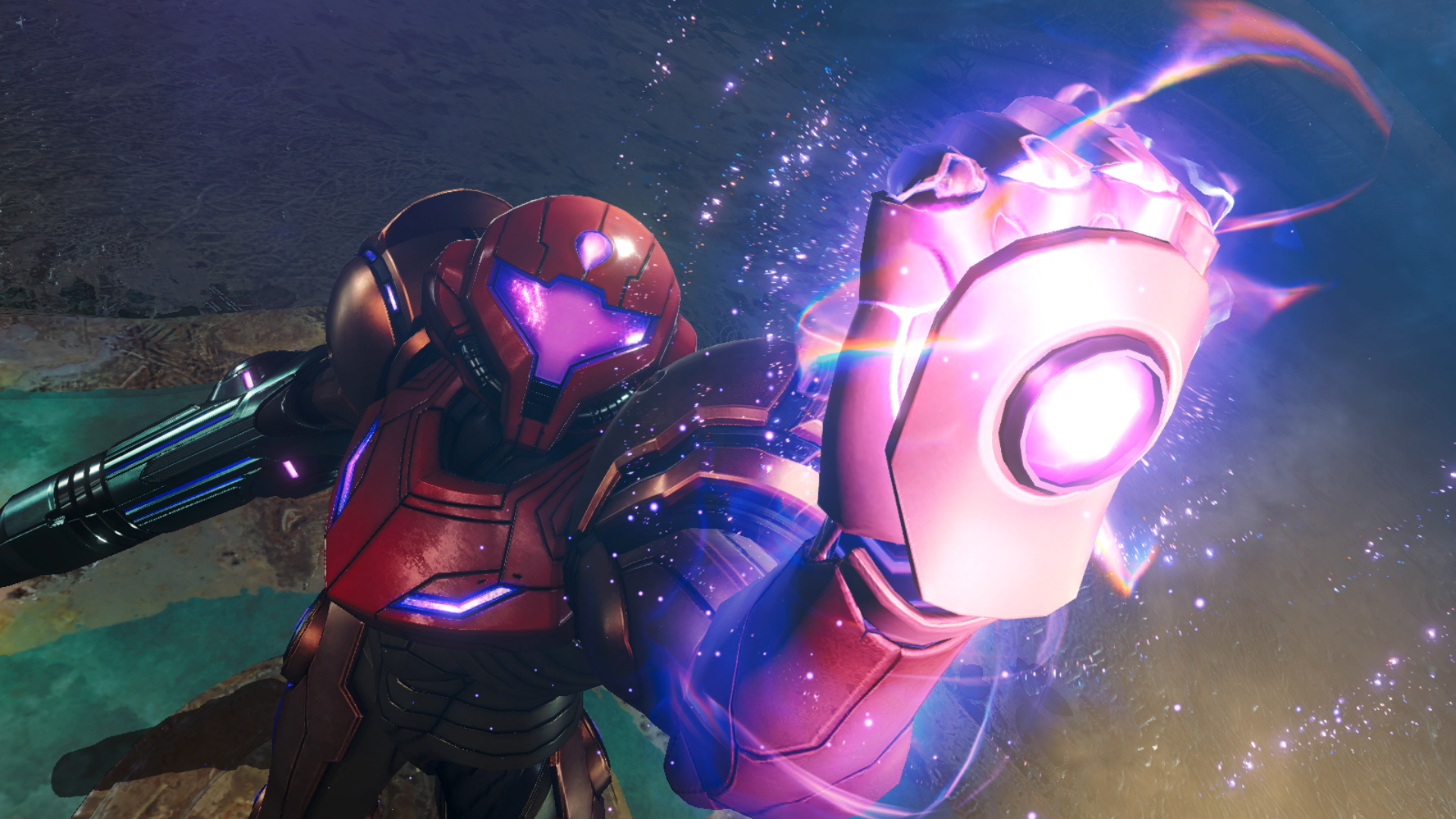
The Vi-0-La is a cool motorcycle (which can only be used with Samus’ new suit) that can perform manoeuvres that provide a speed boost/attack, and it allows Samus to defend against enemies. You can use it throughout most of the game, and it’s not the gimmick some people classify it as. The bike enhances traversal across the vast dunes, works beautifully in high-speed battles, and injects bursts of adrenaline without compromising Prime’s measured tone. Its inclusion feels fresh yet consistent with Samus’s tech and very rewarding in one of the boss battles.
Traversal & exploration
The Morph Ball is faster and more precise, with bomb jumps feeling more forgiving and magnetic rails (and psy-rails) introducing new vertical complexity. Scanning maintains its narrative importance, though optional (findable) logs offer richer lore than ever for players who seek it. Exploration in the ‘dungeons’ feels satisfying because the game respects player intelligence. It rarely points directly to the solution but consistently provides enough visual cues to guide observant players forward. In the overworld, however, there is a bit too much handholding in my opinion.
A beautifully cohesive atmosphere
From the first moment Samus steps onto Viewros, Metroid Prime 4 makes clear that atmosphere is still its most potent weapon. The Switch 2 version offers quality and performance modes, and it shows. This game pops out of your television in 4K (60fps) or 1080p (120fps). And each biome shows its own practical usage of these settings. The Ice Belt is probably my favorite section of the game and shows us a world I could only dream of in a Metroid world. Haunting, dystopic, and isolated. Just what Prime should feel like.
Metroid Prime 4 vs. Metroid Dread: two philosophies, one legacy
Drawing comparison to Metroid Dread and echoing thematic insights noted in my Metroid Dread review reveals just how versatile this franchise truly is.
Metroid Dread:
- Fast, aggressive, reaction-driven
- High-pressure pursuit mechanics
- Precision jumps, rapid counters, and fast movement flow
- Constant adrenaline, where danger is immediate and unrelenting
Metroid Prime 4:
- Slow-burning tension built through isolation and atmosphere
- Combat that rewards positioning over reflex
- First-person immersion makes exploration personal
- A world meant to be studied, not rushed
Where Dread is a surge of controlled panic, Prime 4 is a meditative descent into mystery. Where Dread wants players to feel hunted, Prime 4 wants them to feel small against ancient forces. Where Dread emphasizes survival, Prime 4 emphasizes discovery. They complement each other beautifully. One expresses Metroid’s intensity; the other expresses its introspection. Together, they show how the franchise can evolve in multiple directions without ever losing its identity.
Conclusion: A strong, confident return
Metroid Prime 4 isn’t a revolution. It doesn’t reinvent the franchise’s foundation. Instead, it refines and elevates it. The game respects its lineage while layering thoughtful innovations: a vast desert hub that ties the world together, the Vi-0-La for bursts of energetic traversal, and the smoothest combat the 3D series has seen to date. It may not be as groundbreaking as the original Metroid Prime or the mechanical brilliance of Metroid Dread, but it lands exactly where it needs to: a strong, atmospheric, and intelligently crafted entry that reinvigorates the franchise without compromising its identity. After years of waiting, Samus Aran’s return to the Prime saga is not just welcome, it’s deserved. And let’s be honest, after all this time, we all build up expectations that could never be met.
8.5/10
Tested on the Nintendo Switch 2.
