
In December 2025, Metaphor Games launched a Kickstarter for their new cyberpunk noir RPG, Celestial Return. In stark contrast to most other gaming projects on Kickstarter’s homepage, Celestial Return wasn’t just in the early stages of development. Metaphor Games had a demo ready, a planned webcomic for extra world-building, and an estimated delivery date for the finished product in 2026. And they kept their promise: July 14th marks the release of the game. I got the chance to visit Netherveil a bit sooner to see the city decay before the masses can experience this ultra-capitalist dystopia.
The City Never Sleeps
Our adventure began three years ago, when the main character, detective Howard, led a strike team into the den of an Abstract. This otherworldly abomination seeped in through the cracks of reality. After an interaction with this creature, Howard obtains a rose from the garden it was tending, receiving an undeveloped Abstract.
Fast forward to the present, and the city is deteriorating even further as time passes. Howard is visited by an old friend from the police who offers him a seemingly unsolvable murder case, leading him on a citywide investigation. From tattoo parlors and bars to graveyards and sewers, no stone is left unturned in the search for the truth. Lucky for Howard, his Abstract sidekick, Rose, is a living paradox capable of speaking with the dead. And that will be necessary, because the scars of years of oppression and mismanagement run deep within this city where only the strong survive.

Pay the Dice
In what I can only describe as a bold choice, Celestial Return wears its inspirations on its sleeve like a badge of honor. Both the art and gameplay inspirations are listed in the Kickstarter campaign: Blade Runner, Berserk, and Akira are mentioned as story and art influences, while the gameplay is described as a blend of Disco Elysium and Citizen Sleeper. It’s just the way games are pitched these days, with so many titles releasing. But Celestial Return is far from a copycat. You can clearly see the gameplay influences, but they are shaped into a unique experience.
In what I can only describe as a bold choice, Celestial Return wears its inspirations on its sleeve like a badge of honor.
The story unfolds much like it would in Disco Elysium. Text scrolls down in a textbox on the right side of the screen, and you’re presented with choices Howard must make to move the story forward. These choices are all linked to Howard’s personality traits: Virtue, Perception, Foolishness, Anger Issues, and Intelligence. All of these traits can be upgraded as the story progresses, becoming more powerful versions of themselves. In some cases, the game asks you to roll dice to succeed, where you need to score above a certain number. This is done by rolling two D4s. However, your dice are a finite resource (this being the Citizen Sleeper aspect of the game) that you need to earn back, sometimes as payment for completed tasks or by looking for more clues off the beaten path. Dice come in various forms, with better bonuses or emotion-specific modifiers, so choose wisely which dice you use for each task. There are also items and enhancements to be found that help you succeed.
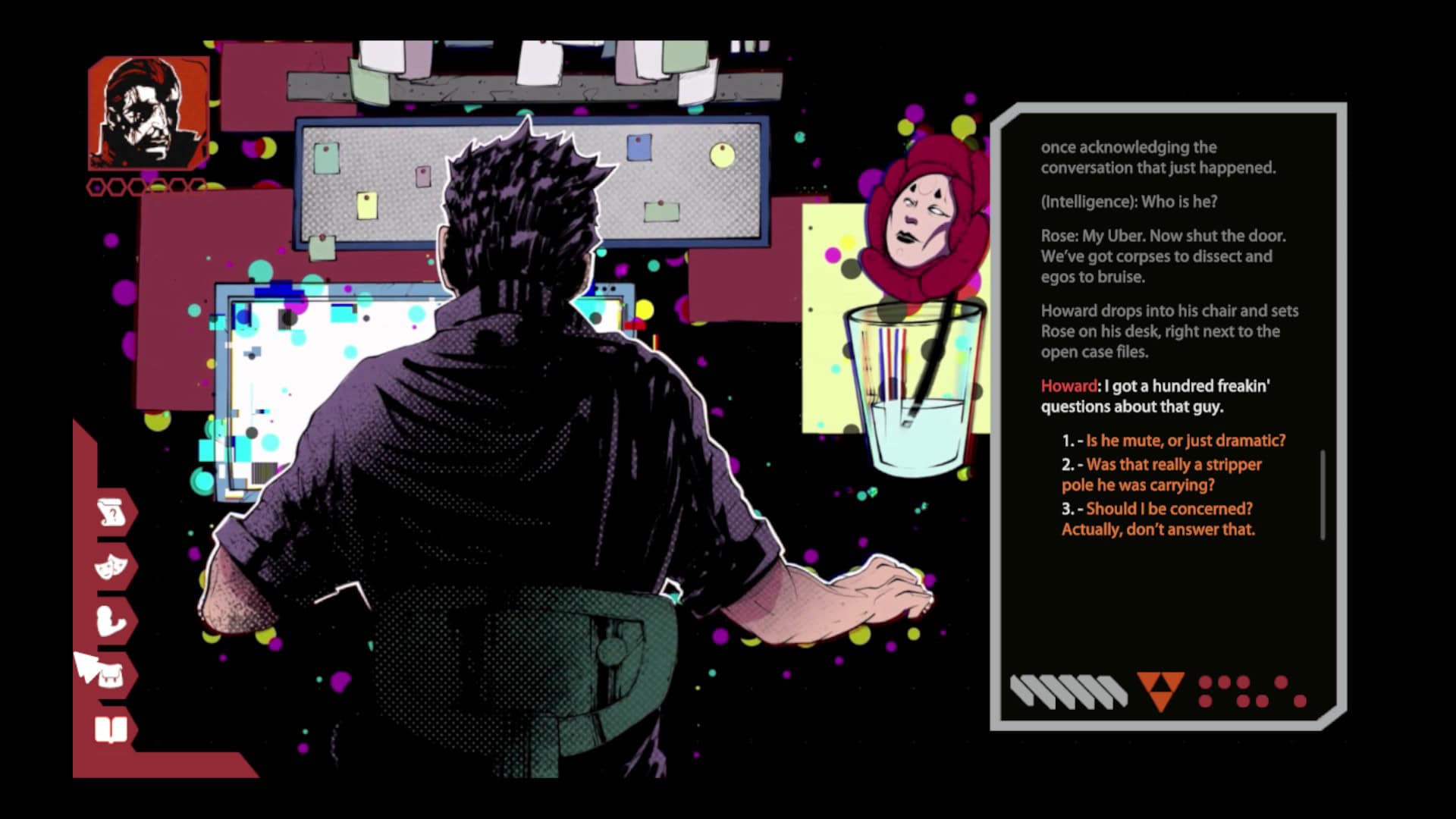
The core gameplay is fun and takes the story in really cool directions, but it took me a while to realize just how finite my dice pool was. Something I wish I’d known earlier is that it isn’t like the previously mentioned games, where you can just go to sleep with your character to replenish your dice supply with a set of stock dice. Or at least, I didn’t discover that option. The story progresses whether you have dice or not. If you don’t, some key interactions can be lost. It also doesn’t help that the currency is also dice, so you can lose them in the shop. Thus, the process of using dice becomes a giant gamble: do you use them now to get an extra piece of info, or do you move around the subject and try to use your die later in a more crucial moment? I would advise you to do the latter. Without dice to roll at certain moments, the game becomes a bit bland, more like a choose-your-own-adventure book with dialogue choices than a high-stakes game.

Human Art in an AI Future
But if you dare to cite inspirations like Berserk and Akira, I would expect your finished product to reflect the high standard of art quality those titles offer. And Celestial Return delivers. The game features beautifully drawn art that integrates the cyberpunk aspects of this world in a recognizable, albeit unique, style. The human shapes mixed with abstract mechanical constructs bring the world to life wonderfully, and the use of black space and darkness only enhances the gritty feeling a cyberpunk city should have.
The overworld and some other gameplay passages are done in a PS1/early PS2 3D art style that complements the character portraits of the inhabitants well. The artistic vision is a clear thread throughout the project. The team even states that no AI was used in the creation of any of the art, which makes my praise even higher. Humanity prevails over machines, even in this cyber dystopia.
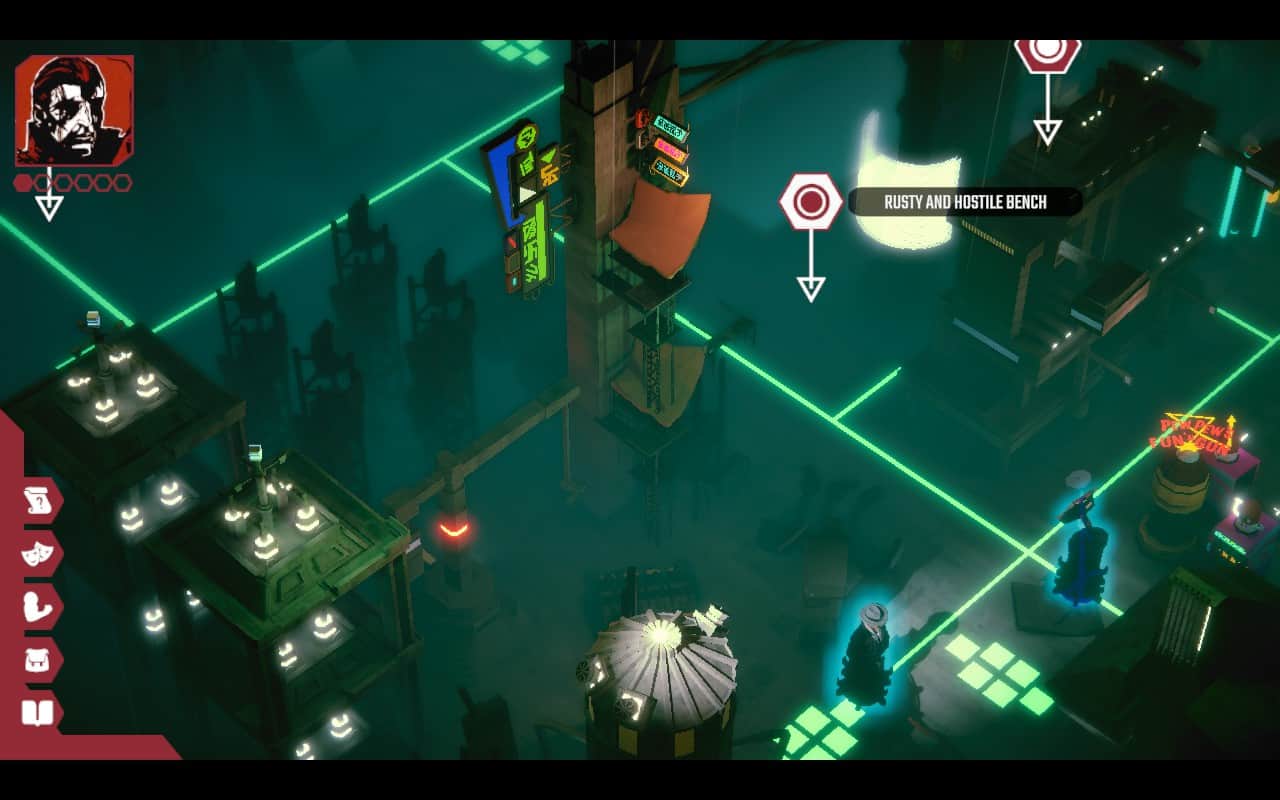
I do have one minor point to bring up regarding the art: the depiction of Howard as the main character. You can see a version of him in the top left corner when you’re on the world map, one in the main menu, and sometimes a full frontal view in dialogue sequences. I have to say that all three depictions don’t look much alike. It might be that there were still temporary art assets in the build I played. It’s not a big deal if that’s the case, but it was a bit confusing. Especially because I want a clear picture of who I’m playing as.
Conclusion
Communicating your inspirations in the marketing of your game may cause people to compare your title to the ones you reference. In the case of Celestial Return, it isn’t a matter of copying those who came before, but of wearing the similarities as a badge of honor. While the gameplay and art direction may be inspired by other intellectual properties, Celestial Return takes them and builds on them even further.
The way you generate new dice might need some extra balancing, as their use as both a resource for investigations and currency for shops makes you lose them a bit too quickly. But the strong narrative and visual design elevate this game to be its own source of inspiration for future teams to build upon.