
Project Songbird is a passion project by Conner Rush of Fyre Games that has been five years in the making. This horror indie game is clearly inspired by cinematic psychological horror titles, games that are often developed by full teams rather than a single creator. That makes it all the more impressive that Project Songbird is, for the most part, the work of one person. Delivering such an engaging experience under those circumstances is no small feat.
Creative Rut
In Project Songbird, you step into the shoes of Dakota, a musician stuck in a serious creative rut. What once came naturally is now frustratingly out of reach. The next album isn’t coming together as planned, and the pressure from the record label is steadily mounting. The game opens in Dakota’s apartment, and its state tells a story of its own. It’s not just the music that’s falling apart here… Everything around Dakota reflects a life that’s losing structure. It’s a subtle but effective way of showing that this isn’t just writer’s block, but something deeper.
Then Dakota gets a call that cuts through the illusion that inspiration will simply return on its own. A solution is proposed: retreat to a remote cabin in the Appalachian woods. The idea is simple: remove all distractions and focus entirely on the music. It has worked for others, so maybe this is the last real shot at finishing the album on time. While isolating in the woods doesn’t exactly sound appealing, for Dakota it represents a potential lifeline, a chance to hold onto a once promising career.
Looking for the new noise
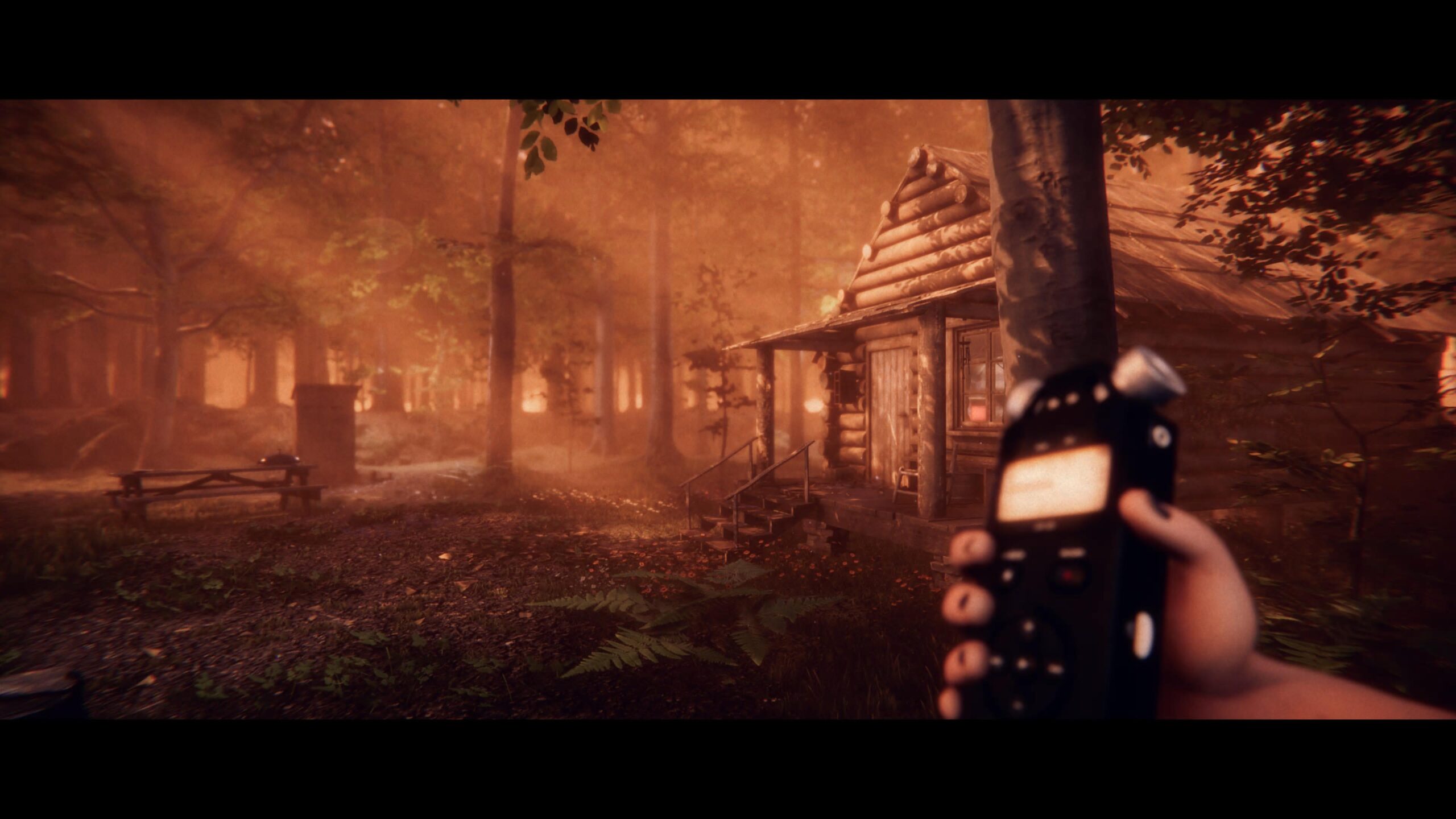
Upon arriving at the cabin, Dakota begins to see potential. The natural sounds surrounding the area spark ideas for new soundscapes. While the creative flow hasn’t fully returned, there are glimpses of progress. That changes when a mysterious light appears, leading Dakota to a red door hidden deep in the woods. Stepping through it reveals a haunting dreamscape, a sort of manifestation of Dakota’s underlying mental struggles.
These surreal worlds force you into a head-on confrontation with deeply rooted fears and unresolved trauma. Getting through them provides a sense of relief, and along with that comes renewed creative energy. One such experience would be enough for me to dash out of there for good, but Dakota is determined to seek out more of those experiences. As the game unfolds, you’ll slowly discover more of the cabin’s surrounding areas and uncover the secrets of the woods.
Psychological horror
Project Songbird is not a game that relies on cheap jump scares to get under your skin. Instead, it builds a constant sense of unease. As someone who isn’t particularly comfortable with horror games, I found this approach far more effective than anything that simply throws monsters in your face. The tension built during the nightmare sequences is almost suffocating.
While there are enemies present in these nightmare worlds, the game never overuses them. They add tension and give you the choice between stealth and using one of your weapons. The use of weapons is not my favourite choice in this game. I felt like the game could easily do without them and be purely built on the sense of tension instead of giving you the chance to blast away one of those nightmarish creatures.
Speaking of those nightmarish encounters, there is one moment I won’t fully spoil, but it involves a piano puzzle and the sound of heavy breathing slowly closing in on you. It was enough to make me step away from the game for a while just to calm down. Now, this is very much a subjective experience. Some players will likely recognise the horror trope from a mile away, but in the moment, I found myself muttering a whole lot of “nope” under my breath.

Although not exactly a pleasant experience for me personally, this is where Project Songbird truly shines. Its threats are used sparingly, making them far more effective. The game constantly makes you question your surroundings and your own sense of safety, and that lingering doubt is far more powerful than any scripted scare.
Too many ideas
One of the challenges with a passion project that has been in development for five years is knowing which ideas to keep and which ones to let go. “Kill your darlings,” as the saying goes. In the case of Project Songbird, it feels like that line was sometimes difficult to draw. There are a few mechanics and ideas present that are interesting on paper but never fully develop into something meaningful within the game.
Take the camera and recording device, for example. Both are introduced as tools with potential, but neither ever feels truly essential to the experience. The ability to collect soundbites with the recording device and use them as inspiration for songs is a nice thematic touch, especially given the game’s focus on creativity. However, it rarely feels like something the game meaningfully builds upon.

For completionists, tracking down every soundbite might serve as an enjoyable side activity, but for me, it felt more like an extra that didn’t quite justify its place in the overall experience. These elements don’t necessarily detract from the game, but they do highlight a lack of focus in certain areas where Project Songbird could have benefited from a more streamlined design.
Conclusion
Project Songbird starts off feeling like it could be a new entry in Life is Strange, but quickly takes a much darker turn, evolving into a focused and unsettling psychological horror experience. Over the course of its roughly 5–7 hour runtime, it delivers a journey that leans heavily on atmosphere, introspection, and a constant sense of unease.
Fans of psychological horror will appreciate both the subtle and more direct nods to genre staples, while the game’s more personal themes help it carve out an identity of its own. It’s not without its rough edges, but Project Songbird still stands as an impressive achievement from Fyre Games… and a strong reminder of what a solo developer can deliver.
