
There’s a moment early in Dragon Eclipse when everything clicks. You’re in the middle of a tightly choreographed card battle—energy’s low, your monster’s health is hanging by a pixel, and you draw just the right combo to turn the tide. It feels clever. It feels earned. It feels like Slay the Spire had a fever dream about Pokémon, and somehow, it’s working. But sadly, that feeling doesn’t last forever. Let’s dive in.
Story Of The Ages
In Dragon Eclipse, you play as a fledgling Beastbinder drawn into the fractured world of Theralis, where elemental rifts have begun tearing through the landscape, spawning corrupted creatures and unraveling the balance between nature and arcane forces. Guided by the mysterious Eclipse Codex—a living artifact with a mind of its own—you set out to uncover the origins of these rifts, track down rogue Beastbinders, and awaken ancient dragons lost to myth.

As you travel through biomes distorted by eclipse energy, you’ll piece together the history of a forgotten war between celestial beings and their bonded monsters, while forming alliances with factions that each interpret the Eclipse phenomenon differently—some see it as a curse, others as evolution’s next step. But as the Codex begins to reveal fragments of your forgotten past, you’ll discover that the corruption isn’t just changing the monsters… It’s changing you.
Deckbuilding With a Familiar Bite
I won’t spoil the rest of the story, since you can breeze through it quite quickly once you figure out the right combos for each biome. I want to delve a bit deeper into the gameplay mechanics. At its best, Dragon Eclipse smartly fuses roguelike deckbuilding with turn-based monster combat. You don’t just play cards—you command elemental beasts that evolve, learn new attacks, and synergize with your chosen build. Think: “Charmander, if he were part of a fragile-but-lethal poison engine.” Every run feels different, even when you’re dragging your third Sludgeclaw through the early biomes again.

There’s depth here, and it’s not just stat-padding. Card effects interlock—positioning matters. And when you land a full combo that stuns an enemy boss into submission while your beast pulls off a dramatic evolution mid-fight—it’s electric. Or shielded, for those who know, know – and if you don’t, try the Shielded Turtle combo. You won’t regret it. But, and it’s a significant ‘but’, that’s when the game behaves.
Bugged and Bothered
Sadly, Dragon Eclipse often trips over itself. There are bugs. Not just the occasional animation glitch or vanishing tooltip—though those are here too—but hard crashes, UI lockups, and turns that don’t resolve. One miniboss straight-up duplicated itself mid-fight, and another just locked up my game when one of my monsters revived itself for the second time. Sure, it’s not game-breaking every time, but it is game-breaking some of the time. And when a single bad draw can derail a run, the last thing you need is a frozen action queue or a missing targeting indicator, especially when it happens a few times on the same boss or with the same monster.
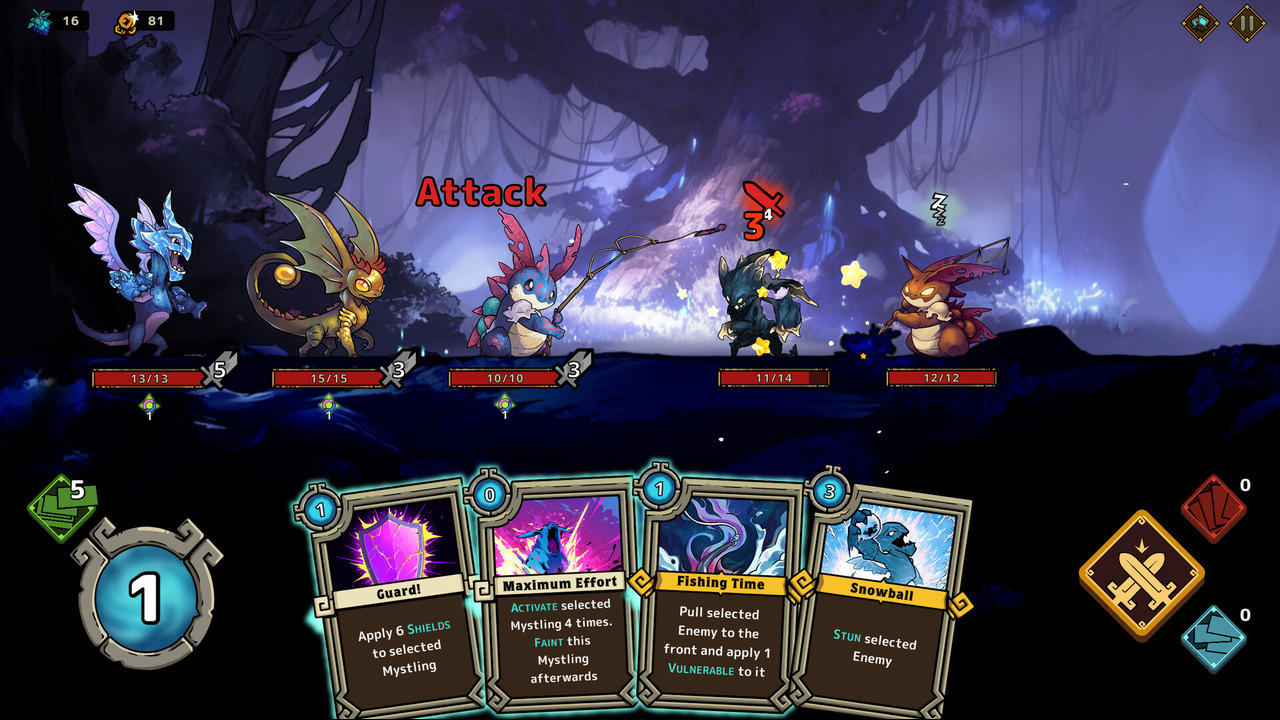
Then there’s the interface, which feels like it’s still stuck in early access limbo. Menus are clunky and weirdly nested. Sorting your cards? Not intuitive. Tooltips overlap on smaller resolutions (like with the Switch 2 for some reason). Trying to equip a newly earned relic feels like you’re convincing the game you’re allowed to. And God help you if you accidentally press the back button during team selection—you’ll be booted with zero warning.

The style is there—slick animations, a rich color palette, and monsters that range from “charmingly grotesque” to “why does this slug have teeth?” But the functionality? That’s still lagging a patch or two behind. Which it shouldn’t, since the game isn’t new…
An Evolutionary Dead-End?
What Dragon Eclipse sorely lacks is a sense of progression beyond your monsters. Yes, you can evolve them. Yes, you can fine-tune your deck per run. But outside of that? The toolset is stale. You have no meaningful upgrades, no skill trees, no persistent bonuses that make you feel like you’ve grown as a trainer, just a deckbuilder. The only thing you upgrade is a bar of unlocks, which makes traveling into a new diome the same as the first diome you visit. Just with some ‘new cards’, but not with a boon, a perk, or an upgraded trainer (apart from their starting compositions).
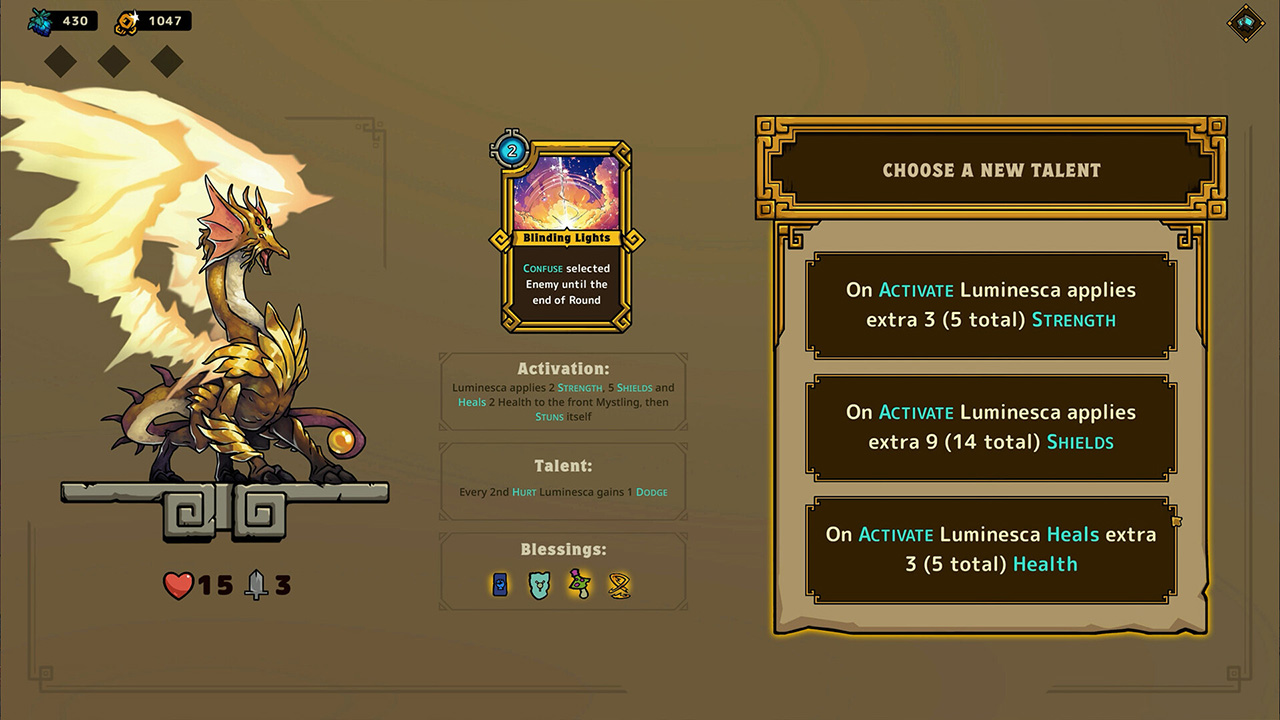
It creates a disconnect. You’re asked to care about these creatures—build with them, battle with them, maybe even name them—but the tools you’re given to do that remain frustratingly static. At a certain point, you start wondering why they choose not to provide some form of progression system to the monsters or tamers, especially since you don’t progress from biome one to five in one long run.
Conclusion
Dragon Eclipse shines when its systems align: clever cardplay, engaging monster mechanics, and a roguelike loop that rewards experimentation. But it’s equally quick to frustrate with a buggy framework, rough UI edges, and a sense that the devs haven’t quite figured out what else to upgrade besides the monsters. It’s a good game, occasionally a great one—but too often it fights against itself. Still, there’s a beating heart here, buried under the clutter. And when it works? It works. Just not as often as you might have hoped.