
Space, the final frontier! Well, not in Chaos Galaxy, in which space is mostly a place where factions and kingdoms wage war on the planets and destroy each other with the push of a button. When this game dropped in our inbox, I read that Chaos Galaxy was inspired by Romance of the Three Kingdoms, Romance of the Three Kingdoms is acclaimed as one of the Four Great Classical Novels of Chinese literature. I’m a big sucker for everything Romance of the Three Kingdoms related, so I was ready to dive in when I read that this combined with tactical space gameplay!
Romance of the Three Kingdoms
Oke, here is a bit of context before we dive into the actual game then:
Romance of the Three Kingdoms (traditional Chinese: 三國演義; simplified Chinese: 三国演义; pinyin: Sānguó Yǎnyì) is a 14th-century historical novel attributed to Luo Guanzhong. It is set in the turbulent years towards the end of the Han dynasty and the Three Kingdoms period in Chinese history, starting in 184 AD and ending with Western Jin reunifying the land in 280. The novel is based primarily on the Records of the Three Kingdoms (三國志), written by Chen Shou.

The historical and fictional story romanticizes and dramatizes the lives of feudal lords and their retainers, who tried to replace or restore the dwindling Han dynasty. While the novel follows hundreds of characters, the focus is mainly on the three power blocs that emerged from the remnants of the Han dynasty and would eventually form the three states of Cao Wei, Shu Han, and Eastern Wu. The novel deals with these states’ plots, personal and military battles, intrigues and struggles to achieve dominance for almost 100 years.
Chaos Galaxy
The great Galactic Empire, which had ruled the galaxy for one thousand years, collapsed under the sudden impact of aliens and fell into disputes and civil war. Many heroes, with their purposes, set foot on the road of conquering the three thousand worlds of the galaxy. In the background of this chaotic war, a greater crisis of galaxy destruction is about to come. I will not spoil too much about the story, but it revolves around how the player’s faction responds to various events set into motion. What I found interesting about the game is that it has events designed to be seen by players who play a specific faction the opposite way it was intended.

Planet Management
Chaos Galaxy is centered around Planetary Management, similar to games like XCOM and Jagged Alliance. It falls under the category of 4X games, which stands for Explore, Expand, Exploit, Exterminate. This genre encompasses turn-based and real-time strategy games focusing on building an empire. Economic and technological development and military and non-military strategies are crucial in attaining supremacy. Chaos Galaxy is a lighter version of a typical 4X game, hence categorized as 4x-lite. There are four resources to manage: trade, industry, loyalty, and defense.

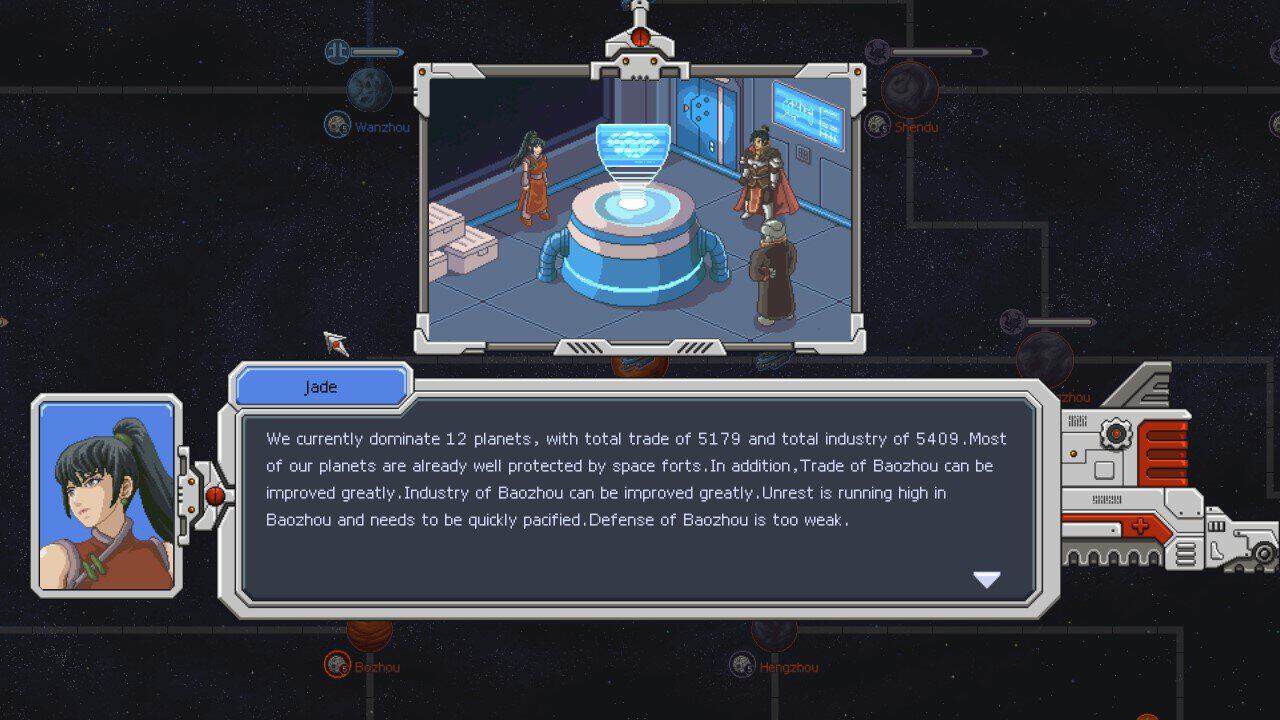
Trade generates income, industry generates money, and loyalty provides more money and supply, which is essential for a larger fleet. Defense determines the number of attacks required to conquer a planet. To conquer a planet, the player places a ship over an enemy planet and can assault or bomb it. Bombing is a quicker path but also destroys all of the enemy’s infrastructure, starting from zero. These stats increase slowly over time but can be accelerated with monetary investments. A captain can serve as a governor, increasing the bonuses generated through monetary investment. Their planet management determines the governor’s admin skill; some captains are better at it than others. However, a fleet of ships is necessary to get anything done.
Space & Combat!
So most of the time, you battle in outer space, which means ships (and mecha’s)! There are two main types of ships, each with advantages and disadvantages. The first type is called mecha suits, mobile units that can maneuver through asteroid fields to gain a position advantage and increase their dodge chance. However, they are weak because they don’t have as much power (health) or energy (ammo) as their battleship counterparts. Additionally, mecha suits are composed of multiple units, and as they take damage, their number of units decreases, which lowers their attack power. On the other hand, battleships are hulking titans of destruction that are quite slow but very strong. Their main flaws are that they are expensive to run compared to mecha suits, and the most powerful ones limit how many can be in a fleet.
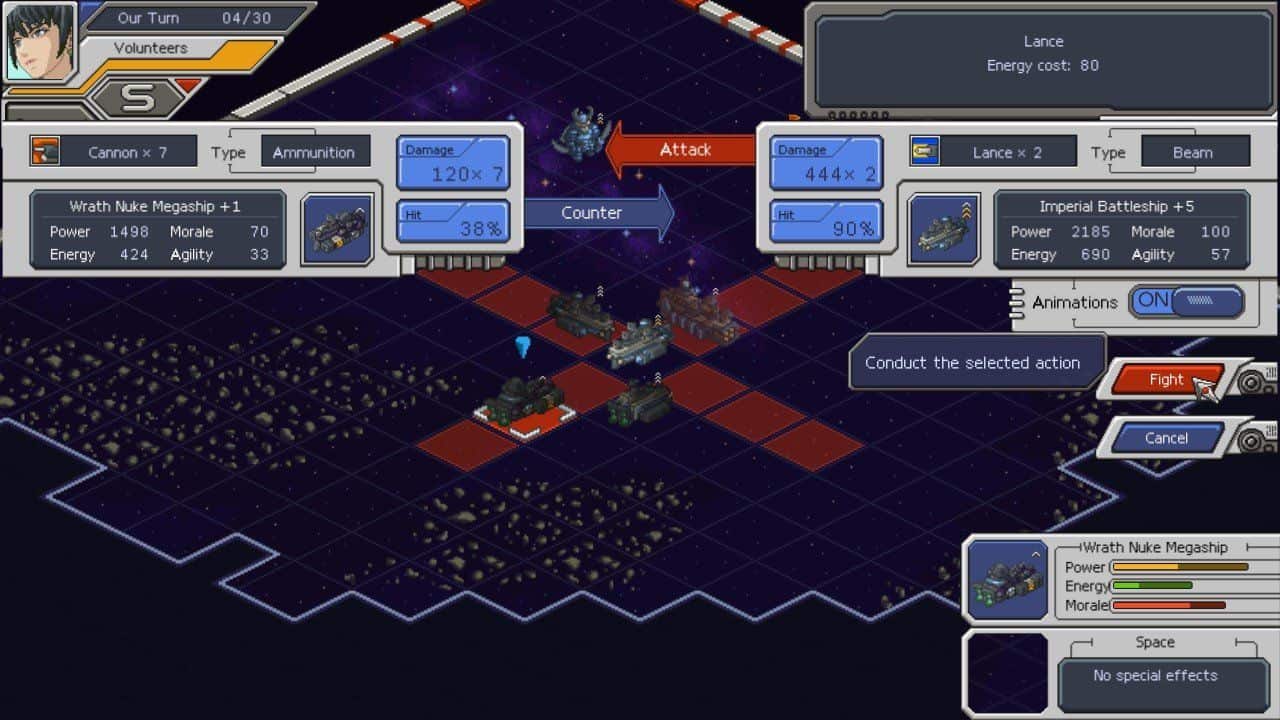
Combat occurs on a grid, similar to the turn-based games Advance Wars and Zone of Enders. Ships are moved into the range of their weapons systems and fire upon their enemies’ ships. Each commander has a unique battle skill that can be used after enough turns have passed and enough damage has been done. These skills can be game-winning; for example, one commander can prevent their ships from dying for two turns. The third ship resource that comes into play during combat is morale, which decreases when a fleet is hit. Morale decreases significantly when a fleet’s flagship is destroyed; a unit will leave the battle if it reaches zero. However, this resource is rarely an issue unless the player loses the battle significantly.
Diplomacy & Keys of Victory
I find diplomacy to be the most confusing aspect of the game. Although gifts can be given and resources can be requested from friendly factions, I never understood how enemy factions could declare war during peace when we were all allies. The explanation for this could be improved, in my opinion. This game is a 4x-lite, but it also has a storyline. While this isn’t necessarily bad, I have found that sometimes all the remaining factions are at peace with me, which can lead to repetitive turns. I would love to see a sleep function for ships, so I wouldn’t have to leave commanders sitting on planets, and I wouldn’t have to keep confirming that I want to end my turn. But luckily, we can also destroy other factions! This brings us to one of the most exciting moments in the game is when the player destroys the last planet of a particular faction. This frees their hired generals, who can be hired by the player and bring along their special abilities. Additionally, new ships can be gained upon destruction, allowing for more unit variety.
Conclusion
In conclusion, Chaos Galaxy may be perfect if you enjoy intense tactical gameplay (similar to Jagged Alliance). However, be prepared for a challenging experience without much guidance after the initial tutorial. Despite the high learning curve, the game’s pixel art is impressive, with detailed character portraits that showcase their unique abilities – and it makes up for some of the ‘flaws.’ For instance, a ninja commander can assassinate fleet commanders, while a commander wearing a plague doctor mask can drop nukes. The character designs are also distinct and reflective of their underlying skills. The replayability is high because the player can experience the galactic war from many perspectives and the accompanying events. I could see a lot of playtime from one who enjoyed this game. With sixteen factions, this enjoyable rough gem of an indie game has many stories.
