
When I was younger, I read books like crazy – nowadays, I don’t give myself the time and patience to read that much, so I usually read the manga. I often wondered what would happen if I was ‘sucked’ into the books I was reading. Would I join the Fellowship? Would I go to Hogwarts? Would I travel to unknown worlds aboard an exploration vessel? Roguebook gives you precisely that – but instead of a magical wonderland, you’re trapped in a world full of things that want to kill you—excited yet? Well, let’s give it a go!
Sequel?
So, before we kick off this review – Roguebook is a sequel to another game. Before Roguebook, we had Faeria – a game in the same setting as Roguebook, a digital collectible card and turn-based strategy game that takes place on a dynamic playing board set in a fantasy universe. It has vast lore that Roguebook uses and expands on – so if you want to read more about that, check this one out – we also reviewed it (by another Nick). And if you came here for the review of Roguebook for the PlayStation, it’s right here – by Michiel.

The Roguebook
The official synopsis for Roguebook states the following: “You are trapped in the Book of Lore of Faeria, and each page represents a new challenge. Put together the best synergies between cards, talents, and treasures, and take on the Roguebook.” Doesn’t sound creepy at all, yikes. So, Faeria is not a spherical planet orbiting a star in space; it is a flat disk encircled by the Ouroboros, a giant snake eating its tail. Faeria’s source of light comes from the eye of Ouroboros as it travels around the disk. The land closest to the eye experiences summer, while the land farthest from the eye has its winter. Above and below the plane that is Faeria are two swirling black holes that destroy everything that enters them.

And what makes the Roguebook interesting is that it originally began as an esteemed book of lore from the world of Faeria. After the events in the Chronicles of Gagana, it was lost and forgotten inside the depths of a Faeriawell. There it lingered for over a decade. The contact with this endless source of faeria transformed the book. Over time, it slowly develops its own free will – and reveals its mischievous personality. By this time, characters like Sharra and Seifer have grown into heroes and villains of legend in their regard. Their thirst for finding new challenges will draw them to this mighty artifact, now known as the Roguebook.
Deckbuilding Time!
Roguebook is, at its core, a roguelight deckbuilder with a very slick visual style, fun characters, and a really interesting map to explore. You use ink to ‘brush’ your way forward and the hopes of uncovering treasure, card pools, and other points of interest to help you on your journey through the Roguebook. When you’re not battling, you are running around in a hexagon-style map – so it offers more than just battles (looking at you, Hearthstone). It adds more balance to the pacing and is a great way to break up the action. You will unlock ink and brushes as you complete battles, which allow you to select areas of the map to uncover, and then explore. There are tons of different rewards to discover, which is one of the game’s highlights.
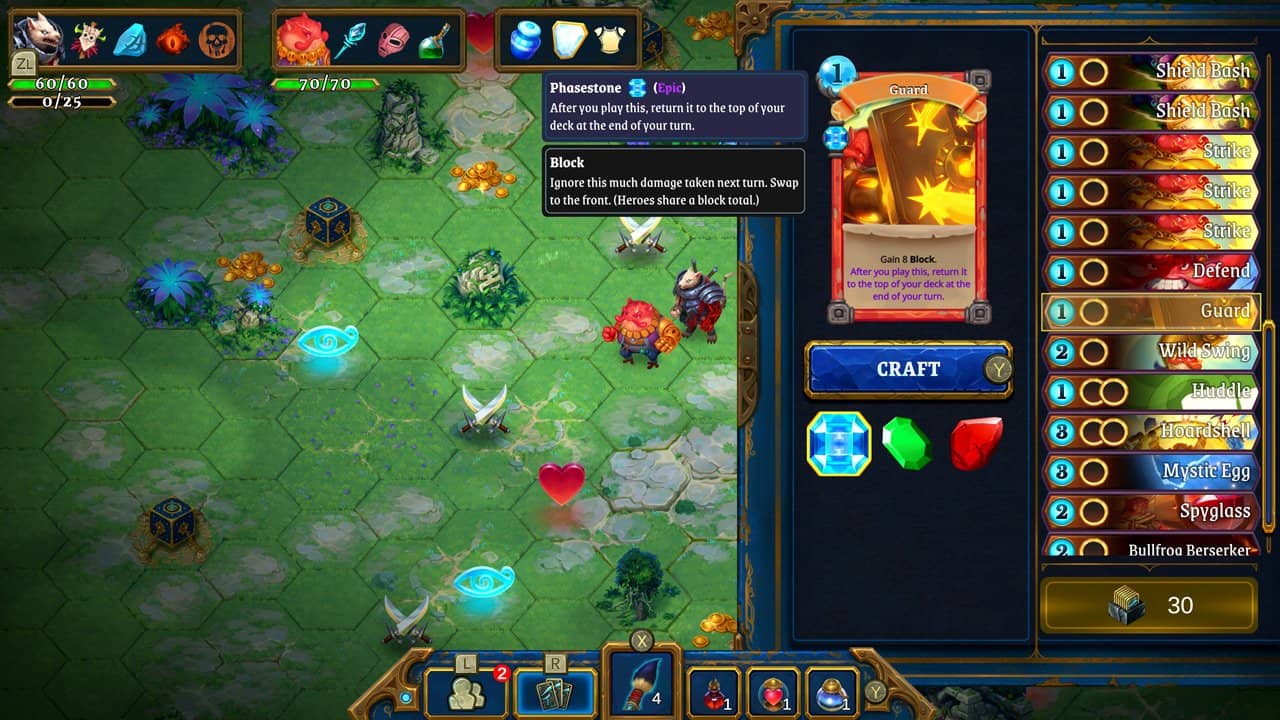
Roguebook is a straightforward deck builder to understand and get started even if you’re unfamiliar with deckbuilding games. The card descriptions are simple and easy to read. Adding gems to cards is simple, or purchasing upgrades from shops is something any newcomer to the genre will have no problem figuring out. These little things are significant to this genre, and you can tell that the developers are very experienced because they didn’t skip any steps along the way. Finally, when you’re deck is up and running, it’s time to tackle some battles with two of your heroes.
Core Battle System
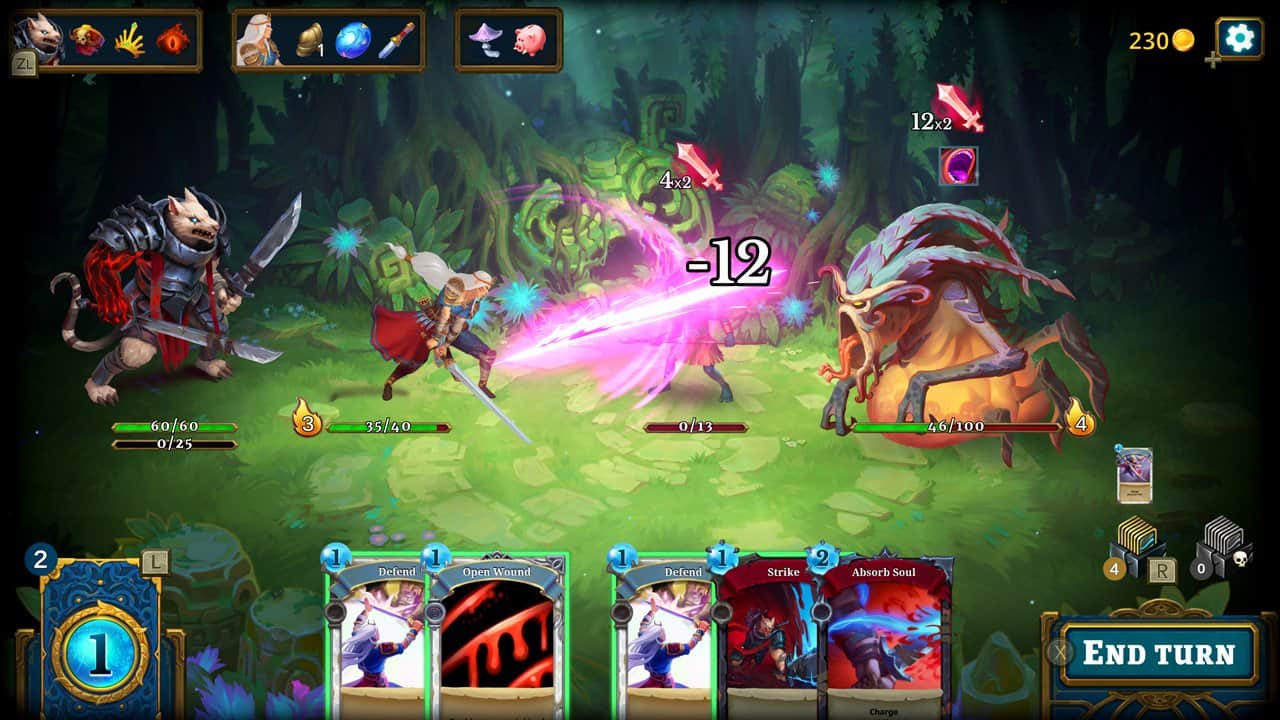
When you first launch the Roguebook, you have a party of two heroes, namely Sharra and Sorocco. During battles, the hero in the front is generally exposed to damage. However, whenever you play a card with Block or Charge, your heroes will swap positions, which can cause some very tactical decision-making. If any hero reaches 0 health, they become inactive, and their cards are replaced with 0-cost “song” cards. If 5 “song” cards are played, that hero is revived (with a low portion of health). After the battle, that hero is healed back to a low amount of health, and two Wound cards are added to your deck – which can’t be played and mess up your deckbuilding process; see it as a handicap. It is said that finding a helpful wandering monk can help you remedy these wounds (at a price). If both of your heroes reach 0 health in the same battle, your current run ends, and the Roguebook wins.
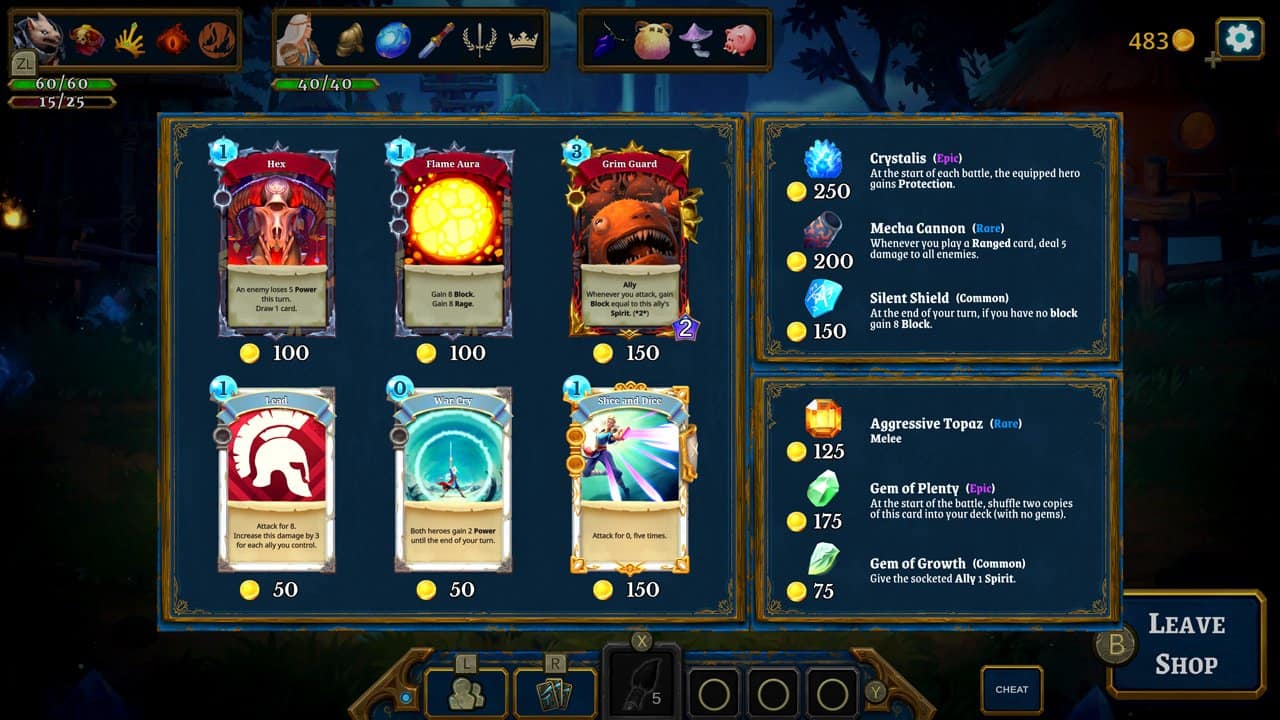
After playing a few runs, you unlock specific mechanics to upgrade your playstyle – this helps tilt the scales in your favor and helps with the permadeath image roguelikes often feature. When you get the hang of the gameplay and build up your deck with some helpful pointers, you’ll notice that you suddenly breeze through the first few levels until you hit another wall that needs conquering – well, enter the roguelike, buddy (I’m not your buddy, friend). – this is what you signed up for.

Problems?
However, the biggest problem with deckbuilding games is that the cards aren’t that interesting, making the battles one-dimensional. Most of the cards are your +attack, +defense, ‘hit all the enemies in a row,’ etc. So, most of the time, you want to maximize DPS and add as many +attack gems as you can to your cards. One character is designed to focus on DPS, the other is designed for blocking, and the third character is a little more a mix of the two. This made my playstyle more focused on positioning than the actual combining of characters to create my perfect run. Luckily Roguebook adds the map system, a nice change of pace from usual deckbuilding games.
Conclusion
So, to conclude – Roguebook doesn’t do a lot of things reasonably new, but it does make existing features decent enough to keep playing. The game looks visually stunning and combined with the map system, Roguebook offers some great deckbuilding roguelike content – especially on the Nintendo Switch. The combat can be a bit harsh and ended some of my runs prematurely, mainly because some characters have a better set of cards and the end bosses hit very hard. A boss can easily do 40 damage, and a character can be between 40 and 70 HP. A bit of tweaking would do the game well. However, the hexagons, decision-making situations, and explorable areas make up for a game that’s worth replaying from time to time. If you’re into either deckbuilding or roguelikes, Roguebook is one of the games you should check out.
