
Welcome to a remade collection review of the Collection of Sage – Final Fantasy Legends, an offshoot of the original Final Fantasy series and way ahead of its time. But did it stand the test of time? Let’s find out in our triple deluxe review!
For obvious reasons, I divided this review into three parts, all covering one of the games to keep it simple. However, I did rate the whole package as one since it’s not an option to buy only ‘one’ game, like with some other re-releases of these kinds of games. So, to recap (before we pick apart each one), the Collection of SaGa Final Fantasy Legend is an anthology release of The Final Fantasy Legend, Final Fantasy Legend II, and Final Fantasy Legend III. These three titles are considered the foundation of the SaGa series of RPGs from Square Enix that began in 1989 as an offshoot of the original Final Fantasy. It was only the second Square series to see an international release.
The Final Fantasy Legend I
The Final Fantasy Legend, originally released as (魔界塔士 サ・ガ, Makai Toushi Sa·Ga, lit. Hell Tower Warrior Sa·Ga) in Japan, was actually the first game in the SaGa series and had no connection to the Final Fantasy series. Hell Tower Warrior makes a lot more sense in the setting the game takes. This and the other two SaGa games released on the Game Boy system were rebranded as the Final Fantasy Legend series when released in the United States, undoubtedly to bolster sales, as it was only the second RPG Square had ever released in North America.

Just as Final Fantasy was originally inspired by the tabletop RPG Dungeons & Dragons, SaGa was inspired by Gamma World. Its blend of sci-fi and fantasy, absence of experience, race-based characters, and collection of various shared skills via mutation or transformations are staples of the series.
Character Creation!
At the beginning of the game, players create their initial character to lead the party. This character will be the strongest statistically and will begin with a strong weapon, but the selection cannot be undone once chosen. They are given a choice of three races:
Humans cannot learn any abilities or use magic books. Instead, they have the most equipment slots allowing them to equip a wide variety of weapons and armor.
Mutants (called Espers in the Japanese version) – they grow stronger with each battle, obtaining random stat boosts at the end of the battle. They also may learn or forget abilities, up to a total of four abilities being available to learn.
Monsters get stronger as the party defeats other monsters. At the end of each battle, one monster may drop its meat, which any of the party’s monsters can eat. The meat may transform the monster from one genus to another.
The player can also choose a gender for the Human or Mutant character, which will affect his/her starting stats; males start with higher Str values, while females begin with higher Agl values. After the initial character has been chosen, three more can be recruited at Base Town, created just like the initial character, to make a party of four members. However, units recruited from the Base Town Guild will be much weaker than the initial character.
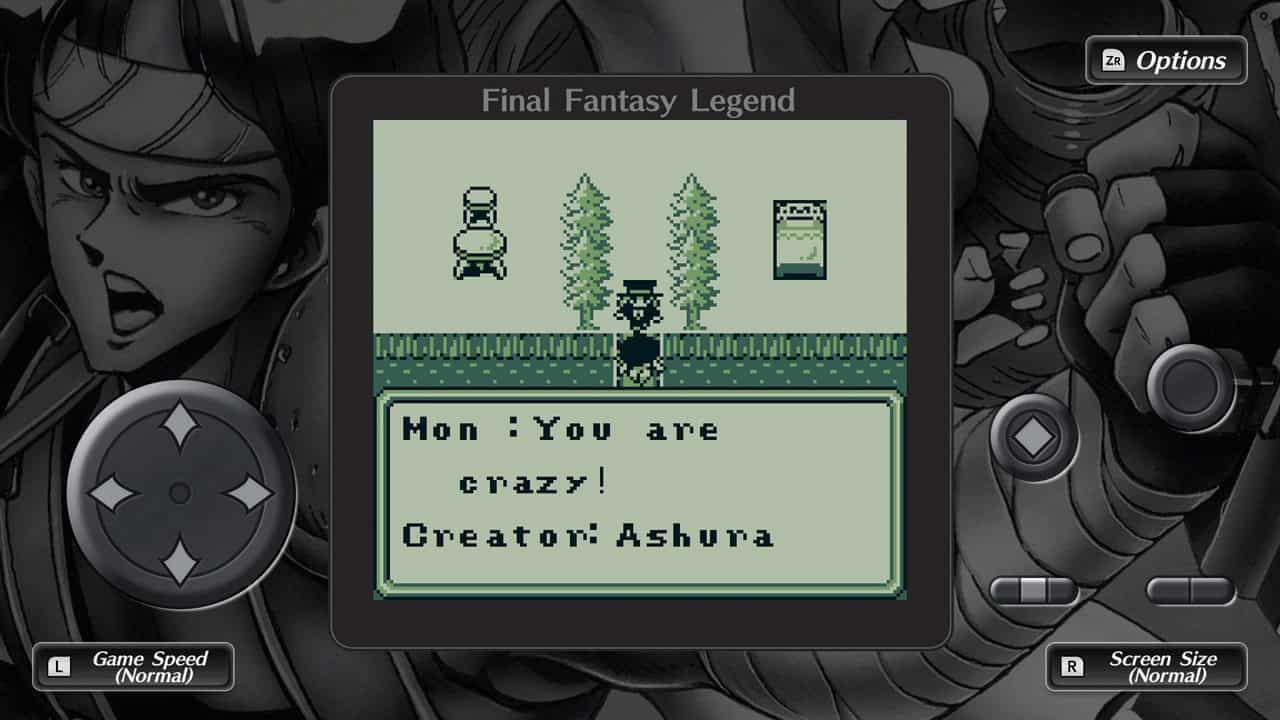
Storytime!
Storywise, The Final Fantasy Legend brings a basic J-RPG story to the table; In the center of the world is a great tower. This tower connects to many worlds, and at the top the entrance to Paradise. A group of adventurers from the world at the base of the tower decide to climb it to explore the various worlds. Along the way, they encounter many strange creatures and, among them, strong monsters based on the Four Symbols who guard the key to the next floor. Since the game does not offer any tutorial, it might be a tough one to bite through at the beginning.
The Final Fantasy Legend II
Final Fantasy Legend II, originally released as SaGa 2: Hihou Densetsu (Sa・Ga2: 秘宝伝説, Sa・Ga2 ~ The Treasure Legend?) in Japan, is a game released for the Nintendo Game Boy. Like its predecessor, the English version was re-branded as a Final Fantasy title due to its popularity in the Western territories.
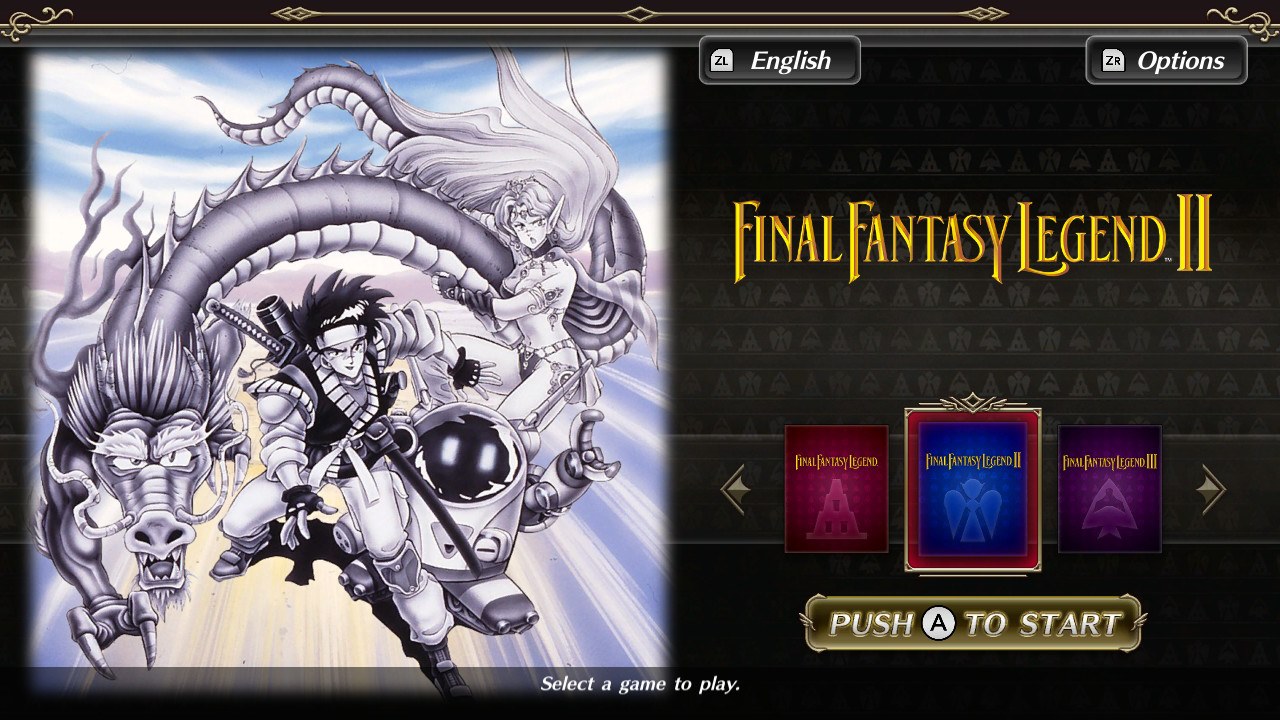
Party Time!
At the beginning of the game, the player creates their party. They are given a choice of four races, three of which are from the first Final Fantasy Legend:
Humans do not learn any abilities, but their stats increase randomly after battles depending on the equipment used. They have the most equipment slots, and are able to use potions to increase their stats.
Mutants (called Espers in the Japanese version) – Like Humans, Mutants get random stat increases after a battle. They also may learn or forget a skill, with up to a total of four skills being available to learn.
Monsters get stronger by defeating other monsters. After an enemy is defeated in battle, they may drop some meat which the monster can eat, turning them into a new monster which changes their stats and what skills they can use in battle.
Robots’ stats are dependent entirely on their equipment. Any weapon equipped by a robot only has half the number of uses, but when a robot rests at an inn, its weapon’s uses are fully restored.
Additionally, guest characters will join the party at certain points during the adventure and act of their own will in battle. Unlike the main party, these characters have predefined names as well as individual backstories.

Battle & Story
The story felt more like a J-RPG in the style of its name-sharing franchise;
…MAGI…
The symbol of great power. The legacy of the ancient gods who made this world.
Many fought for the mighty power. Some won and some failed.
Now…. another legend of bravery is about to begin….
A great tower is located in the world and connects various other worlds. All these worlds contain MAGI, fragments of an ancient Goddess who existed several eons ago. The party sets out to gather the MAGI to prevent those with sinister methods from collecting it and becoming new Gods.

There was, however, a change in the battle system, although still taken in turns. When the attack option is chosen, the character must decide which weapon they want to attack. However, the equipment has several uses. Using a weapon will decrease it by one, and when it reaches zero, it breaks and must be replaced. Luckily, a character can equip multiple weapons not to be totally useless should one of their weapons break. Every weapon has limited use regardless of whether they’re attack, agility, or mana-based. Even shields have several uses. This reminded me a lot of the Fire Emblem remade I played last year and shows how much games have changed.
The Final Fantasy Legend III
Final Fantasy Legend III, originally released as Jikuu no Hasha: Sa・Ga 3 [Kanketsu Hen] (時空の覇者 Sa・Ga3 [完結編], lit. The Ruler of Time and Space ~ SaGa3 [Final Chapter]) in Japan, was the third in the SaGa series released for the original Nintendo Game Boy. Like its two predecessors, the English version was re-branded as a Final Fantasy title due to its popularity in the Western territories.
In this entry, the player can transform into a robot, monster, cyborg, or beast by eating monster meat or installing parts to change up the gameplay again. Unlike Legend and Legend II, they can also purchase magic, where the characters learned abilities through level-ups. The party in this game comprises two humans, Arthur and Sharon, and two mutants, Curtis and Gloria. Each of the party members, and just about every character in the game, is “attuned” to a particular element that affects the creatures they can transform into.

J-RPG Standards
Storywise, the game also changes the whole setting, bending much more towards the whole ‘Final Fantasy-series and setting the example for writing J-RPGs. Although I’m a fan of them, I’m not particularly good at them, so I might miss some references they hid in here. But the story goes like this; In the future, the world is being destroyed by the Pureland water entity, and a band of rebels have gathered to avert this disaster. Their leader, Borgin, has sent three children back in time to the present in the hopes of altering the future.

The game begins in the present with Arthur, Curtis, Gloria, and Myron all engaged in a fight using the Battle Simulator, a huge device that simulates actual battles (including the spoils earned from them) with less risk than real battles. After the battle is over, Myron leaves, and the remaining three go and talk with the Elder of Dharm about their mission, which for the time being is to travel to the town of Elan and talk to Cronos about the Talon units. Units are installed into the futuristic fighter called the Talon, which can travel to the past, present, and future once the proper units have been found and installed. The first key item Arthur received is the Radar, which detects the number of units that remain uncollected in the current time period.
Conclusion
Since these games were never released in Europe, only a handful of people have played these releases before they hit the Nintendo Switch just last December. It will probably appeal to a very certain public since these kinds of games did not stand the test of time in the current gaming climate. Nowadays, gamers are a little bit spoiled when we look at ‘taking the player by the hand and showing him the ropes’. I personally prefer it this way in extremely complicated JRPGs like Xenoblade and the such. But, if you are into old school JRPGs and have never played these before and still get your kicks out of the original Final Fantasy or Golden Sun games, these might be right up your alley. The remakes offer enough options to grant a modern feel and speed up your gameplay or experience. It’s all about making the connection to the game you’re trying to figure out (and maybe read some background info on, since the mechanics can be rough).
