
Have you always dreamed about becoming the next Eiichiro Oda, Masashi Kishimoto, Akira Toriyama, or Osamu Tezuka? Then The Manga Works is right up your alley. If the names I just mentioned don’t ring any bell, then you should probably skip this title. On the other hand, it’s never a bad idea to broaden your horizon with some Japanse culture. Oh, and if you did not notice yet, yes – another Kairosoft title!

The Manga Works!
It’s the manga artist experience you’ve been waiting for! Create a manga masterpiece and draw your way into the nation’s heart. I’ve been a long time fan of manga and anime. What began with series like Fullmetal Alchemist and One Piece were already there in my childhood. I just did not know that it was anime. We had dubbed versions of Pokémon, Yu-Gi-Oh, Digimon, Sailor Moon, and many more on the Dutch TV. Even Crayon Shin-Chan was broadcasted, and it was NOT child-friendly, although it was marketed as such – we watched a series about a little boy doing the bare-bottom-boogie. One of my all-time favorite manga (and anime adaptation) is Bakuman, by the writer & artist of Death Note. The premise of Bakuman is a simple one:
When Moritaka Mashiro, a junior high student, forgets his notebook in class, he finds his classmate, Akito Takagi, who notes Mashiro’s drawings. Takagi asks him to become a manga artist to his stories. Mashiro declines, citing his late manga artist uncle, who died from overworking. Takagi incites Mashiro to meet with Miho Azuki, Mashiro’s crush, and tells her the two plan to become manga artists. In response, Azuki reveals her plans to be a voice actress. Mashiro proposes to her that they should both marry when Azuki becomes a voice actress for the anime adaptation of their manga. She accepts, but under the condition that they not meet face-to-face again until then. The two then start creating their manga, under the pen name Muto Ashirogi, in hopes of getting serialized in Weekly Shōnen Jump.
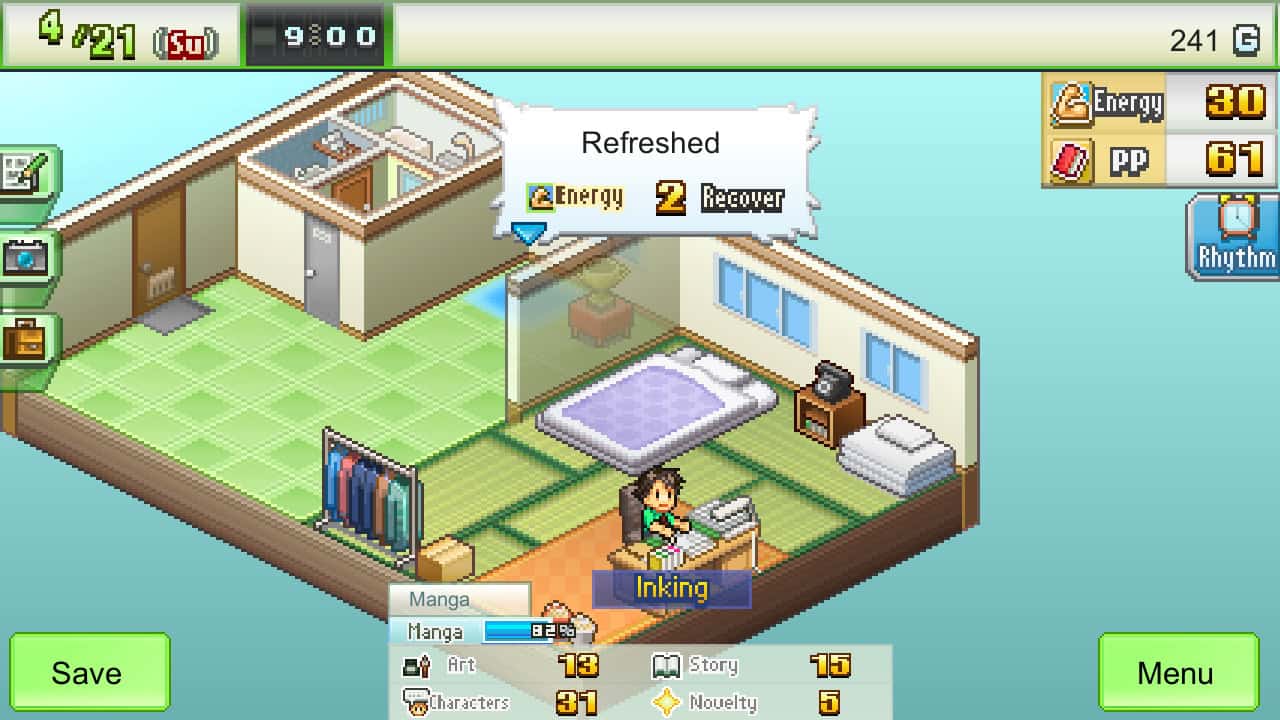
The Manga Works follows a similar path (except for the romance). You start as a fledgling manga artist in a small and empty room… Armed with only a single pen, you’ll have to draw the best manga you can and march proudly to the publishers to show off your work. But you can’t draw manga without a good concept. Ideas are the lifeblood of a manga artist. So The Manga Works offers a way to gain inspiration. Trading in some of your precious energy will result in search of inspiration and gather plot points, then stuff your manga full of creativity. Accumulate experience points and use them for training up your drawing, storytelling, and other skills. When you think you’ve created a great one-shot, take it to a publisher! If you manage to make the “editor from hell” smile, it might just be the start of a fruitful relationship.
Gameplay
Usually, the game follows the same path. Pick a manga theme – battle, emotional, horror, etc. and combine it with an idea. Since the battle manga is the easiest to write, I started with some simple battle manga. The themes I used were ones I used to watch when I was a little younger. Highschool x Teens, Highschool x Witches, Family x House, Monsters x Stone Age, Gangsters x Classroom, etc. You can probably guess some of the manga I had in mind when picking my combo’s. Some worked well, some.. well, were mildly received. Once a one-shot gained enough momentum, you could go for a serialization. In the beginning, your manga runs for a total of one or two volumes, depending on the set while upgrading your skills, and writing more complex manga, the length of the volumes increases – which means more money and more room for upgrades, assistants, etc.
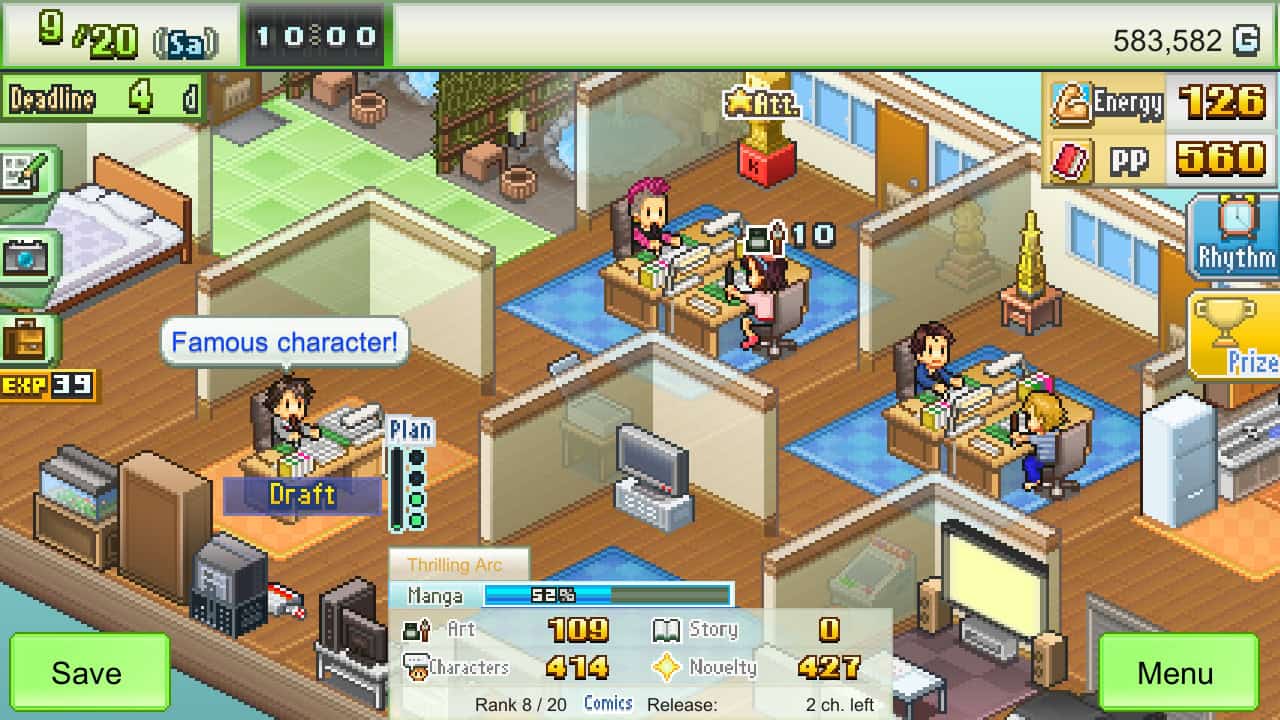
Gaining more fame and momentum also means working with other publishers than run-of-the-mill publishers. These more ‘high-end’ publishers do tend to have a particular fanbase, so you have to keep that in mind when creating a manga. I could write a lovely battle manga, focused on a warzone with snipers, but that wouldn’t be a hit with a publisher that concentrates on female office workers. These mechanics made the game challenging and refreshing since the gameplay feels a little repetitive. With the change of theme’s and fanbase, The Manga Works keeps it fresh, and probably more refreshing than the room of most mangaka.
Approval?
So, no downsides this time? No complaints about a steep learning curve? Well, no, not really. I had a blast with my first career and breezed through the game once I figured out a decent balance between work and inspiration. The one thing I hated was the fact that I had gained a reputation with most editors at some point (except for the final ones), which resulted in getting offers from the ‘lower’ ones. I wanted to make more money and gain more fame, which would not work if I kept accepting the ‘lower’ publishers. But by declining them, my approval rating of these editors plummeted, which resulted in taking a few steps back at a particular magazine. And since you can’t work for two magazines at the same time, this held back my game progression quite a bit.

Conclusion:
On the other hand, it felt like I was living the gamification of Bakuman (sort of). They captured the essence of the manga-business and distilled it into a fun to play simulator, with deep mechanics. If you understand them, you’ll produce the best manga the world has ever seen and will be able to write your name down in history! Ever wanted to turn your manga into a toyline? Well, you can get it with The Manga Works. Except for the minor setback, it’s one of my favorite Kairosoft titles I played till now (and as you know, I played a lot).
