
Join professor Lemeza Kosugi and his daughter Lumisa Kosugi in the exploration of La-Mulana. Tales of the exploits of Lemeza in the ruins of La-Mulana may be known worldwide, but he was also responsible for the ruins’ destruction and has gone into hiding as a result. His love of exploration has not faded, however, and he still finds time to go spelunking in secret. Meanwhile, you can also opt to play as Lumisa. Some say she is Lemeza’s wife’s daughter from a previous marriage, while others believe she’s Professor Shawn’s illegitimate child. Either way, she is a Kosugi; that much is clear. She travels to La-Mulana to make her archaeological debut after accepting Xelpud’s request to search the ruins. Sidenote: I’ll be reviewing both games in one article.
But first, let’s set the mood, and yes, this was the first thing that popped into my head when booting up La-Mulana.
Storywise:
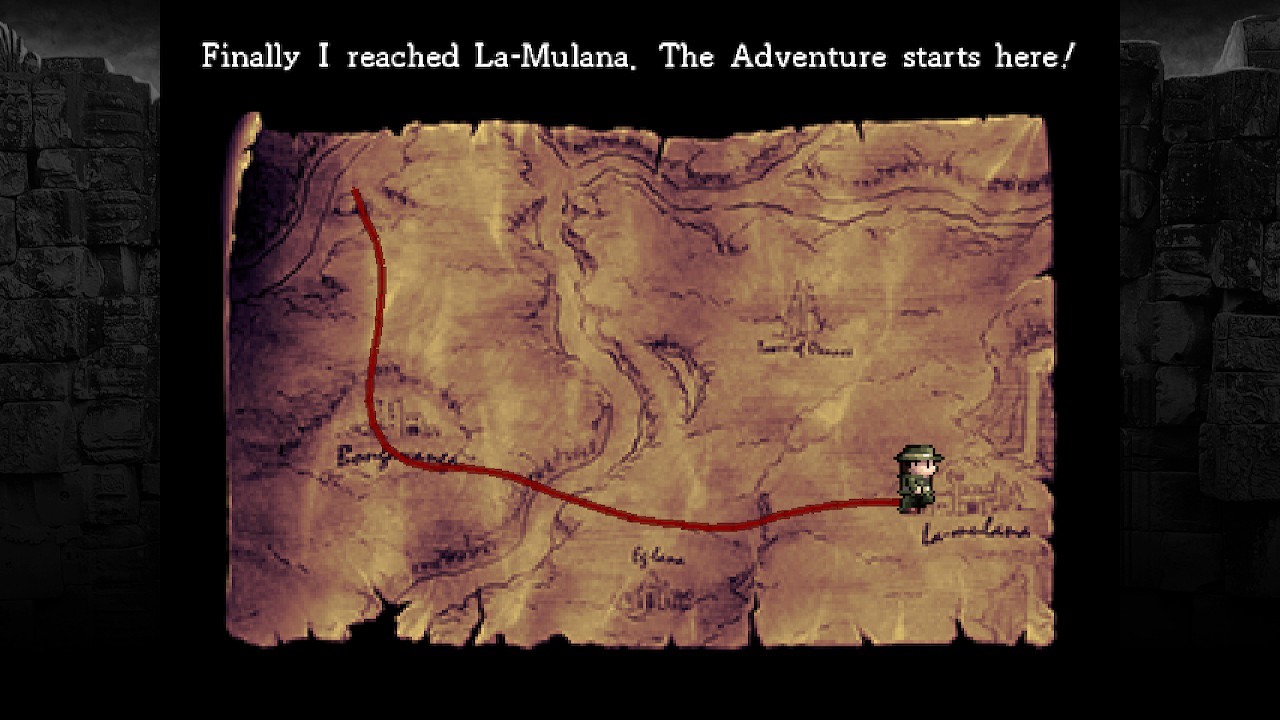
La-Mulana 1 and 2 are action-adventure games; to be more genre-specific, it’s a Metroidvania game that allows for lots of action via multiple rooms of brain-tingling puzzles. Of course, the main aim of the game is to enjoy solving these puzzles aided by a wide array of hints and tips, and of course, whipping enemies into oblivion. So if you want to classify these titles, it’s Castlevania with, and Indiana (or Indianette) Jones sauce poured over it. In the first entry, you play as Lemeza Kosugi, a professor of archaeology. He receives a letter from his father, Shorn Kosugi, who claims he has discovered the ruins of La-Mulana, supposedly the birthplace of all civilizations, and carries the secret treasure of life itself. Following his father’s trial, Lemeza comes to the ruins and discovers it is composed of various amalgamations of various ruins and structures from different areas around the globe. Upon further exploration and discovery within the ruins, Lemeza learns the story about how a being known as “the Mother” fell from the sky and crashed onto the planet. The Mother has sought to do to return to space where it came from. To this end, she created various “children,” which were different races that roamed the planet that she tasked to find a way to send her back to the sky. None of them could figure out a way to accomplish this task, which angered the Mother much and would destroy them in her rage, to start over again with a new race.
La-Mulana 2:
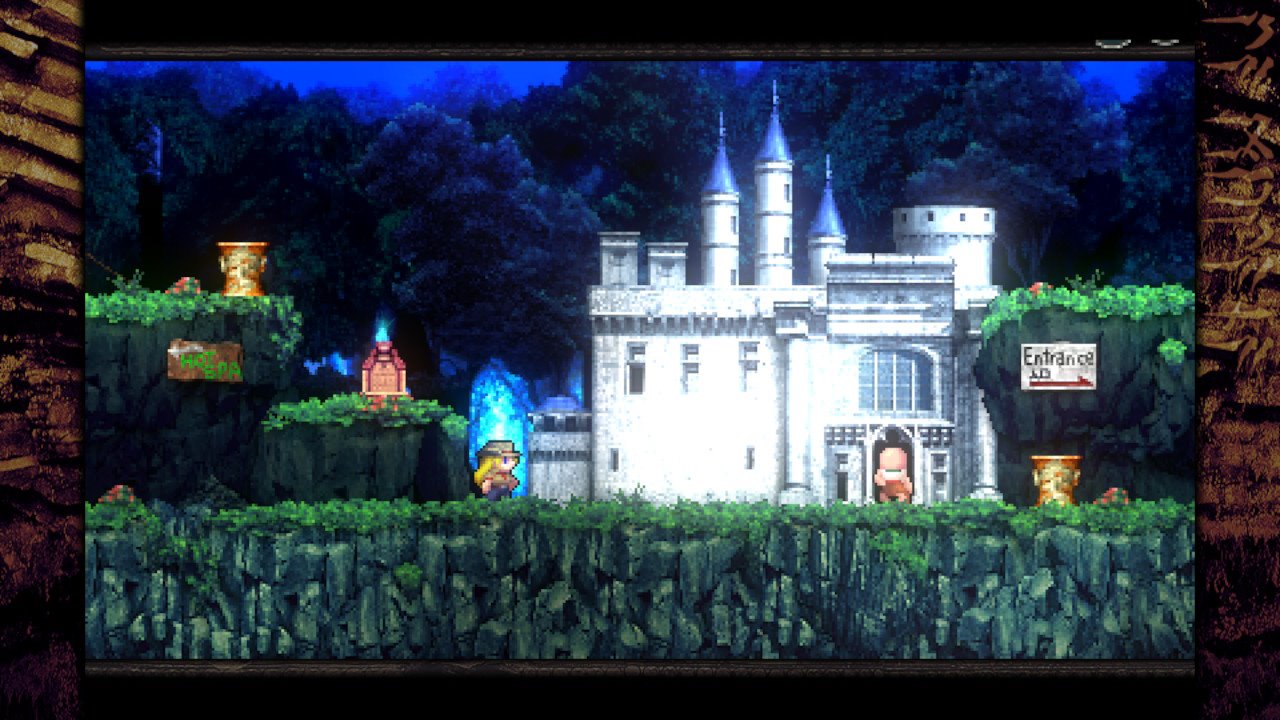
Due to spoilers, I will not tell you more about the story of La-Mulana since it the power of the story that makes the game worthwhile. In La-Mulana 2, the story continues. The game came together through a successful Kickstarter campaign. Several years have passed since the secrets of the La-Mulana ruins, said to be the cradle of all civilization, were revealed by a single archaeologist. The ruins were almost destroyed, and inspections have barely made any progress. But nearby villagers have succeeded in turning the entrance to the ruins into a hot tourist spot. Known as the “7th Children” born from the “Mother” – the source of all humanity – the villagers who have spent millennia protecting the ruins have begun a new life. But monsters have started popping up from somewhere within the ruins, which have now been transformed into a tourist spot. The “Mother” birthing the monsters – the La-Mulana ruins themselves – were supposed to have stopped functioning altogether. The village elder sends a request for the inspection of the La-Mulana ruins to a father and son team of archaeologists. Still, currently lying low to escape the anger of the villagers after previously having almost wholly destroyed the ruins, they apparently can’t be contacted. That’s when Lumisa Kosugi, an archaeologist’s daughter, arrives at the village. The Eg-Lana ruins – also known as “the other La-Mulana” – were used by the inhabitants of the ruins as a land of exile. There lies evil, hatred, rage… Will Lumisa prove able to uncover and solve the mysteries of the Eg-Lana ruins?
Gameplay:
La-Mulana is one of those games with a huge cult following. I dig the whole Metroidvania genre, but I also prefer a game which gives me some pointers on how to proceed. La-Mulana does not offer any help in this genre at all. Although there is only one ending in the game, there are many ways to get there, in that completing objectives in the game (gaining power-ups and reaching new areas) is not linear, nor is there an obvious recommended path to take. Since the game was intended as a tribute to the MSX games of the 1980s (and especially to Maze of Galious), it uses the 16-color palette and low resolution typical of those games. The opening sequence parodies the standard load screen of the MSX, displaying the amount of available video RAM and a copy of the MSX logo. The protagonist has a laptop MSX in his possession throughout the game, and can collect or buy ROM cartridges for it; many of these can be combined to produce various special effects. An ingenious feature!
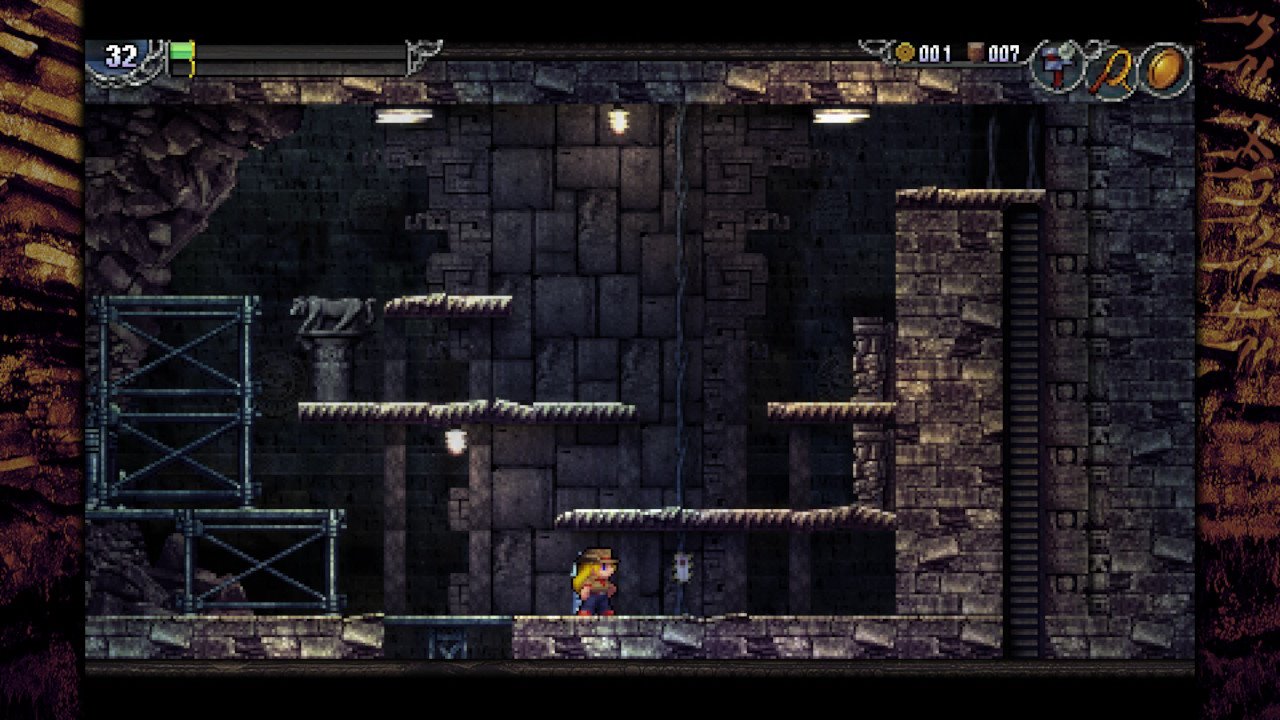
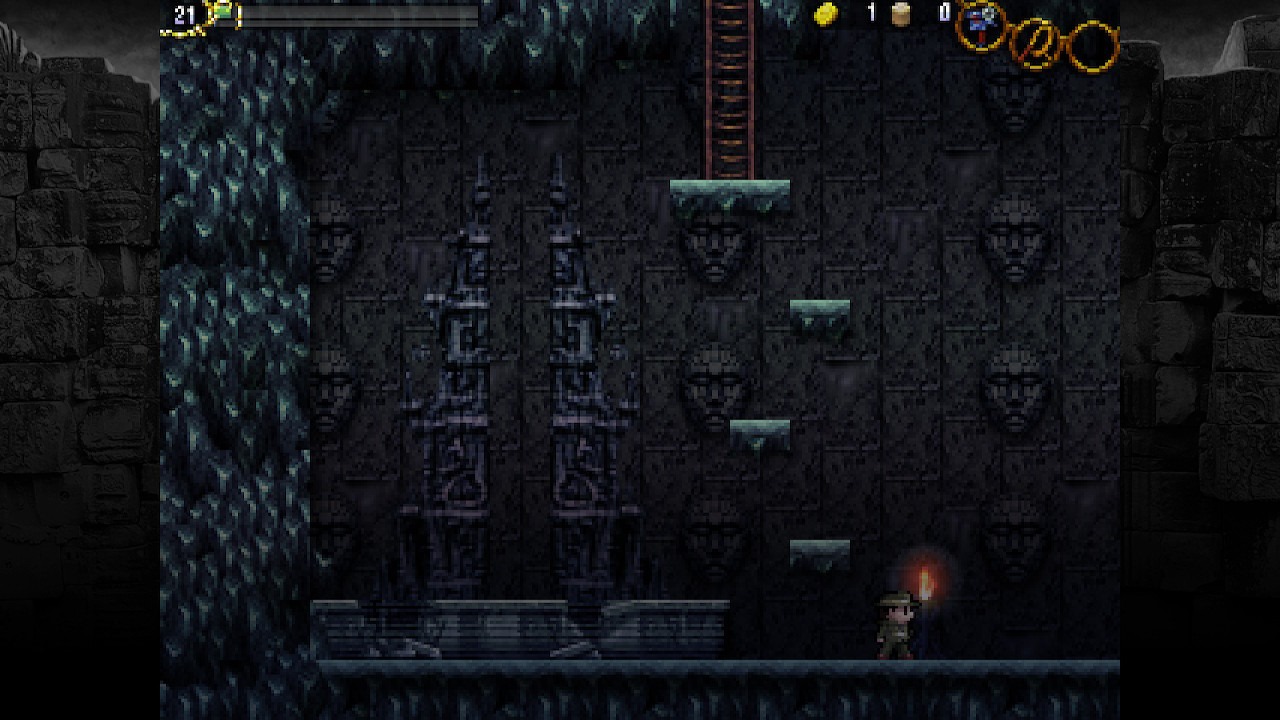
One of the principles behind the game’s design is the difficulty. As described in the game’s manual, the developers were disappointed in the lack of challenge prevalent among many games and sought to help create a sense of tension in the game. In essence, the example they gave was that, if one were a real-life archaeologist, one might think twice before jumping into a dark pit. Still, in many videogames, it is too easy to simply attempt the action, suffer the consequences, and reload. The tension is created by arming many features in the game with various traps that can quickly occur reckless adventurers, as well as several complete dead ends, from which, short of teleportation, there is no way out. The game explains these traps as existing to protect the sacred ruins. This is probably one of the reasons these games have such a cult following. I am not one of them.

Cons:
I liked the mythological settings of both La-Mulana 1 and 2, but the games felt the same. When playing a Metroidvania, you except some exploring and backtracking, this was the whole point of most of the Castlevania games. But they at least gave you a heads-up where to start. My first few rounds with La-Mulana ended up with missing points or places. I found out due to the mail conversation of the perverted professor. So, restarting the game and heading off in another direction – only to end up in an area I should not have been for a long time and getting stuck/dying a lot. And for those pointing at the higher difficulty level, I played through Salt & Sanctuary, Dead Cells & Hollow Knight – so no, it was not too hard.

Another factor is the language barrier. La-Mulana was initially developed in Japanse and was translated a lot later (like a lot of the Fire Emblem and Mother games). The translation is not always on point, and I was uncomfortable with a lot of the cultural references. Sure, you wanted to add a certain Master Roshi spinoff-character in your game, but harassing a female lead in a game is not oke. There are a lot of games out there, like Catherine, for example, that put this kind of situation in a game-perspective – La-Mulana missed the mark on this point. Just keep going with the Indiana Jones vibe, that’s where you’re good at.
La-Mulana 2 is described as the other Mulana – but felt like La-Mulana backward. The dungeons felt the same; the enemies felt the same; the vibe felt the same. And the fact that “The first La-Mulana was a remake of a retro-styled game that ran in a 4:3 aspect ratio, which made widescreen support impossible. For La-Mulana 2, NIGORO is developing the game’s areas and rooms with a 16:9 aspect ratio in mind, making it perfect for widescreen TVs and monitors.” does not make up for this.

Conclusion:
The La-Mulana collection is a nice addition to the ever-growing Switch library. However, it’s not the great Metroidvania some people claim it to be. I get it, it’s the Shovel Knight of my library, that one game with a mass adoration from a lot of people. But it bugs me that I need to read a start-up guide to master the controls and figure out some of the basic elements of the game. Sure, I don’t mind some reading, but include it in the game or give us a download with the game (or in a booklet in print). It’s a game with a great story, a nice soundtrack but a lot of flaws. Some of which I can not overlook since I’m not playing the game with pink-lovely-dovely-glasses on.
