
As a historian by trade, I don’t often dabble with the big what-if question. I do like it when I have the opportunity to experience such a feat through a movie, book or video game. Iron Sky is an excellent example of a movie I would never show in a classroom (but neither will I let them watch Troy). Luckily I don’t have to share Vampyr with the average day students, since we don’t teach about vampires in school anymore, and neither do we teach about the Spanish flu. Class is in session!
A little bit of vampiric story:
London, 1918. You are newly-turned vampire Dr. Jonathan Reid. As a doctor, you must find a cure to save the city’s flu-ravaged citizens. As a vampire, you are cursed to feed on those you vowed to heal. Will you embrace the monster within? The game was released in 2o18 for PS4 and Xbox, but we get to experience the vampire’s life for the first time on Nintendo Switch™. You must survive and fight against vampire hunters, undead, and other monstrosities. Armed with unholy powers to manipulate and delve into the lives of those around you are to decide who will be your next victim. Struggle to live with your decisions… your actions will save or doom London.

With Vampyr we have what would have been the lovechild between Bioware’s Dragon Age/Mass Effect, and any Assassin’s Creed game. Add in the ‘little sister’-paradox from Bioshock and some graphical tricks from The Saboteur (Black-White & Red setting) and you have yourself an old school vampire game.

Doctoral Paradox
In the aftermath of the Great War, 1918 London is ravaged by a mysterious illness that is tearing the city apart. As a doctor, you have taken an oath to heal those in need, and your medical expertise has given you the means to find a cure that will save the city. As a newly-turned vampire, you now also have the power to defend London from the strange creatures roaming at night. However, you’ll need to survive and grow strong enough to succeed in your calling – and that means you’ll need to feed…

Reid is not any ordinary doctor. No, he’s a specialist in, you guessed it, blood transfusions. What does this mean for the game? Well, we have a doc-pire that specializes in sucking blood out of his patients. This does come in handy since Vampyr is built around the setting of the Spanish Flu, which was one of the most deadly influenza outbreaks in the modern era. To give you an idea:
The outbreak of this influenza virus, also known as Spanish flu, spread with astonishing speed around the world, overwhelming India, and reaching Australia and the remote Pacific islands. In just 18 months at least a third of the world’s population was infected. Estimates on the exact number of fatalities vary wildly, from 20 million to 50 million to 100 million deaths. If the upper end of that estimate is accurate, the 1918 pandemic killed more people than both World Wars put together.
The drama of the war also served to obscure the unusually high mortality rates of the new virus. At this early stage, the illness was not well understood and deaths were often attributed to pneumonia. Strict wartime censorship meant that the European and North American press were unable to report outbreaks. Only in neutral Spain could the press speak freely about what was happening, and it was from this media coverage that the disease took its nickname.

War, war never changes
This concept of Spanish Flu, mixed with a vampiric outbreak, is what makes the game interesting. The signs of the ravaging war are really visible through interbellum London. Propaganda posters are torn on the walls, the buildings are severely damaged and throughout London, you will encounter men with shellshock (PTSS) and women who have lost all sanity due to their husbands dying. It’s not strange that flu will have more power to ravage such a country.
“With Vampyr we have what would have been the lovechild between Bioware’s Dragon Age/Mass Effect, and any Assassin’s Creed game.”
To find a solution for the constant deaths, caused not only by flu – but also by vampiric creatures, street gangs rise, the church creates vampiric hunting squads and the districts of London try to keep its sanity by looking for the social pillars of the community. Vampyr is a game of choice and consequence – only you can decide which citizens to feed upon or spare. The game’s progression is intrinsically tied to London’s citizens, and each sacrifice grants a potentially huge growth in power (Bioshock system). Just remember… Every character you talk to has a purpose in the world; a job, a family, and a story. Impact one of them, and you will touch the others… Yes, even that annoying priest with it’s burning cross.

Choices
While playing through Vampyr I had to make choices. Some I liked, some made me question if I should start over, some felt like ‘finally’. I saved my first ‘victim’, a local gang leader – as I learned of later. I also saved a nurse who was helping the back allied citizens of White Chapel.. but I made her stop practicing in the region, brainwashed and all. The first victim never hurt a fly after I saved him – he only was foul-mouthed. The second one, the nurse, left and the district plummeted into chaos… Should I have let her practice her illegal acts? Should I have killed her and gained a massive amount of XP I could certainly use to evolve my abilities? There was no way back, so I will never know.

Dilemmas
It’s this lingering ethical dilemma that triggered my ‘I like this game’-part in my brain. No, the game does not stand out graphically and still suffers from long loading times. But it’s well written and the moral dilemmas are nicely done. The historical accuracy is nicely interwoven with vampiric tendencies (which I can not share in this review since it would spoil a lot of the story).

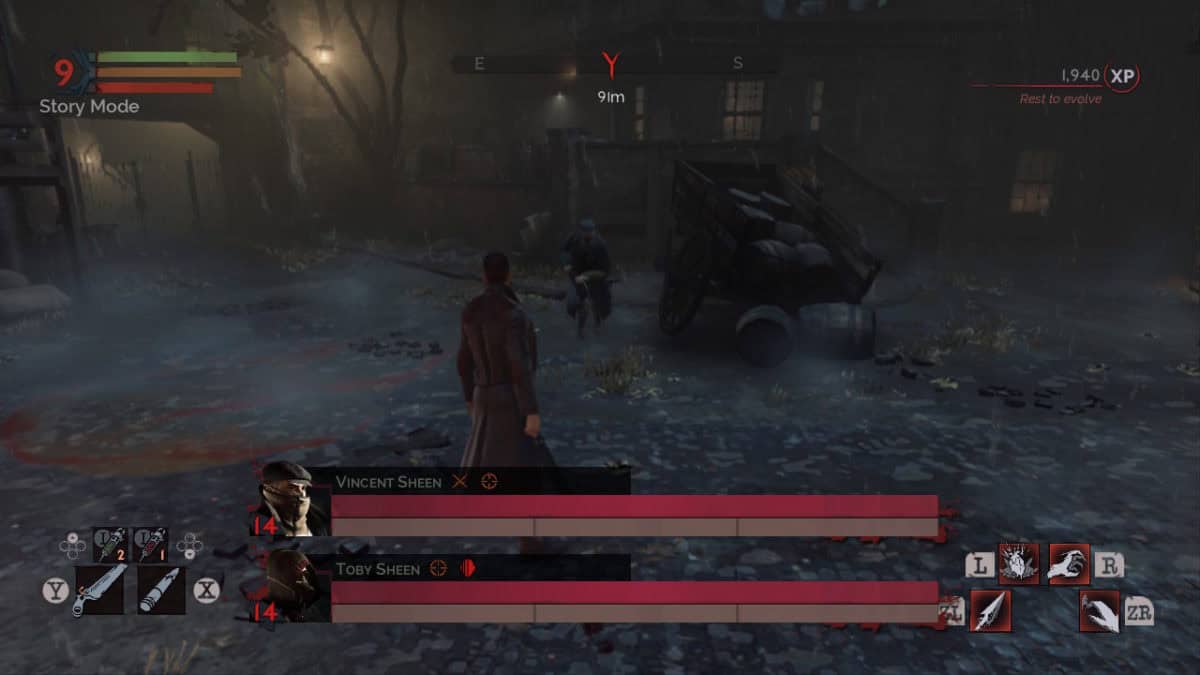
The combat system is ok, not the best I have ever seen. You have the choice to fight with one and two-handed weapons. Close combat, ranged and vampiric are all options for your own personal combat-style. I personally prefer to use close combat surgical weaponry, combined with long-range blood spears (which are highly overpowered). Vampyr gives you a whole range of vampiric weaponry attributes which can be gained by evolving your character. You gain XP by solving quests or murdering the people of London. The better the health and relationship with the victim, the more XP you’ll gain. I personally tried to kill as less people as possible, since I prefer the pacifistic playstyle. This left me enough room to tackle most of the enemies, but that’s a personal preference.
Conclusion
So, what does this leave us with? A game about post-Great War London which is being ravaged by flu, vampires, and other.. strange occurrences. A detective meets action-RPG is probably the best combination of genre for Vampyr – and it works. It’s a nice touch for people who prefer a more dark game, instead of the bright Nintendo-mascot themed games. Then again, it’s one of those ports where you never thought the Nintendo Switch would receive. It’s also one of those games that will probably be overlooked in the Witcher and Pokémon violence. Meanwhile, the studio behind Life is Strange delivers a solid vampire game on the Nintendo Switch. So, if you don’t mind, I’m going to find out more about the Spanish Vampire Flu.
