
Is it me, or does Bigben Interactive have too many racing game IPs in its possession? Whenever a new racing game gets released and it’s not one of the big titles like Need for Speed or Forza, there’s a big chance it’s a game made and/or published by Bigben. That’s not a bad thing per se, but it does make it obvious at times that Bigben creates theses game just so they can keep the IPs alive and earn a quick buck. V-Rally 4 is a clear example of that, which makes the game a generic experience.
The story behind the creation of V-Rally 4 is pretty interesting. The ‘V-Rally’ name hasn’t been used in 15 years, with the last entry of the series, V-Rally 3, being released in 2002. The V-Rally games weren’t bad games, far from it actually, but V-Rally 3’s sales numbers were basically depressing. The series then got shelved and most of the developers shifted their focus to other projects. The V-Rally IP eventually got acquired by Bigben Interactive, who decided to release the next installment in 2018. The reason behind that is simple business tactics, as Bigben didn’t have any other rally game to release this year, which they wanted to avoid. Thus, V-Rally 4 was hastily created with only one member of the original team behind the early V-Rally games overseeing the project.
In V-Rally 4, you have access to five different types of competition: Rally, V-Rally Cross, Buggy, Hillclimb, and Extreme-Khana. I’ve started off with the V-Rally Cross and after an hour or so I determined that this game is not the kind you’re playing with your right trigger always pressed to the max. The controls are calibrated pretty sensitively from the start and you’ll eventually find yourself dancing through corners just by pinching the brake trigger and slightly pushing down on the throttle. Turning the car by using the analog stick might seem a bit problematic at times, especially when you’re jumping your buggy off ramps. I mean, jumping is easy; finding the right turning angle upon landing is the tricky part. Reaching that finesse is not impossible, it only requires a bit of patience and practice.
In the Activity Hub screen, you see all the available events at a given moment, scattered across the world map. Regardless of the discipline, each event has an entry fee and a duration. By entering the event, you’re implicitly skipping the said number of days. This becomes relevant once you find out you have to pay for your employees (engineers, mechanics, agent) in weekly increments. So, for example, if you’re entering a three-day event and, after that, a four-day event, you have to make sure these two events are paying well enough to keep your team happy. Luckily, there are enough race offers, and they’re paid generously as well. All you have to do is finish the race on the podium, preferably at the top of it.
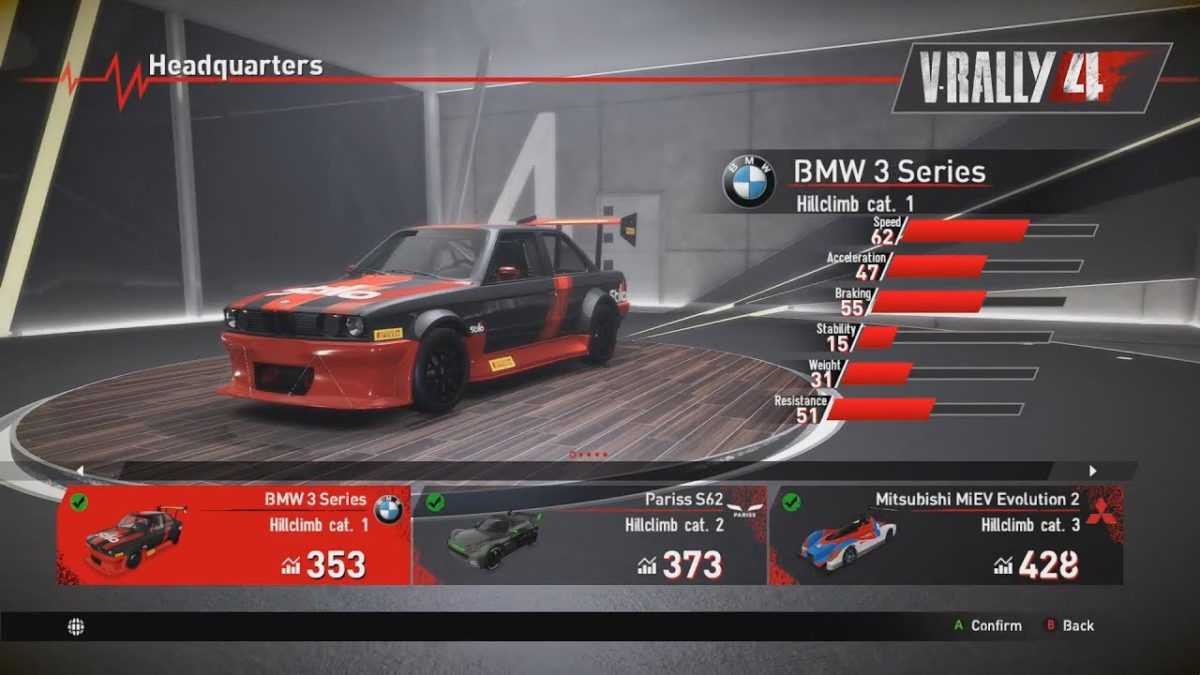
This day-skipping mechanism is also relevant when it comes to upgrading your cars. The Garage has three features: Upgrade, Customize, and Technical Sheet. In the Upgrade screen, you’re shown various areas where you can enhance your car (engine, chassis, gearbox, etc.) and the number of days required for that upgrade to unlock. So the more you drive a car, the more it becomes available for upgrades. Customizing your car is far different from what you’ve been used to recently and not necessarily in a good way. The tools for customization seem to have been made available only because the other racing games also have it. It’s not impossible to make art on your car, it’s only very disheartening at the beginning. I didn’t have the curiosity, or the patience to fully explore this feature.
Gameplay-wise, sticking with one car is a money-efficient way of progressing through the game, although winning a three-star championship with you initial Beetle buggy might prove challenging. Luckily, this doesn’t automatically mean you need a more expensive car; just dial down the AI Level at the beginning of the race. But mind you, this will come with a decrease in payment. You can also win money via multiplayer events or races. In the V-Rally Mode (career mode) the multiplayer component consists of online time-trial events. Depending on your position in the standings (once the event is finished), you’re rewarded with money. In the Multiplayer tab found in the Main Menu, you’ll be able to rub shoulders with (and compete against) other human players via online live races or the good old fashion split screen.

Regarding the graphics, I’ve postponed the topic for the end of the review, because it is still a bowl of mixed feelings for me. To put it bluntly, V-Rally 4 leaves to be desired in this area, at least on Xbox One. The textures seem shallow, and the cars renderings, crude. However, hop in your Hillclimb car for a Transfagarasan ride on a clear morning weather, and you’ll be tempted to raise your arm to shield your eyes from the sun rays. The environments can look pretty with the right weather effects, but that’s the only part of the graphics that can look good. All the other visual effects are severely lacking.

Conclusion
To be honest, V-Rally 4 is a fine racing game, but it has one major issue. It simply is a ‘generic’ game that doesn’t offer that much unique when compared to other titles in the genre. The only mechanic that’s somewhat unique is the calendar system that tells you how long an event takes and thus how much money you have to earn to pay all your bills. All the other mechanics V-Rally 4 can be found in every other racing game. Add to that the rather subpar visuals and outdated car customization and you get a bland game that probably won’t convince most people to try it out.
