
There’s a specific kind of confidence required to step into the souls like arena. It’s a genre where players expect punishment, systems layered on top of systems, and a learning curve that doesn’t wait for you to catch up. Crimson Capes clearly understands that challenge, perhaps a little too well. From the opening moments, Crimson Capes presents itself as a game that wants to be taken seriously. Dark fantasy, methodical combat, punishing encounters, all the familiar signals are there. The question is not whether the ambition exists, but whether the experience supports it.
The studio behind the Cape
Crimson Capes is developed by Poor Locke, a small studio with a clear vision and a strong love for classic design philosophies. The sheer depth of the game’s systems, from combat disciplines to composite attacks, stamina pressure, recalls, and status effects, shows a team that has spent serious time thinking about how players should engage with combat rather than simply react to it. The manual alone reads like a design document from another era: dense, unapologetically detailed, and fully committed to explaining its mechanics rather than simplifying them. It feels like one of those manuals you read in the back of the car when you drive home from the store. And that’s admirable, but it also foreshadows some of the game’s core issues.
A story told in blood and fragments
The narrative of Crimson Capes is rooted in a familiar yet effective dark-fantasy premise. A kingdom corrupted by mages, a king betrayed, and an elite order of witch hunters armed with enchanted crimson cloaks. The lore, spanning the Witching War, the conspirators, and the Crimson Capes themselves, is rich and atmospheric, but mostly delivered indirectly. You won’t find Henry Cavill, but you will find a surprising depth through other means. Much like traditional souls, story elements are uncovered through memory fragments, environmental clues, and short encounters rather than direct exposition. While this approach fits the genre well, Crimson Capes never quite elevates its story beyond background flavour. The world feels lived-in, but distant. And that’s okay? It lingers, it’s there, and I want to unravel the cape to see if I connected the dots in the right way. But it could have been a little bit more on the surface. And with that in mind, let’s talk about the elephant in the room. Combat.
Gameplay: deep systems, heavy hands
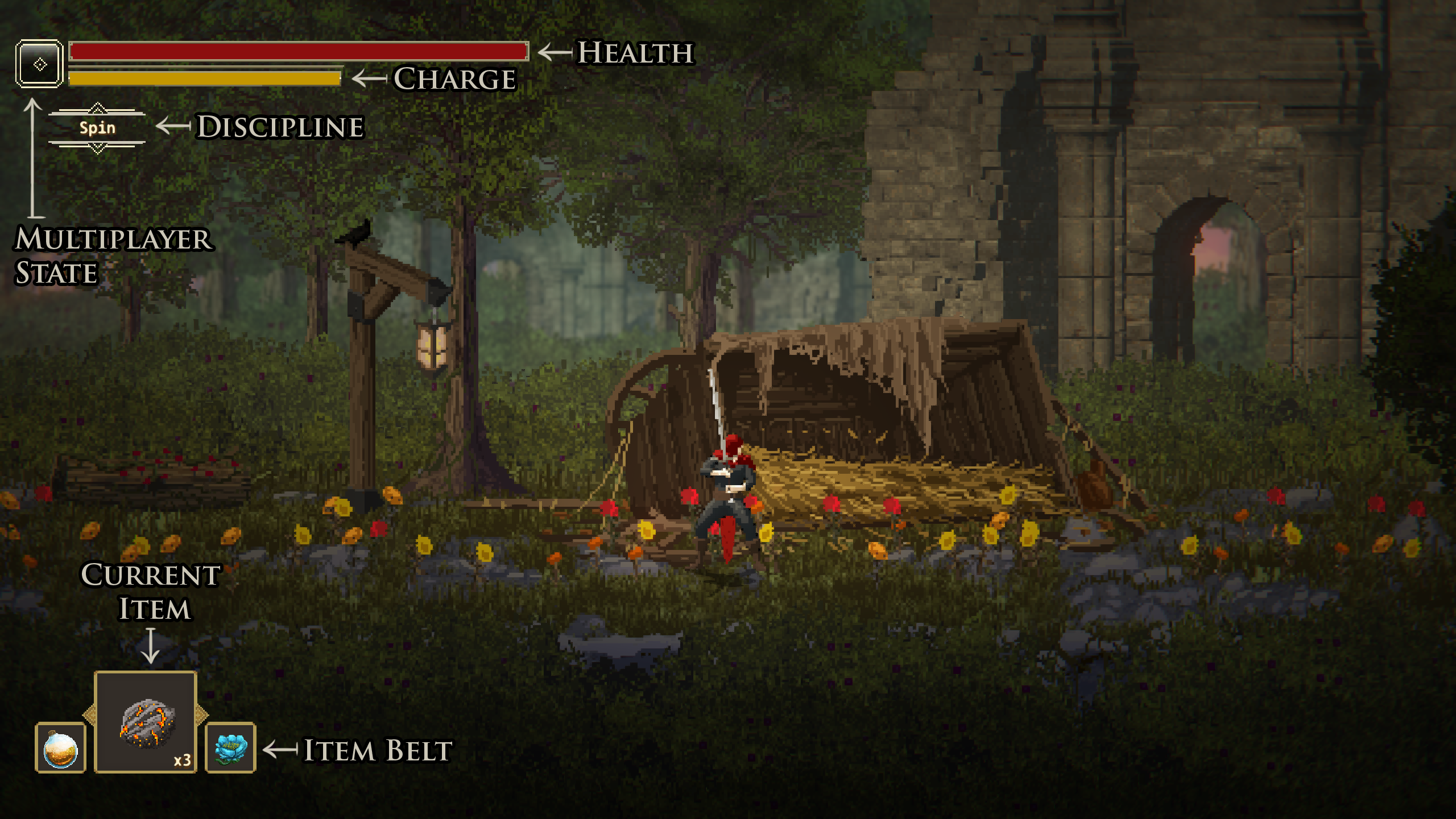
Crimson Capes is mechanically dense. Combat revolves around stamina management, precise timing, and layered decision-making. Light and heavy attacks behave differently; deflection is often preferable to dodging, and breaking enemy stamina is key to opening them up for critical hits. Composite moves, combat disciplines, recalls, feints, taunts, the toolkit is extensive, and on paper, it’s impressive. In practice, it often feels overwhelming rather than empowering.
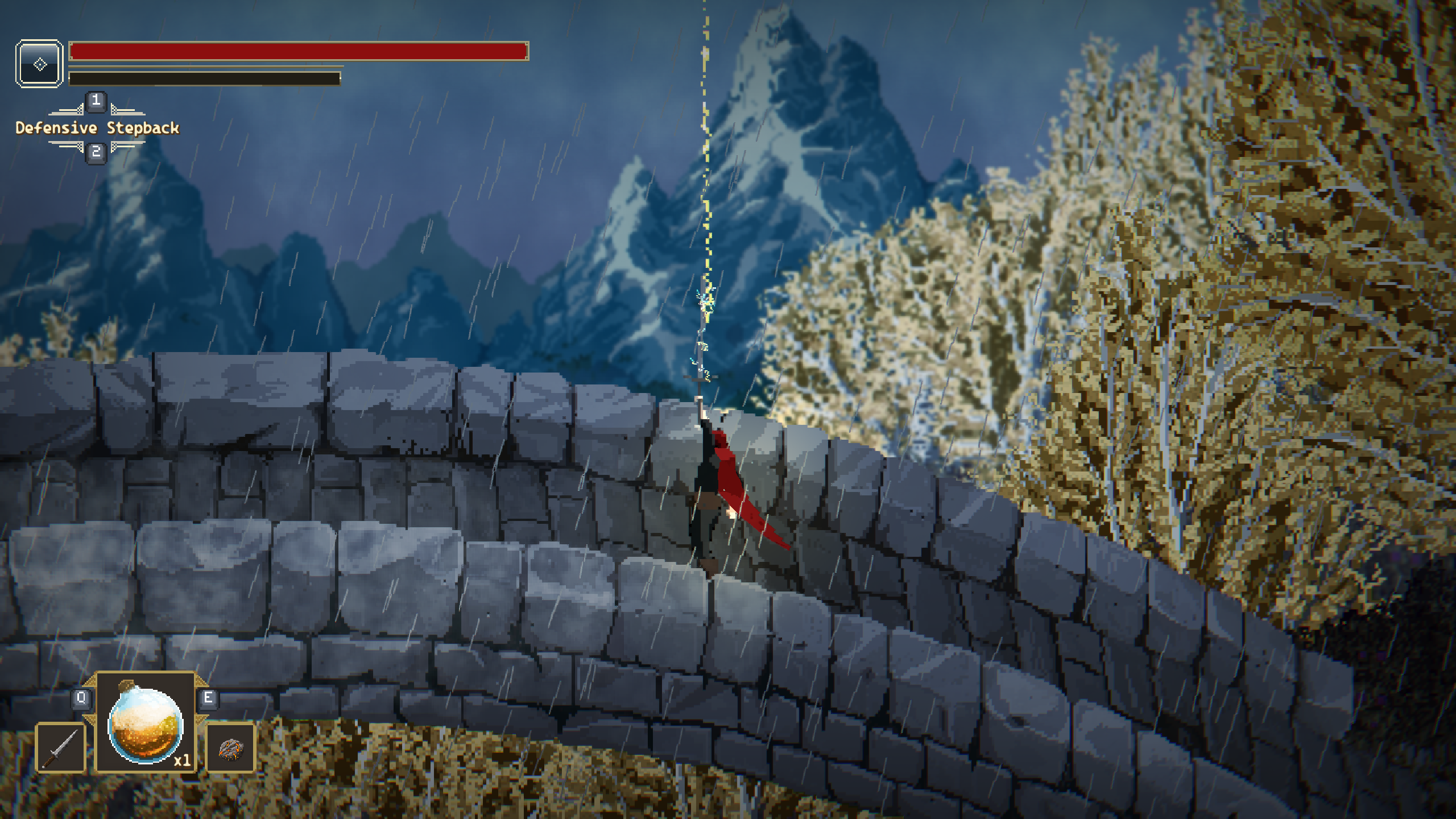
Enemy encounters demand near-constant focus, with little room for experimentation or recovery. Mistakes are punished hard, sometimes disproportionately so. While the systems themselves are well thought out, the margin for error is razor-thin, making progression feel more like endurance than mastery. And yes, that makes every ‘win’ over a boss feel like you just ran a marathon, but I don’t think it’s something you need to put on your player right from the start. Also, I don’t think it’s enjoyable for any normal-minded person playing a game to die 30 times in a row before even handing out a little bit of damage.
Art direction
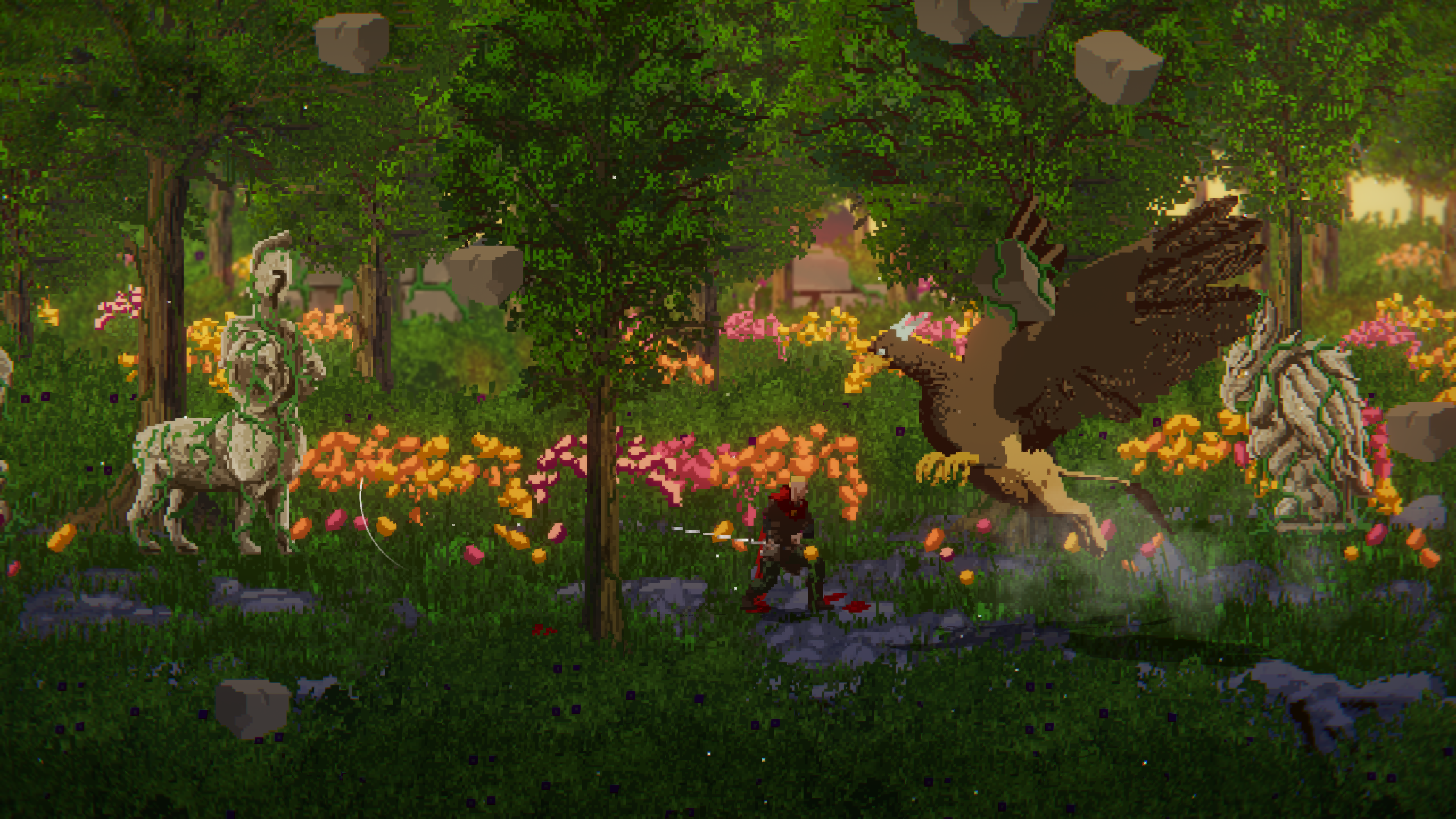
But before we dive too deep into the difficulty settings, I want to talk about why I kept playing Crimson Capes. Visually, the game makes a strong impression. The hand-drawn 2D art style immediately stands out in a genre often dominated by muted 3D environments. The characters, enemies, and locations carry a grim fairy-tale quality that complements the game’s tone beautifully (Henry, are you sure you aren’t hiding somewhere). It’s impossible not to think of games like Salt & Sanctuary mixed with The Witcher when exploring Crimson Capes’ world, and that’s meant as a compliment. The use of colour, silhouette, and animation gives the game a distinct identity while still feeling comfortably at home within the Souls-like space. Hell, it might even give Salt & Sanctuary a run for its money in the way the game is drawn. Both have very specific art styles, and this is one of those rare games that immediately stood out.

When the challenge stops being fun
This is where Crimson Capes stumbles the hardest. The game is not just difficult, it’s exhausting. And before I start my rant, I might just not be the right ‘target audience’ for this game. But then again, I normally enjoy these types of games, and I completed a lot of these, so it might be balancing? Let’s dive in a bit deeper. So we have enemy placement, damage output, and checkpoint spacing as the three main ‘problems’. These combine to create a pacing that feels relentlessly punishing. Yes, checkpoints are available before each boss fight, but even a simple enemy can turn you into mincemeat before even reaching a new checkpoint. Instead of encouraging learning and adaptation, the game often demands repetition. Dying doesn’t inspire a “one more try” mentality; it more often results in a sigh and a sense of obligation.
One of the ‘later’ bosses has absurd damage output and can only be tackled by breaking his power through mode, which I’m going to call ‘the whack-a-mole’. So that means parrying the hammering until you have depleted his stamina. But once he’s depleted of his stamina, you need to heal up, which leaves no room for attacking him. Once you have him down to half his health, he’s joined by one of the final boss monsters, which most of the time instantly kills you with magic attacks. Sure, I get that you need to figure out boss patterns and find other ‘means to end’ this boss, but this boss also drops a certain item you need to beat another two bosses without dying from damage over time. See where I’m going with this?
It’s entirely possible that this comes down to balancing still being tuned ahead of launch. But in its current state, Crimson Capes feels less like a test of skill and more like a test of patience. Challenge is part of the genre’s DNA, and frustration doesn’t have to be.
Conclusion
Crimson Capes is a game overflowing with ideas, systems, and artistic ambition. Its combat mechanics are deep, its world is thoughtfully constructed, and its visual style stands out in an increasingly crowded genre. Unfortunately, all of that potential is weighed down by a difficulty curve that actively undermines enjoyment. If Poor Locke manages to rebalance the experience, Crimson Capes could grow into something special. As it stands now, playing it feels more like work than discovery. So I’ll wait until people who are probably better than me at this game work out how to beat the bosses I’m stuck on, and I’ll revisit the game later. However, this leads me to give this game, in its current state, a grade lower than I initially thought.
