
The first thing Marvel Cosmic Invasion made me do wasn’t read a tutorial or parse a skill tree. It made me move. Enemies poured onto the screen, a hero dropped in with zero ceremony, and within seconds I was already reacting instead of thinking. Dodging, punching, improvising. That immediate sense of flow says a lot about what kind of game this is.
Cosmic Invasion feels like a game built around momentum. Not speed for the sake of speed, but the feeling that stopping is optional. There’s a clear love for classic arcade brawlers here, yet it never feels like a museum piece. Instead, it treats that foundation as something alive: flexible enough to support superhero excess, visual bravado, and co-op chaos without collapsing under its own weight. It doesn’t try to impress you with systems. It tries to keep you playing.
The combat loop
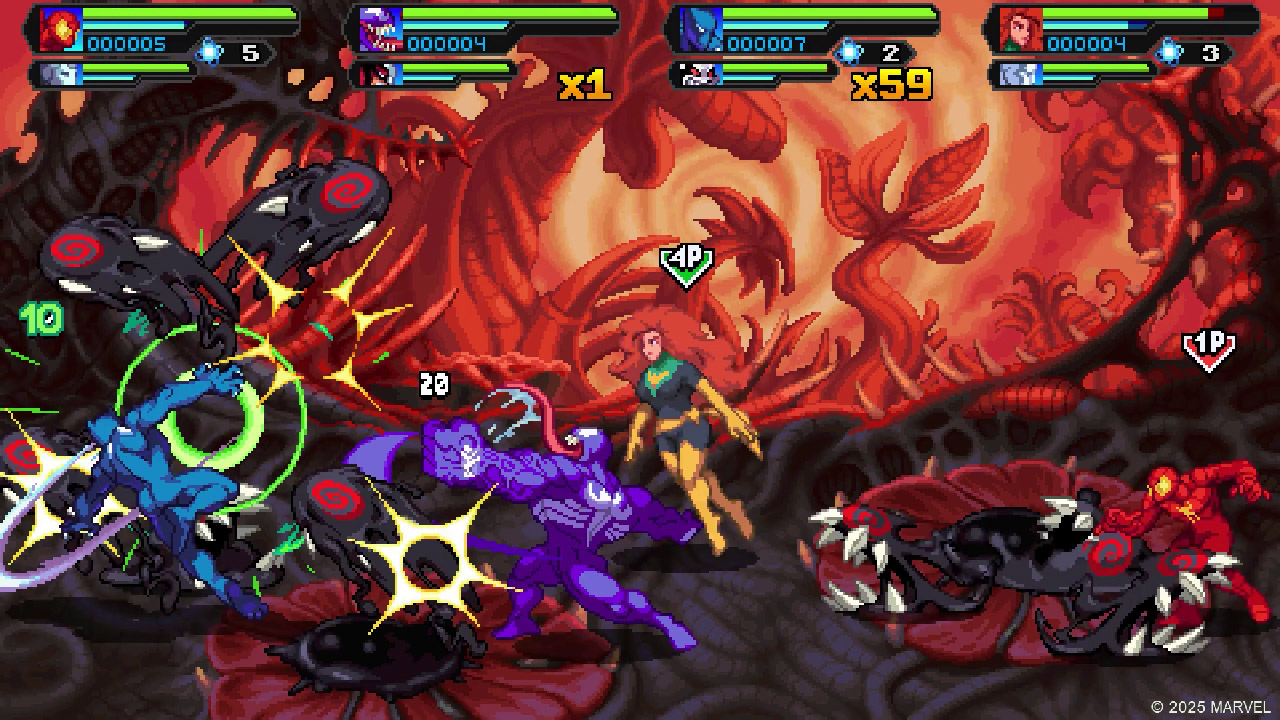
Combat in Marvel Cosmic Invasion is deceptively simple. Move, attack, launch, crowd-control, unleash a super. You understand it almost instantly, and that’s by design. What keeps it engaging isn’t mechanical depth but responsiveness. Hits land cleanly. Enemies react properly. Supers feel earned and appropriately destructive without turning encounters into cutscene spam.

Each hero brings a different tempo rather than a radically different rule set. Some characters thrive in the middle of the chaos, others feel better when controlling space or picking targets off-screen. None of them feel broken or useless, which matters more in a game that encourages switching and replaying.
That said, this isn’t a lab monster’s dream. You won’t be discovering hidden tech or mastering frame-perfect routes. The depth here comes from situational awareness: knowing when to clear space, when to spend meter, and when to back off before the screen overwhelms you. Enemy variety helps, though some encounters lean a bit too heavily on sheer numbers instead of smarter pressure.
In co-op, everything improves. What might feel busy solo becomes energetic with friends. Accidental combos, shared supers, chaotic saves, this is clearly how the game wants to be played.
No MCU weight
One of Cosmic Invasion’s biggest strengths is that it doesn’t feel obligated to mirror the Marvel Cinematic Universe. This is comic-book Marvel: exaggerated, colourful, sometimes silly, and completely comfortable with that identity. Characters don’t need lengthy introductions. They arrive fully formed, visually expressive, and immediately readable in motion.
The roster balances recognisable faces with deeper cuts, and the game treats them all with the same level of enthusiasm. Animations do a lot of storytelling on their own. Villains posture. Heroes overcommit. Supers are indulgent without becoming parody. It’s fan service, yes, but fan service that understands why these characters are fun to control, not just to look at.
Narratively, the story exists to justify escalation. Cosmic threats, shifting locations, increasingly absurd stakes. It never pretends to be more than a framing device, and that honesty works in its favour. Cutscenes are brief, stylish, and smart enough to know when to end before momentum is lost.
Style, performance, and smart restraint
Visually, Marvel Cosmic Invasion commits hard to a bold, comic-inspired aesthetic. Thick outlines, expressive silhouettes, and colour choices that prioritise clarity over realism. Even when the screen fills up, you can still read what’s happening something a lot of modern action games struggle with.
Performance is stable, which is crucial for a game like this. Frame rate holds, input lag never becomes a concern, and transitions between encounters are quick enough to keep the rhythm intact. This is a game built for repetition, and it respects your time.

Sound design does more work than the soundtrack. Music sets the tone but rarely steals attention. Effects, on the other hand, sell impact beautifully. You hear when a hit connects, when danger approaches, when a super is about to turn the tide. The UI mirrors this restraint: clean, readable, functional. No clutter, no unnecessary layers.
Conclusion
Marvel Cosmic Invasion succeeds because it knows exactly what it wants to be and doesn’t chase anything beyond that. It’s not trying to redefine the genre, and it’s not pretending to offer endless depth. What it offers instead is consistency: solid combat feel, strong presentation, and an understanding of why arcade-style brawlers still work in 2025.
It’s a game I enjoyed more the longer I played, especially in shorter sessions or with friends. While repetition does creep in if you push too hard, the core loop is satisfying enough that returning never feels like a chore.
For Marvel fans who want something energetic, tactile, and refreshingly unburdened by modern excess, Cosmic Invasion hits the sweet spot.
